
Replicate vs Self-Hosted Models: A Developer’s Comparison
The Replicate vs self-hosted models decision is really a question about what your team wants to own. Do you want to focus on product workflows and call models through an API, or do you want to manage the infrastructure required to serve models yourself?
For small development teams in 2026, the right answer depends on workload predictability, control requirements, engineering capacity, latency needs, and long-term operating costs. This guide compares both approaches without assuming one is always better.

Comparing the operational complexity: self-hosted AI models require significant infrastructure management, while API-first platforms like Replicate streamline the developer’s focus to integration and product logic.
Understanding the Trade-offs: Replicate vs Self-Hosted
Replicate and self-hosted model deployment represent two different operating models.
With an API-first platform, your application sends inference requests to an external service. Your team focuses on integration, orchestration, user experience, and business logic.
With self-hosting, your team manages more of the stack: model runtime, hardware or cloud GPU access, deployment, scaling, observability, security patches, and operational incidents.
The comparison is not just technical. It affects hiring, roadmap speed, reliability expectations, and how much time your team spends on infrastructure instead of product.
Infrastructure Costs and Scalability
Infrastructure cost is not only the price of a model run or the price of a GPU. It includes engineering time, idle capacity, scaling complexity, monitoring, maintenance, and incident response.
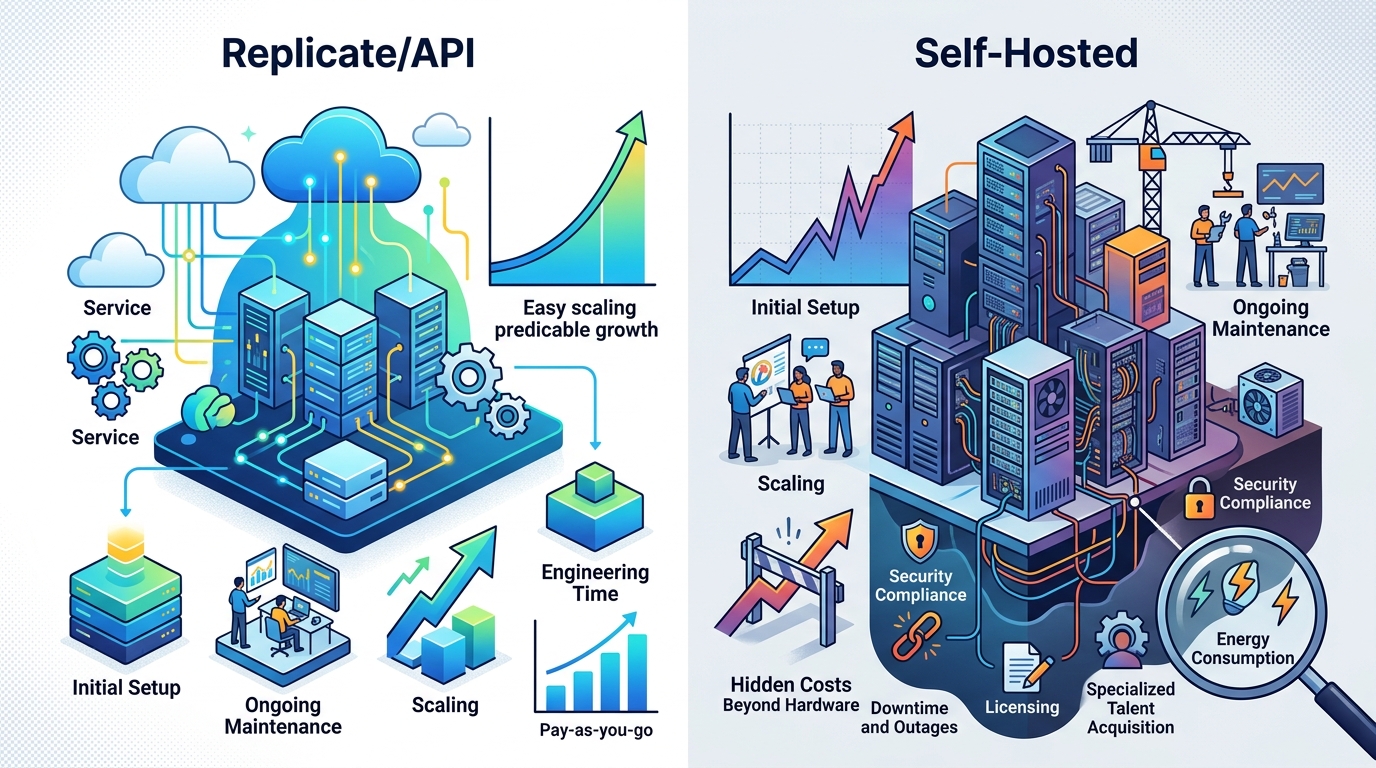
A visual representation of the cost comparison between Replicate and self-hosted models, illustrating how self-hosting often includes hidden expenses beyond just hardware, such as engineering time and operational overhead.
API-first model access may be easier to start with because you do not need to provision inference servers before shipping a feature. That can be attractive when usage is uncertain or when the team is still testing which models work best.
Self-hosting may become attractive when workloads are predictable, high-volume, and stable enough to justify dedicated infrastructure. However, the team must be prepared to manage utilization, availability, and scaling.
Scalability questions to ask:
- Is usage predictable or spiky?
- Can jobs run asynchronously, or do users need low-latency responses?
- Do you have engineers who can maintain inference infrastructure?
- How often will models change?
- What happens when demand exceeds available capacity?
- Do you need advanced workflow coordination across model calls?
If orchestration and scaling are becoming the main challenge, review your AI model orchestration options before defaulting to more infrastructure.
Ease of Deployment and Maintenance
Deployment is where the difference becomes clear.
API-first deployment usually involves:
- Creating an API integration.
- Storing credentials securely.
- Sending model inputs.
- Handling outputs, errors, and webhooks.
- Monitoring your application workflow.
Self-hosted deployment may involve:
- Selecting model versions.
- Packaging runtime dependencies.
- Provisioning GPU infrastructure.
- Configuring autoscaling or job queues.
- Monitoring memory, utilization, failures, and latency.
- Applying updates and security patches.
Neither approach removes all work. An API strategy still requires careful application design. You need retries, validation, job state, and observability. But self-hosting expands the operational scope substantially.
Should I use Replicate or self-hosted models?
Use Replicate or an API-first model platform when speed, experimentation, and reduced infrastructure ownership matter most. Consider self-hosting when control, predictable scale, or specialized deployment requirements matter more than operational simplicity.
A practical decision framework:
| Factor | API-first approach | Self-hosted approach |
|---|---|---|
| Early prototyping | Strong fit | Often slower to start |
| Infrastructure ownership | Lower | Higher |
| Model experimentation | Easier | More operational work |
| Deep runtime control | More limited | Stronger |
| Operational maintenance | Lower | Higher |
| Predictable high-volume workloads | Depends on economics | Potentially attractive |
| Small team fit | Often strong | Depends on infrastructure skill |
This table is directional, not a universal benchmark. Actual cost and performance depend on your workload, provider terms, model choices, and operational requirements.
When to Choose Replicate (API)
Choose an API-first approach when your team wants to ship AI features without building the model-serving layer.
Replicate may be a fit when:
- You are validating a new AI product feature.
- Your model usage is uncertain or changing.
- You want to test multiple models quickly.
- Your team is small and product-focused.
- You prefer to spend engineering time on workflow quality.
- You need async inference patterns with application-level orchestration.
If you choose this path, start by using the Replicate API correctly: keep credentials server-side, normalize responses, handle async tasks, and build a clean model client abstraction.
When to Choose Self-Hosted GPUs
Self-hosted GPUs may be the better path when your requirements justify the added responsibility.
Consider self-hosting when:
- You need deep control over model runtime and deployment.
- You have predictable workloads that can keep infrastructure efficiently utilized.
- You have strong internal infrastructure or ML operations expertise.
- You need custom runtime modifications.
- You have strict data, compliance, or deployment constraints that cannot be met through an API provider.
Self-hosting can be powerful, but it should be treated as a product and operations commitment. Someone must own uptime, capacity planning, model updates, observability, and incident response.
Moving from Self-Hosted to an API Strategy
Teams sometimes start with self-hosting because they want control, then later realize their bottleneck is not model access. It is workflow reliability: queues, retries, webhooks, validation, user status, and multi-step orchestration.
Moving to an API strategy can simplify the model-serving side while preserving your product logic.
A migration plan:
- Create an internal model interface. Hide self-hosted and API-specific calls behind the same application contract.
- Normalize outputs. Convert provider responses into your internal schema.
- Move one workflow first. Start with a non-critical or isolated model task.
- Compare operational behavior. Track failures, latency, developer time, and maintenance effort in your own environment.
- Add orchestration. Use queues, job state, and webhooks to make the workflow production-ready.
- Retire infrastructure gradually. Avoid big-bang migrations when multiple product features depend on the old stack.
A clean abstraction might look like this:
class ModelProvider:
    def run(self, model_name: str, inputs: dict) -> dict:
        raise NotImplementedError

class SelfHostedProvider(ModelProvider):
    def run(self, model_name: str, inputs: dict) -> dict:
        return call_internal_inference_service(model_name, inputs)

class ApiProvider(ModelProvider):
    def run(self, model_name: str, inputs: dict) -> dict:
        return call_external_model_api(model_name, inputs)
This keeps your application from depending directly on infrastructure choices.
Ultimately, the best choice is the one that lets your team deliver reliable AI features at the right level of operational ownership. If you choose an API-first route, the next step is to build your AI pipeline with state tracking, retries, and production workflow design.
FAQ
Is Replicate better than self-hosting models?
It depends on your team and workload. Replicate or an API-first approach is often better for speed and reduced infrastructure ownership. Self-hosting may be better when you need deep control or have predictable workloads that justify dedicated infrastructure.
Is self-hosting AI models cheaper?
Not always. Self-hosting costs include hardware or cloud GPUs, engineering time, monitoring, maintenance, scaling, and incident response. It may be cost-effective for predictable high-volume workloads, but teams should calculate total cost of ownership.
When should a small team avoid self-hosting?
A small team should be cautious about self-hosting when it lacks infrastructure expertise, needs to move quickly, has uncertain usage, or expects to change models frequently.
Can I move from self-hosted models to an API later?
Yes. The easiest path is to create an internal model provider interface, normalize outputs, and migrate one workflow at a time.
What is the main benefit of an API-first model strategy?
The main benefit is reduced infrastructure ownership. Your team can focus on product workflows, orchestration, and user experience instead of maintaining model-serving infrastructure.