
The Complete Guide to AI API Orchestration for Developers
AI applications are no longer built around a single model call. A useful production workflow may classify an input, retrieve context, transform media, call an LLM, validate the output, generate an asset, and notify another system when the result is ready. AI API orchestration is the discipline of coordinating those steps reliably.
For developers, orchestration is where AI systems become software systems. It is where you decide how models communicate, how failures are handled, how long-running tasks complete, and how your application remains maintainable as providers, prompts, and user requirements change.
This guide explains how to design a multi-model AI pipeline, chain AI models via API, integrate model providers cleanly, and deploy serverless AI model API workflows without creating a fragile stack of hard-coded calls.
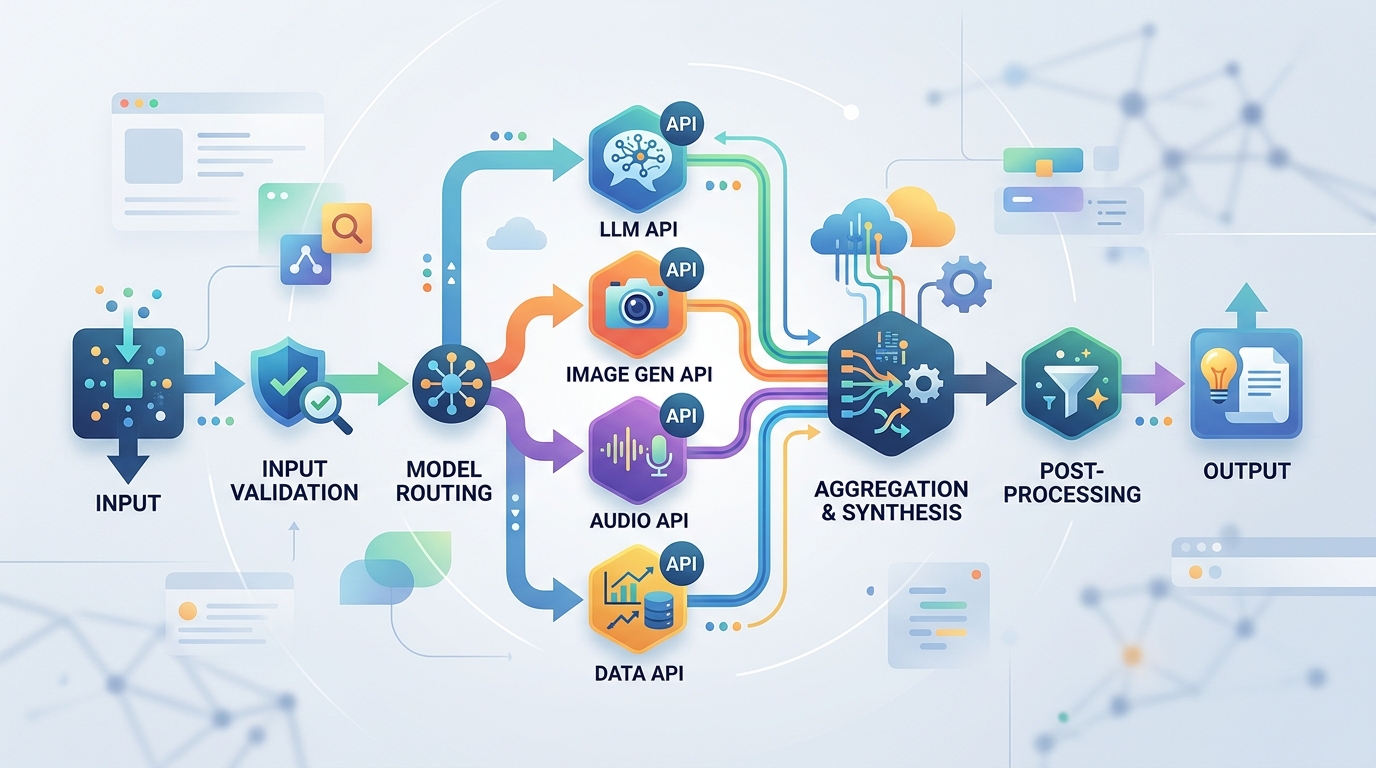
A conceptual flowchart demonstrating the key stages of multi-model AI pipeline orchestration.
Why You Need AI API Orchestration
A single API call can support a demo. Real products usually need coordination.
AI API orchestration becomes necessary when your workflow includes:
- Multiple model providers or model types
- Conditional routing based on input type, user tier, or confidence score
- Long-running inference jobs
- Parallel steps that need to be merged
- Fallback models when a provider fails
- Output validation before returning a result
- Human review or approval gates
- Cost-aware model selection
- Audit logs and workflow history
Without orchestration, application code becomes a chain of nested provider calls. That approach is hard to test, hard to debug, and dangerous to change. A provider outage can break the entire experience. A prompt update can silently alter downstream behavior. A missing timeout can leave user requests hanging.
A good orchestration layer makes the workflow explicit. Each step has inputs, outputs, retry rules, timeout behavior, and observability. This is also a core part of building your production AI pipeline, because production readiness depends on the system’s ability to manage uncertainty.
Designing a Multi-Model AI Pipeline
A multi-model AI pipeline combines two or more AI models to complete a task. The models may run sequentially, in parallel, or conditionally.
Common patterns include:
Classifier-first routing
A lightweight classifier determines which specialized model or prompt should handle the request. This is useful when inputs vary widely and you want to avoid sending every request through the same expensive path.
Retriever-generator workflows
A retrieval step finds relevant context before an LLM generates a response. The orchestrator manages document lookup, prompt assembly, model execution, and citation or schema validation.
Generate-then-validate pipelines
One model produces an output, and another process validates safety, structure, relevance, or policy compliance. Validation may be deterministic, model-assisted, or human-reviewed.
Parallel enrichment
Several independent model calls enrich the same input. For example, one model may extract entities, another may summarize content, and another may classify sentiment. The orchestrator merges the outputs into one normalized result.
Fallback routing
If a primary model times out or returns a recoverable error, the workflow routes to a secondary model. Fallbacks should be intentional, not accidental, because different models may produce different output formats or quality levels.
When designing the pipeline, define the contract for each step:
- What input does this step require?
- What output does it promise?
- Is the step synchronous or asynchronous?
- Can it be retried safely?
- What errors are expected?
- What metadata should be logged?
- What happens if the step fails?
Chaining AI Models via API
Chaining AI models API calls means using the output of one model as the input or control signal for another. The core challenge is not making the HTTP requests. The challenge is preserving context, structure, and reliability across boundaries.
A typical chain might look like this:
- Validate the incoming request.
- Preprocess files or text.
- Run a classification model.
- Use the classification result to choose a prompt or model.
- Call a generation model.
- Validate the generated output against a schema.
- Store metadata and deliver the final result.
Each transition is a possible failure point. A classifier may return an unexpected label. A generation model may return invalid JSON. A provider may time out. A webhook may arrive after the user has closed the session.
To make chaining reliable, use normalized intermediate objects rather than raw provider responses. For example, instead of passing a full provider payload downstream, convert it into your own shape:
classification.labelclassification.confidencegeneration.textgeneration.usageasset.urlworkflow.status
This keeps the rest of your system stable even if providers change response formats.
Passing Context Between Models Effectively
Context passing is where many multi-model pipelines become brittle. Passing too much context increases cost and latency. Passing too little context reduces output quality. Passing unstructured context makes downstream validation harder.
Use these practices:
- Summarize intermediate context when full raw input is unnecessary.
- Preserve source references so downstream steps can trace where facts or assets came from.
- Use schemas for structured context instead of loosely formatted text blocks.
- Separate instructions from data to reduce prompt ambiguity.
- Track prompt and context versions so output changes can be debugged.
- Avoid hidden dependencies where a downstream step only works because an upstream model happens to phrase something a certain way.
If a downstream model needs structured data, require structured data. Do not rely on prose parsing when a schema would work better.
Best Practices for AI Model API Integration
AI model API integration should be treated like integration with any unreliable external dependency, with extra attention to output variability.
Best practices include:
Create provider adapters
Wrap each model provider in an adapter that handles authentication, request formatting, response normalization, and error classification. Your business logic should not be full of provider-specific payloads.
Set explicit timeouts
Never rely on default network behavior. Define connection, request, and job-level timeouts based on user experience and workflow importance.
Classify errors
Separate validation errors, authentication failures, rate limits, provider outages, timeouts, and malformed responses. Each class should have a different handling strategy.
Use retries carefully
Retry transient failures, not deterministic failures. Retrying a bad request wastes money and can worsen rate limiting.
Design for idempotency
Repeated requests should not create duplicate jobs or duplicate user-facing results. This matters especially when clients retry after timeouts.
Log operational metadata
Log provider, model, prompt version, workflow ID, latency, status, and normalized error type. Avoid logging sensitive raw user data unless necessary and approved for your use case.
For deeper operational patterns, including retries and rate limits, learn how to handle API errors.
Deploying AI Models via API using Serverless Architecture
Serverless architecture can be a strong fit for AI API orchestration because many workflows are event-driven. A request arrives, a job is created, a provider webhook returns, and downstream processing continues.
A serverless AI model API architecture may include:
- API gateway or edge function for request intake
- Serverless function for validation and job creation
- Queue for asynchronous tasks
- Worker function for model API calls
- Object storage for large files or generated assets
- Database for workflow state
- Webhook endpoint for provider callbacks
- Notification function for final delivery
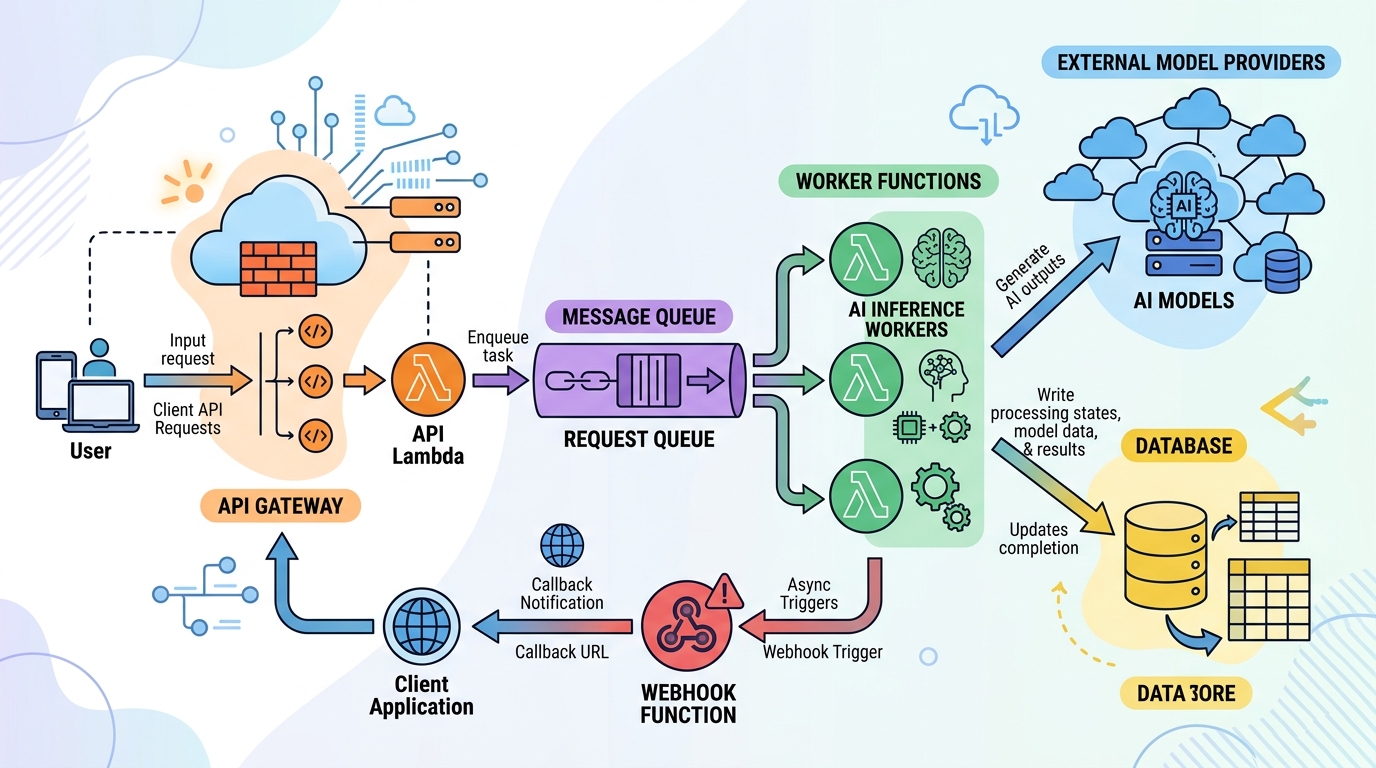
A serverless architecture diagram illustrating the deployment of AI models via API.
Serverless deployment works best when each function has a narrow responsibility. Avoid creating one large function that performs the entire workflow synchronously. Long-running model calls can exceed execution limits, increase user-facing latency, and complicate retries.
Use queues to decouple the user request from model execution. Store workflow state before calling external providers. If a provider returns a webhook later, your system should be able to resume the workflow from persisted state rather than relying on in-memory context.
Serverless is not a free pass on operations. You still need logging, alerting, retry policies, dead-letter queues, and cost monitoring.
How to Chain Multi-Model AI Pipelines via API
Here is a practical step-by-step approach for chaining a multi-model AI pipeline via API.
Step 1: Define the workflow contract
Start with the final output. What does the user or downstream system need? Define the response schema before selecting models.
Step 2: Break the workflow into steps
Separate validation, preprocessing, model calls, post-processing, storage, and delivery. Each step should have a clear input and output.
Step 3: Choose models by role
Assign models to specific jobs: classification, extraction, generation, embedding, moderation, transcription, or asset generation. Avoid choosing a model first and then forcing the workflow around it.
Step 4: Build provider adapters
Normalize each provider’s request and response format. This makes orchestration logic portable and testable.
Step 5: Add state management
Persist workflow status, step outputs, errors, and timestamps. State management is essential for asynchronous jobs and webhook recovery.
Step 6: Implement retries and fallbacks
Apply retries only to transient failures. Define fallback models where output differences are acceptable and documented.
Step 7: Validate every boundary
Validate incoming data, intermediate model outputs, and final responses. Reject or repair malformed outputs before they reach users.
Step 8: Monitor and iterate
Track latency, cost, failure rate, fallback rate, and output validation failures. Use these signals to improve routing, prompts, and provider choices.
If you want to build a concrete provider-based implementation, you can implement this using the Replicate API.
FAQ
What is AI API orchestration?
AI API orchestration is the process of coordinating multiple AI model calls, data transformations, retries, fallbacks, and delivery steps inside a reliable workflow.
When should I use a multi-model AI pipeline?
Use a multi-model pipeline when one model cannot reliably handle the entire task, when you need specialized steps such as retrieval or validation, or when routing requests to different models improves cost, latency, or quality.
Is serverless a good fit for AI API orchestration?
Serverless can be a good fit for event-driven AI workflows, especially when combined with queues, persisted workflow state, and webhook handling. It is less suitable for large synchronous workflows that exceed execution limits.
How do I prevent model chains from becoming fragile?
Use structured intermediate outputs, provider adapters, schema validation, explicit error handling, and versioned prompts. Avoid passing raw, unvalidated model output directly into downstream steps.