
Building a Self-Healing Automation with AI Agents
Every SRE knows the pattern: a cron job fails because an upstream file arrived late. A pipeline breaks because an API added a field. A service restart loop starts because a config value drifted. None of these are hard problems — they’re just problems that happen at 2 a.m., and each one costs a human interrupt for a fix that takes five minutes.
A self-healing automation AI agent error handler exists to absorb exactly this class of failure: detect it, understand it, fix it within safe bounds, and escalate cleanly when it can’t. This guide covers the architecture — from failure detection through remediation to the loop-prevention safeguards that keep “self-healing” from becoming “self-harming.”
Moving from Brittle Scripts to Self-Healing Automation
Traditional automation is brittle by construction. A script encodes one path through a task; anything off that path is an unhandled exception. Teams respond by adding try/except blocks and retry wrappers, but retries only help when the failure is transient. When the failure requires diagnosis — reading the error, checking the environment, understanding what changed — the script gives up and pages a human.
The insight behind agentic self-healing: most recoveries that page a human follow a reasoning pattern, not a fixed procedure. The engineer reads the error, looks at logs, checks recent changes, forms a hypothesis, applies a known fix. That’s precisely the loop an AI agent can execute — if you give it the right context, the right tools, and the right limits.
The architecture is a layered escalation:
- Deterministic retry handles transient failures (network blips, timeouts). Cheap, fast, no AI needed.
- AI agent error handler handles diagnosable failures (bad input file, drifted config, changed API shape).
- Human escalation handles everything else — with the agent’s diagnosis attached, so the human starts halfway to a fix.
Layer 2 is where the interrupt reduction happens. Layer 1 keeps the agent from wasting effort on noise; layer 3 keeps the system honest about its limits. This pattern is one of the highest-leverage applications of AI agent runbook automation — the agent is effectively executing your recovery runbooks with judgment.
Designing an AI Agent Error Handler
An error-handler agent has four components:
1. The trigger. The handler activates on failure signals: a non-zero exit code from a scheduled job, an alert from your monitoring stack, a dead-letter queue message, or a health-check failure. Attach the raw failure payload — error text, exit code, job ID — to the invocation so the agent starts with evidence, not a blank page.
2. The context toolkit. The agent needs read access to diagnose: recent logs for the failed component, the job’s configuration, recent deploy/change history, and the state of relevant dependencies. Read tools should be broad; this is where the agent earns its diagnosis.
3. The remediation toolkit. Write tools should be narrow and enumerated. Not “shell access” but specific, named actions: restart_service, requeue_job, rollback_config, clear_temp_files, extend_disk_alert_silence. Each remediation tool is something you’d be comfortable with a junior engineer doing without approval. Anything beyond the list becomes an escalation, not an action.
4. The reporter. Every invocation ends with a structured report — what failed, what the agent concluded, what it did, whether it worked — logged and posted to the team. Successful recoveries need review too: silent fixes hide systemic problems (why does this job fail every Tuesday?) that deserve a root-cause fix.
Constraint worth stating explicitly: the error handler runs with its own scoped permissions, separate from the workloads it repairs, following least-privilege the same way any production agent should.
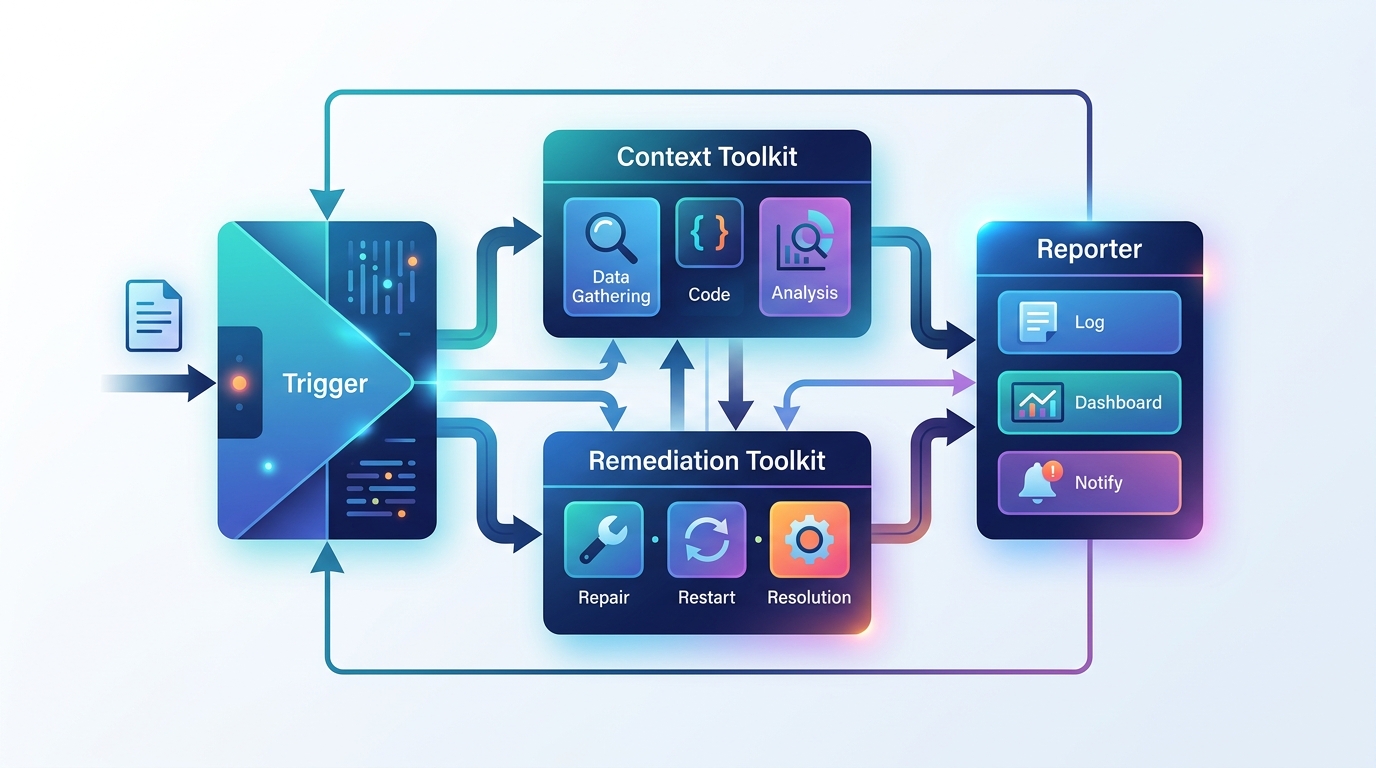
An effective AI agent error handler integrates triggers, context gathering, remediation tools, and reporting to autonomously resolve issues.
The Ideal AI Agent Error Recovery Workflow
A production-quality AI agent error recovery workflow runs through five phases.
Detecting the Failure
Detection quality determines recovery quality. The best triggers carry rich payloads: full error output (not just “job failed”), the exact job/service identity, timing, and the run ID of the failed execution. If your monitoring already produces structured events — the kind you get from proper AI agent observability tools — wire those directly into the handler’s input.
Filter before invoking the agent: deduplicate repeated alerts for the same failure, let deterministic retries exhaust first, and rate-limit handler invocations per component. The agent should see distinct, retry-resistant failures — not alert noise.
Context Gathering and Remediation
Once triggered, the agent works a structured loop:
- Gather: pull recent logs, config state, and change history for the failed component. Recent changes are checked first — they explain a large share of failures.
- Hypothesize: form an explicit diagnosis and log it (“input file missing from /data/drops; upstream job appears delayed”).
- Match: check the diagnosis against its enumerated remediations. A confident match proceeds; a weak match escalates with the diagnosis attached.
- Act: execute the matched remediation — one action at a time, logging before and after.
- Verify: re-run the failed job or health check and confirm actual recovery. Unverified fixes count as failures. If verification fails, the agent doesn’t improvise a second theory indefinitely — it gets a bounded number of attempts (see below) before escalating.
The explicit diagnosis step matters more than it looks. It forces the agent to commit to a theory before acting, makes every action reviewable afterward, and gives escalations real content: an on-call engineer who receives “job X failed; input file absent; upstream job Y delayed 40 minutes; requeue attempted, failed because Y is still running” starts the incident 80% done.

The ideal AI agent error recovery workflow involves a structured loop of detection, diagnosis, action, and verification to ensure robust self-healing.
Preventing Infinite Loops in Error Recovery
The signature failure mode of self-healing systems is the healing loop: the fix triggers the failure, which triggers the fix. A service that crashes due to a bad config gets restarted, crashes again, gets restarted — and your “self-healing” system is now a flapping machine that pages nobody. Guardrails, in order of importance:
- Attempt budgets. Hard cap on remediation attempts per incident (2–3 is typical). Budget exhausted → escalate, with the full attempt history.
- No-repeat rule. The agent may not apply the same remediation twice for the same incident. If the restart didn’t fix it, a second restart won’t either — that’s new information pointing to a deeper cause.
- Cooldown windows. After handling an incident for a component, the handler won’t act on that component again for a set window. Recurrence within cooldown escalates automatically — recurrence is the signal that the fix is cosmetic.
- Flap detection at the fleet level. Track remediation frequency per component over days, not minutes. A job that gets “successfully” fixed every night has a root-cause problem the agent is masking; surface it as a weekly report to force the real fix.
- Global circuit breaker. If handler invocations spike across the fleet (a shared dependency is down), pause autonomous remediation entirely and page a human. Mass failure is never a per-component problem, and an agent fixing 40 symptoms of one cause creates chaos.
- Runtime and cost caps. Per-incident limits on agent turns, wall time, and spend — the same discipline you’d apply to any unattended agent, as covered in our guide to running AI agents on a schedule.
The philosophy behind all six: self-healing is for absorbing known-shape failures, not for hiding unknown ones. Every guardrail is a mechanism for converting “the agent can’t safely fix this” into a high-quality human escalation as early as possible.
Start Small: A First Implementation
A pragmatic rollout for SREs and platform engineers:
- Pick your top three recurring failure types from the last quarter’s pages.
- Build the handler with diagnosis-only permissions — it investigates and posts its conclusion next to each real failure, but a human still fixes.
- After a few weeks, grade its diagnoses. Grant remediation tools only for the failure types it diagnoses reliably.
- Add attempt budgets, no-repeat, and cooldowns before the first autonomous fix, not after the first loop.
- Review every autonomous recovery weekly and promote recurring fixes into root-cause work.
Done this way, the handler earns autonomy the same way an engineer would — by being demonstrably right, repeatedly, with its work visible to the team.
FAQ
What’s the difference between retries and a self-healing error handler?
Retries re-execute the same operation hoping the failure was transient. A self-healing handler diagnoses why the operation failed and applies a targeted fix — requeueing with corrected input, rolling back a drifted config, restarting a wedged dependency. Retries handle noise; handlers handle causes.
Which failures should an AI agent be allowed to fix autonomously?
Failures that are frequent, well-understood, and fixable by actions you’d delegate to a junior engineer without approval: service restarts, job requeues, temp-file cleanup, known config rollbacks. Anything novel, destructive, or ambiguous should escalate with the agent’s diagnosis attached.
How do I stop a self-healing agent from looping?
Layer the guardrails: hard attempt budgets per incident, a no-repeat rule on remediations, cooldown windows per component, fleet-level flap detection, and a global circuit breaker for mass failures. Escalation on budget exhaustion must be automatic and non-optional.
Does a self-healing agent hide problems that need real fixes?
It can, if unmonitored — which is why every recovery gets logged and reviewed, and recurring recoveries get surfaced weekly as root-cause candidates. The agent buys you time on symptoms; the team still owns causes.