
Top Generative AI Security Concerns Every CTO Must Know
As enterprise adoption of generative artificial intelligence accelerates across software engineering, customer operations, and strategic planning, technology executives face a complex new risk landscape. In 2026, Large Language Models (LLMs) are deeply integrated into production workflows. However, the unique, probabilistic nature of neural networks introduces threat vectors that traditional cyber defense frameworks—such as signature-based firewalls, static code analysis, and perimeter access tokens—were never designed to handle.
Chief Technology Officers (CTOs), Chief Information Security Officers (CISOs), and IT leaders must expand their risk frameworks to address the technical realities of generative AI. Unmanaged AI deployments expose enterprises to massive data breaches, corporate espionage, catastrophic intellectual property loss, and critical infrastructure lock-in.
This executive briefing examines the primary generative ai security concerns facing corporate leadership, analyzes core threat vectors including data leakage llm vulnerabilities, and outlines actionable mitigation protocols for enterprise environments.

The rapid adoption of generative AI in enterprises has led to a corresponding rise in security concerns, necessitating robust mitigation strategies.
Understanding AI Model Security Implications
Unlike traditional software applications that execute explicit deterministic logic, LLMs function as complex statistical prediction engines. They process natural language inputs, generate unstructured outputs, and dynamically execute multi-step tool calls. Consequently, evaluating broader ai model security implications requires recognizing that the input interface (the prompt) is intrinsically merged with the application execution layer.
       +-------------------------------------------------------+
       |               AI Threat Vector Triad                  |
       +-------------------------------------------------------+
       | 1. Confused Deputy Attacks (Indirect Prompt Injection) |
       | 2. Sensitive Context / Memory Exfiltration            |
       | 3. Unsanitized Autonomous Tool & API Execution        |
       +-------------------------------------------------------+
Primary Enterprise Threat Vectors
- Prompt Injection Attacks: Malicious actors manipulate model inputs to bypass safety alignment rules. Direct prompt injection (“jailbreaking”) tricks the model into revealing internal instructions, while indirect prompt injection hides malicious payloads inside third-party documents or web pages processed by an AI agent.
- Model Inversion & Membership Inference: Attackers query public or semi-private model endpoints repeatedly with specially crafted payloads to reconstruct private training data or confirm whether specific proprietary datasets were used in model fine-tuning.
- Adversarial Poisoning: Compromising training datasets, fine-tuning samples, or vector store documents to introduce subtle backdoors, biases, or covert extraction routines into production models.
What are the generative AI security concerns for enterprise?
The top generative AI security concerns for enterprise organizations center on four operational pillars:
- Uncontrolled Data Leakage: Inadvertent transmission of proprietary source code, customer records, and strategic plans to external cloud API endpoints.
- Intellectual Property Exposure & Ownership Uncertainty: Loss of trade secret protection when proprietary code is uploaded, alongside legal ambiguity regarding AI-generated IP.
- Vendor Lock-in & Dependency Architecture: Over-reliance on proprietary closed-weights APIs, creating security blind spots when vendor policies or underlying infrastructure configurations change unexpectedly.
- Shadow AI Usage: Unregulated employee use of unsanctioned consumer AI tools across corporate devices without central IT visibility or cryptographic logging.
The Threat of Data Leakage in LLMs
Among all risks, data leakage llm vulnerabilities represent the most immediate threat to corporate operational integrity. When employees paste confidential data into generative AI interfaces to draft reports, debug software, or analyze financial sheets, that data crosses enterprise trust boundaries.
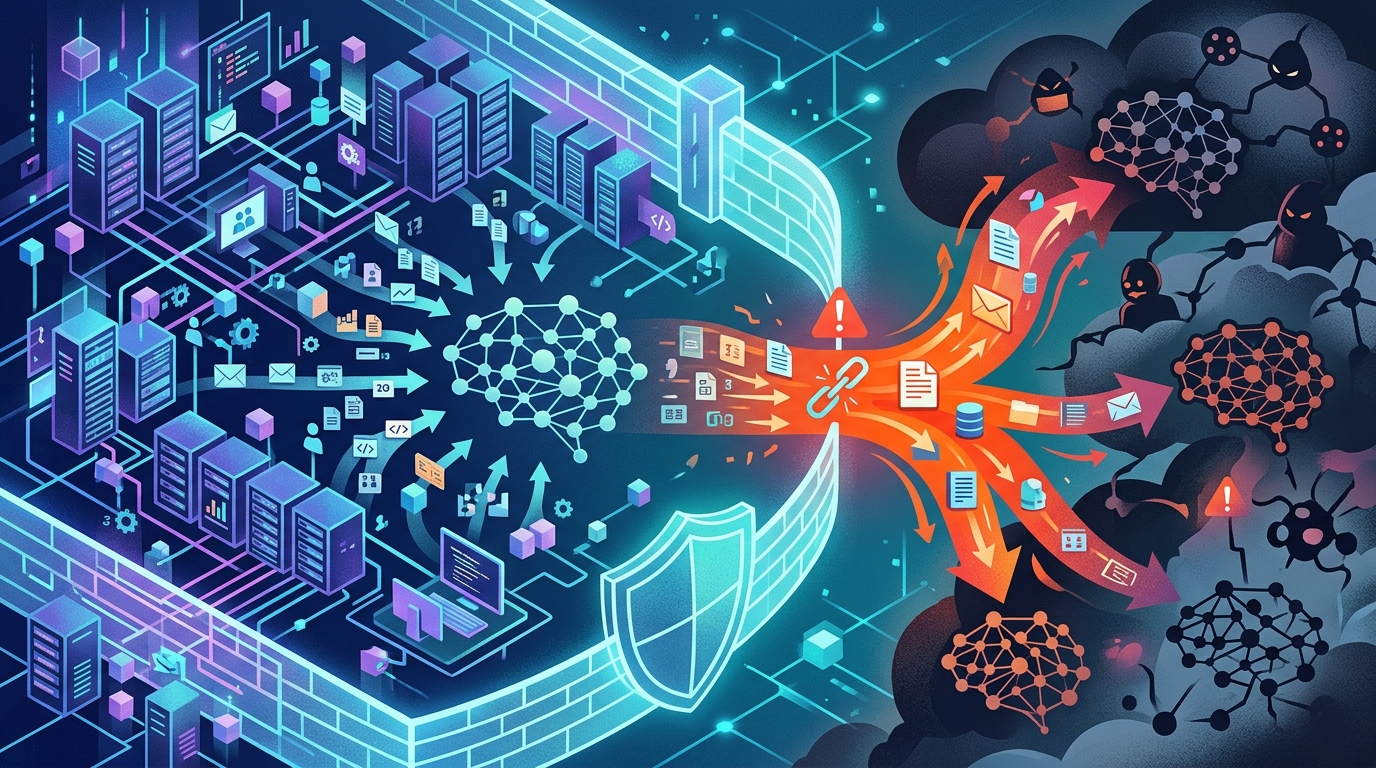
Data leakage through LLMs poses a critical threat to corporate operational integrity, as sensitive information can inadvertently cross enterprise trust boundaries.
Mechanics of Enterprise Data Leakage
[Employee Prompt] ---> [Public Cloud Endpoint] ---> [Third-Party Storage / Logs]
       |                                                    |
       v                                                    v
(Contains PII / Code)                             (Potential Retraining /
                                                   Multi-Tenant Exposure)
Data exfiltration across LLM pipelines generally occurs through three main mechanisms:
- Continuous Fine-Tuning & Retraining Retention: Public cloud providers may retain customer prompts and completions to retrain future model generations. If an employee inputs proprietary source code, that code can later be surfaced to external users via completion suggestions.
- Side-Channel & Telemetry Interception: Insecure TLS handshakes, misconfigured client SDKs, or unencrypted local prompt logging can expose raw context windows to internal or external network eavesdroppers.
- Vector Database (RAG) Sprawl: Retrieval-Augmented Generation architectures index corporate knowledge bases into vector embeddings. If these vector stores lack granular identity and access controls, a basic user query can trigger the retrieval and display of sensitive executive communications.
What is the risk of data leakage in LLMs?
The risk of data leakage in LLMs includes the irreversible exposure of confidential corporate secrets, severe regulatory penalties under frameworks like GDPR and CCPA, loss of trade secret status under legal protection laws, and potential public disclosure of sensitive customer PII or healthcare records. (CCPA) (GDPR)
Implementing robust LLM data privacy guardrails is essential to preventing catastrophic data exfiltration.
AI Intellectual Property Risk and Protection
Generative AI tools create a dual intellectual property risk: the loss of proprietary internal IP through outbound queries, and incoming IP infringement liabilities from generated assets.
Managing ai intellectual property risk requires strict corporate policy coupled with automated technical controls.
Inbound vs. Outbound IP Hazards
- Outbound IP Dilution: In many jurisdictions, disclosing trade secrets or patentable algorithms to an unencrypted, third-party cloud service without a non-disclosure agreement can legally invalidate trade secret protections or trigger statutory patent application deadlines.
- Inbound Copyright Infringement: Foundational models trained on scraped internet data may generate outputs that closely mirror copyrighted software code, images, or written text. Deploying these outputs in commercial software exposes the enterprise to copyright infringement lawsuits.
How to prevent AI intellectual property risk?
To protect enterprise IP when utilizing generative AI, CTOs must institute four critical controls:
- Deploy Enterprise AI Proxy Gateways: Route all corporate AI traffic through central proxy gateways that automatically inspect, redact, and scrub proprietary source code, API keys, and trade secrets before external transmission.
- Enforce Corporate IP Indemnification Terms: Only license commercial AI services that provide explicit contractual indemnification against third-party copyright infringement claims arising from model output.
- Implement Automated Code Attribution Scanning: Integrate real-time scanning tools into CI/CD pipelines to inspect AI-generated code snippets for matching open-source licenses (e.g., GPL, AGPL) before merging into internal master branches.
- Maintain Immutable Prompt & Generation Logs: Record precise provenance metadata for all commercial code or content generated by AI to establish clear evidence during potential legal discovery or patent filings.
LLM Vendor Lock-in Security Risks
While leading closed-weights cloud models offer cutting-edge performance, building entire software ecosystems around proprietary APIs introduces severe llm vendor lock-in security risks.
Security Consequences of Closed Vendor Lock-in
- Black-Box Security & Opaque Updates: Proprietary model vendors regularly update model weights, safety filters, and system prompts without advance notice. An update designed to suppress toxic content can inadvertently break an enterprise app’s safety guardrails, alter system behaviors, or expose new prompt injection vectors.
- Abrupt Service Deprecation & Policy Shifts: If a cloud provider abruptly modifies its terms of service, alters its regional data hosting infrastructure, or deprecates a specific API version, the enterprise may be forced to migrate workloads under tight timelines, leading to rushed, insecure deployments.
- Inability to Conduct Independent Security Audits: Closed-weights APIs prohibit third-party security penetration testing or direct weight inspection, making it impossible for internal security teams to independently verify safety alignment or weight integrity.
How does LLM vendor lock-in impact security?
LLM vendor lock-in impacts security by depriving enterprises of architectural visibility, preventing independent vulnerability testing, forcing reliance on third-party security update schedules, and creating operational fragility if vendor API endpoints experience outages or unilateral terms-of-service changes.
Architects evaluating these lock-in hazards often analyze cloud LLM security risks against modular open-weights alternatives.
Mitigating Cloud LLM Security Risks
To maintain innovation momentum while protecting corporate assets, enterprise technology teams must adopt a multi-layered defensive framework.
       +-------------------------------------------------------+
       |            Defense-in-Depth AI Architecture           |
       +-------------------------------------------------------+
       | 1. Ingress Guardrails (Prompt Sanitization / Regex)    |
       | 2. Egress Guardrails (PII / Code / Secret Redaction)  |
       | 3. Model Isolation & Strict RBAC Entitlements          |
       | 4. Continuous SIEM Auditing & Behavioral Analytics    |
       +-------------------------------------------------------+
Actionable Mitigation Playbook
- Implement Egress & Ingress Guardrails: Deploy middleware guardrails (e.g., NeMo Guardrails, Llama Guard) to filter incoming user prompts for malicious injection payloads and inspect outgoing model completions for PII or sensitive system data. (NeMo Guardrails)
- Adopt a Model-Agnostic Middleware Abstraction Layer: Interpose an abstraction layer (e.g., LiteLLM, LangChain Enterprise) between internal application code and LLM APIs. (LiteLLM) This structure allows seamless switching between cloud providers or local open-weights models if a vendor suffers a security breach or policy failure.
- Execute Zero-Data-Retention (ZDR) Enterprise Agreements: Require cloud LLM vendors to sign formal enterprise contracts mandating zero retention of prompt logs and explicit exclusion from downstream training pipelines.
- Establish Secure Local & Hybrid Fallbacks: For critical internal workflows involving high-value trade secrets, transition execution to secure LLM deployment models operating on internal corporate infrastructure.
Frequently Asked Questions (FAQ)
1. What is shadow AI, and how does it threaten enterprise security?
Shadow AI refers to employees using unsanctioned, consumer-grade generative AI tools on company devices or for work tasks without explicit IT authorization. It threatens security by bypassing corporate security monitoring, transmitting sensitive enterprise data to unencrypted third-party servers, and creating unmanaged regulatory compliance liabilities.
2. Can indirect prompt injection compromise internal corporate databases?
Yes. If an LLM agent is granted read/write permissions to internal databases and is instructed to read untrusted external content (such as customer emails or web pages), a hidden injection payload within that external content can command the LLM to execute unauthorized database read, write, or exfiltration commands.
3. How do open-source / open-weights models compare in safety to proprietary models?
Proprietary models typically feature extensive commercial reinforcement learning from human feedback (RLHF) and fine-tuned safety filters out of the box. However, open-weights models allow enterprises to inspect code, apply custom safety fine-tuning, deploy completely offline, and maintain total control over data perimeters, eliminating third-party vendor risks.