
Managing LLM Data Privacy and Compliance in the Enterprise
As enterprise organizations rapidly integrate Large Language Models (LLMs) into customer-facing applications, workflow automation, and internal intelligence stacks, data protection officers and legal teams face unprecedented regulatory challenges. In 2026, corporate data privacy mandates are no longer confined to static databases and web forms. The emergence of nondeterministic AI models, dynamic prompt context windows, and vector databases creates a complex compliance environment where traditional data governance models are insufficient.
Achieving enterprise-grade llm data privacy requires a deep structural understanding of how foundational models ingest, process, store, and potentially leak personal identifiable information (PII) and protected health information (PHI). Whether operating public cloud LLM APIs or deploying localized models, compliance officers must navigate strict cross-border transfer laws, data residency frameworks, and consumer privacy rights.
This comprehensive guide breaks down essential regulatory requirements—specifically focusing on European Union General Data Protection Regulation (GDPR) mandates, Healthcare Portability and Accountability Act (HIPAA) compliance in the United States, and enterprise strategies for effective cloud ai data governance.
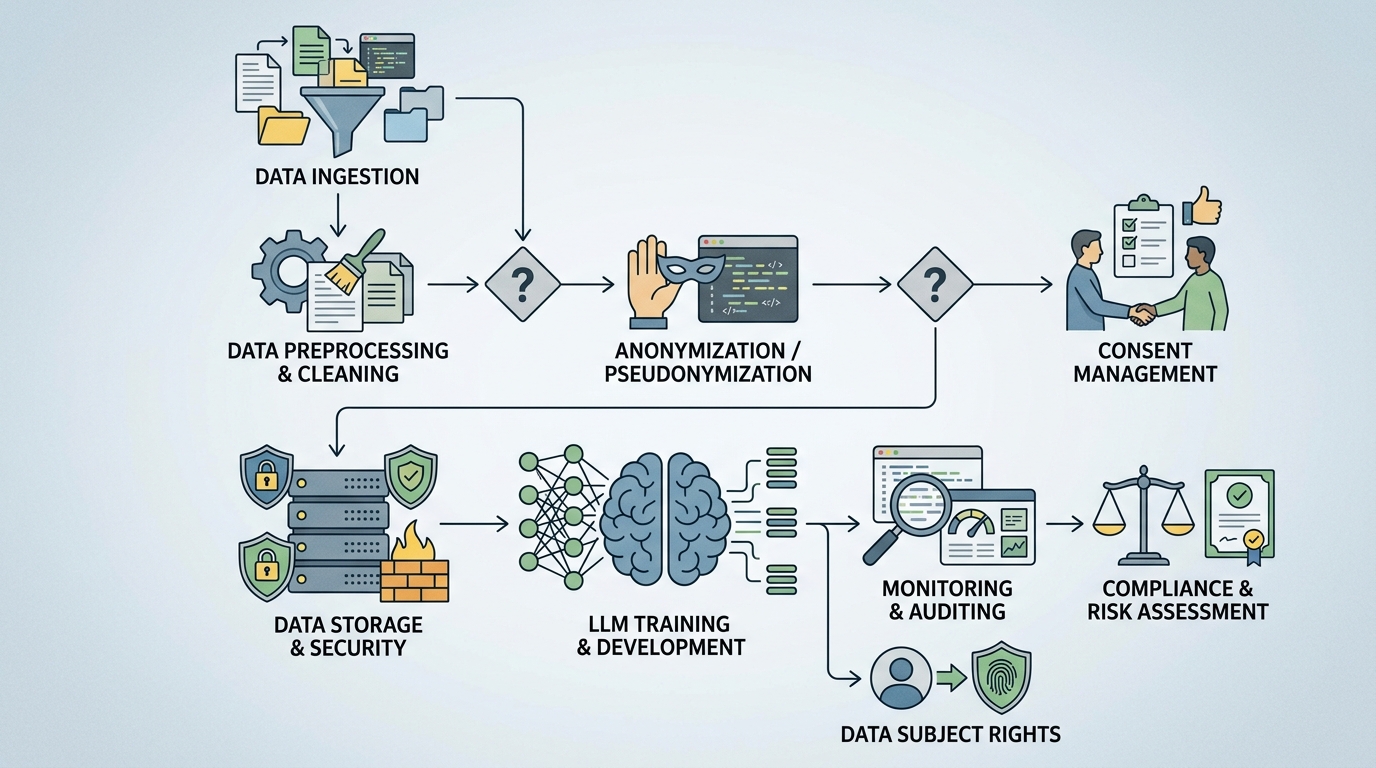
A comprehensive flowchart outlining the critical processes for maintaining LLM data privacy and adhering to GDPR compliance within an enterprise.
The Importance of LLM Data Privacy
The fundamental mechanics of LLM training and inference present unique risks to corporate privacy governance. Traditional relational databases store data deterministically in discrete, indexable rows that can be updated or deleted upon request. In contrast, artificial intelligence models compress training inputs across billions of numerical weights and parameters.
When employee prompt queries or customer records are processed by an LLM without proper sanitization, several primary privacy failure points can occur:
- Prompt Ingestion & Model Retention: Unchecked prompts transmitted to third-party endpoints may be logged for service optimization, exposing customer accounts, sensitive intellectual property, or confidential internal communications to third-party review.
- Vector Database (RAG) Exposure: Retrieval-Augmented Generation systems query enterprise vector stores to supply LLMs with domain context. If vector database permissions are misconfigured, lower-privileged users could extract highly restricted company documents via natural language prompts.
- Inference Memorization and Extraction: Deep learning research demonstrates that LLMs can inadvertently memorize training samples, allowing malicious prompts to extract exact strings of personal data, passwords, or proprietary source code.
Without rigorous operational controls, the unstructured deployment of AI applications can lead to severe regulatory fines, reputation damage, and complete loss of intellectual property integrity.
AI Compliance: GDPR Requirements
For enterprises processing data of European Economic Area (EEA) residents, enforcing ai compliance gdpr standards within LLM architectures is a non-negotiable legal obligation. The non-deterministic nature of generative AI directly conflicts with several core tenets of EU data protection law.
+-----------------------------------------------------------------------+
|                 GDPR Compliance Pillars for LLMs                      |
+-----------------------------------------------------------------------+
| 1. Lawful Basis for Processing (Article 6)                            |
| 2. Right to be Forgotten / Erasure (Article 17)                       |
| 3. Purpose Limitation & Data Minimization (Article 5)                 |
| 4. Automated Individual Decision-Making Controls (Article 22)         |
+-----------------------------------------------------------------------+
Key Regulatory Friction Points
- The “Right to be Forgotten” (Article 17): GDPR guarantees individuals the right to request erasure of their personal data. However, removing specific individual data points from trained neural network weights—a process known as machine unlearning—remains computationally cost-prohibitive and technically imprecise. Enterprise compliance must ensure PII is stripped before model training occurs.
- Data Minimization (Article 5): GDPR mandates collecting only data strictly necessary for specified purposes. Broadly feeding full enterprise document repositories into LLM context windows without strict filtering directly violates this principle.
- Automated Decision-Making (Article 22): Individuals have the right not to be subject to decisions based solely on automated processing if those decisions yield legal or significantly similar effects. Enterprise AI workflows must incorporate clear “human-in-the-loop” governance pathways.
What are the GDPR compliance requirements for AI?
To ensure compliance with GDPR when deploying LLM workflows, enterprises must enforce five primary technical and operational safeguards:
- Establish a Clear Lawful Basis: Maintain explicit legal grounds (e.g., explicit consent or legitimate interest) for processing user personal data within AI pipelines.
- Pre-Inference Data Sanitization: Implement automated PII scrubbing (using Named Entity Recognition tools) to remove names, email addresses, financial details, and government IDs prior to sending context to LLM inference endpoints. (Named Entity Recognition tools)
- Strict Vendor Data Processing Agreements (DPAs): When utilizing cloud APIs, sign legally binding DPAs confirming zero-data-retention (ZDR) policies and explicit guarantees that enterprise inputs will not be used to train vendor foundational models.
- Conduct Data Protection Impact Assessments (DPIAs): Perform comprehensive DPIAs specifically mapping AI data flows, algorithm bias checks, and probabilistic failure rates prior to production deployment.
- User Transparency and Opt-Out Protocols: Clearly inform end users when they are interacting with an AI system and provide mechanisms to opt out of automated profiling.
Understanding these broader governance rules is vital when examining overall AI model security implications across multi-cloud environments.
Ensuring HIPAA LLM Security in Healthcare
In healthcare environments across the United States, integrating generative AI tools requires absolute adherence to Health Insurance Portability and Accountability Act (HIPAA) mandates. Exposing Protected Health Information (PHI) to unauthorized cloud environments triggers immediate mandatory reporting, substantial civil monetary penalties, and class-action legal exposure.
Achieving robust hipaa llm security requires securing both transmission pipelines and storage environments handling patient records, clinical notes, and diagnostic data.
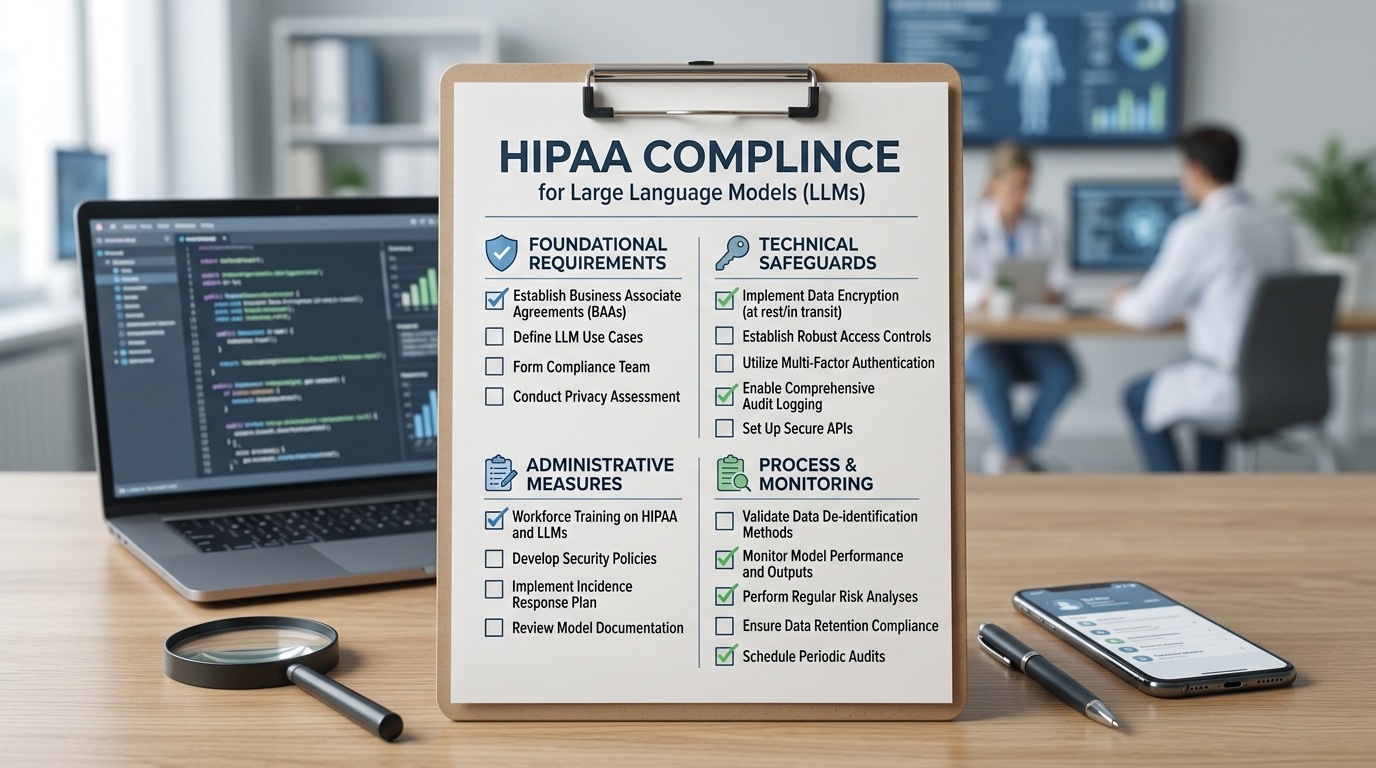
Key steps and considerations for healthcare organizations to ensure robust HIPAA LLM security and compliance.
How to ensure HIPAA compliance with LLM security?
Healthcare providers, health-tech vendors, and enterprise covered entities must execute the following protocol to maintain HIPAA compliance across LLM systems:
- Execute Business Associate Agreements (BAAs): Never route PHI through any cloud LLM provider that refuses to execute a formal BAA. Standard consumer or commercial developer API terms do not satisfy HIPAA statutory requirements.
- Enforce End-to-End Encryption: Encrypt all PHI both in transit (using TLS 1.3 with AES-256 cipher suites) and at rest across vector databases, prompt caching layers, and system logging disks.
- Zero Telemetry & Retention Enclaves: Ensure cloud LLM instances operate within dedicated, single-tenant private enclaves where incoming prompt contexts are processed in volatile memory and purged immediately following inference execution.
- Granular Role-Based Access Control (RBAC): Restrict access to healthcare LLMs using strict IAM principles. Ensure clinical staff only access PHI relevant to their direct treatment authorization, backed by detailed immutable audit logs.
- De-Identification Infrastructure: Before routing patient narratives to an LLM context window, pass data through automated de-identification pipelines that comply with HIPAA Safe Harbor or Expert Determination standards.
Cloud AI Data Governance Strategies
To bridge legal mandates with technical execution, enterprise technology leaders must establish comprehensive cloud ai data governance frameworks. Data governance for generative AI extends far beyond traditional static database access policies, requiring active runtime policy enforcement.
       +-------------------------------------------------------+
       |           Enterprise AI Governance Stack             |
       +-------------------------------------------------------+
       | Layer 4: Human Oversight & Policy Audit               |
       | Layer 3: Runtime Prompt/Completion Guardrails          |
       | Layer 2: Automated PII Masking & Context Scrubbing    |
       | Layer 1: Encrypted Storage & Network Segmentation     |
       +-------------------------------------------------------+
Core Architecture Pillars for AI Governance
- API Gateway Interceptors (AI Guardrails): Deploy an intermediate proxy layer between company users and LLM endpoints. This gateway monitors, logs, and sanitizes all outbound prompts and incoming model responses in real time, neutralizing credential leaks and PII exposure.
- Context Control & RAG Governance: Implement document-level permission tags within vector databases. Ensure retrieval algorithms respect existing enterprise file permissions, preventing unauthorized data aggregation.
- Immutable Telemetry & SIEM Integration: Forward all metadata—including prompt timestamps, token lengths, user IDs, and policy flags—to enterprise SIEM solutions (e.g., Splunk, Datadog) while maintaining zero storage of sensitive raw prompt text.
Implementing these frameworks aligns directly with established AI security best practices across complex IT environments.
Navigating Data Residency for LLMs
Cross-border data transfer restrictions represent one of the most complex operational hurdles for global enterprises utilizing cloud-hosted LLMs. Regulators globally increasingly require that citizen data remain within national or regional borders.
Managing data residency llm challenges requires addressing both the geographic location of inference processing servers and the physical location of vector indexing databases.
How does data residency affect cloud AI governance?
Data residency laws radically transform how enterprises design cloud AI architectures:
- Inference Server Geofencing: Routing a user’s query from an EU branch office to a cloud LLM cluster located in the United States constitutes an unauthorized cross-border data transfer under GDPR, regardless of how quickly the response returns. Cloud AI governance strategies must enforce strict regional routing boundaries.
- Sovereign Cloud Enclaves: Major cloud infrastructure vendors offer specialized sovereign cloud regions designed to guarantee that hardware hosting AI models physically resides within defined national boundaries (e.g., EU Sovereign Cloud boundaries).
- Distributed Vector Architectures: Organizations operating globally must deploy localized vector database nodes in each operating region to prevent centralizing cross-border personal data into a single global repository.
Conclusion: Is On-Premise LLM Security Better for Data Privacy?
When evaluating long-term compliance strategies, many security architects question whether private deployments outperform cloud services for absolute privacy protection.
Adopting on-premise LLM security eliminates third-party vendor risks, completely avoids cross-border internet transmissions, and ensures absolute control over data retention policies. For healthcare institutions, defense contractors, and financial enterprises handling ultra-sensitive datasets, running open-weights models inside air-gapped internal data centers provides the most defensible regulatory position possible.
However, for enterprise applications where localized GPU maintenance is impractical, multi-tenant cloud LLM APIs can satisfy regulatory scrutiny—provided they are backed by strict BAAs/DPAs, automated pre-inference PII scrubbing, robust regional routing, and continuous AI guardrail monitoring.
Frequently Asked Questions (FAQ)
1. Can an enterprise be fined under GDPR for using public cloud LLM APIs?
Yes. If an enterprise feeds personal customer or employee data into a cloud LLM API without a valid legal basis, proper user consent, or a formal Data Processing Agreement (DPA) that guarantees appropriate data handling, national data protection authorities can issue significant regulatory fines.
2. What is the difference between data masking and de-identification in LLM workflows?
Data masking temporarily obfuscates sensitive fields (such as replacing a credit card number with asterisks) before processing. De-identification is a formal process (especially under HIPAA) that systematically removes or modifies 18 specific identifiers so that the remaining data cannot be reasonably linked back to an individual.
3. Does RAG (Retrieval-Augmented Generation) solve LLM data privacy issues?
RAG improves factual accuracy and reduces model hallucinations, but it does not automatically solve privacy concerns. If the underlying vector store contains unencrypted PII or lacks role-based access controls, RAG systems can inadvertently retrieve and expose sensitive information to unauthorized users via natural language responses.