
Local vs. Cloud LLM Security: A Comprehensive Comparison for Enterprise
As generative artificial intelligence moves into core operational infrastructure, Enterprise CTOs, CISOs, and Chief Risk Officers face a pivotal architectural choice: should Large Language Models (LLMs) be hosted in third-party cloud environments or deployed on-premise? In 2026, the question is no longer merely about inference speed or API costs. Instead, it centers heavily on enterprise data protection, regulatory compliance, intellectual property safeguarding, and attack surface management.
Both deployment paradigms present distinct benefits and strategic risks. While cloud-hosted LLM endpoints deliver unmatched scalability and access to bleeding-edge foundational models, they introduce systemic vulnerability vectors around data residency, multi-tenancy exposure, and third-party vendor dependency. Conversely, private, local LLM deployments provide complete data sovereignty and zero-trust perimeter containment, but require dedicated hardware investments, complex lifecycle maintenance, and rigorous internal governance.
This guide delivers an in-depth ai security comparison analyzing local llm security versus cloud infrastructure, helping enterprise technical leaders evaluate key ai security tradeoffs to construct a resilient AI architecture.
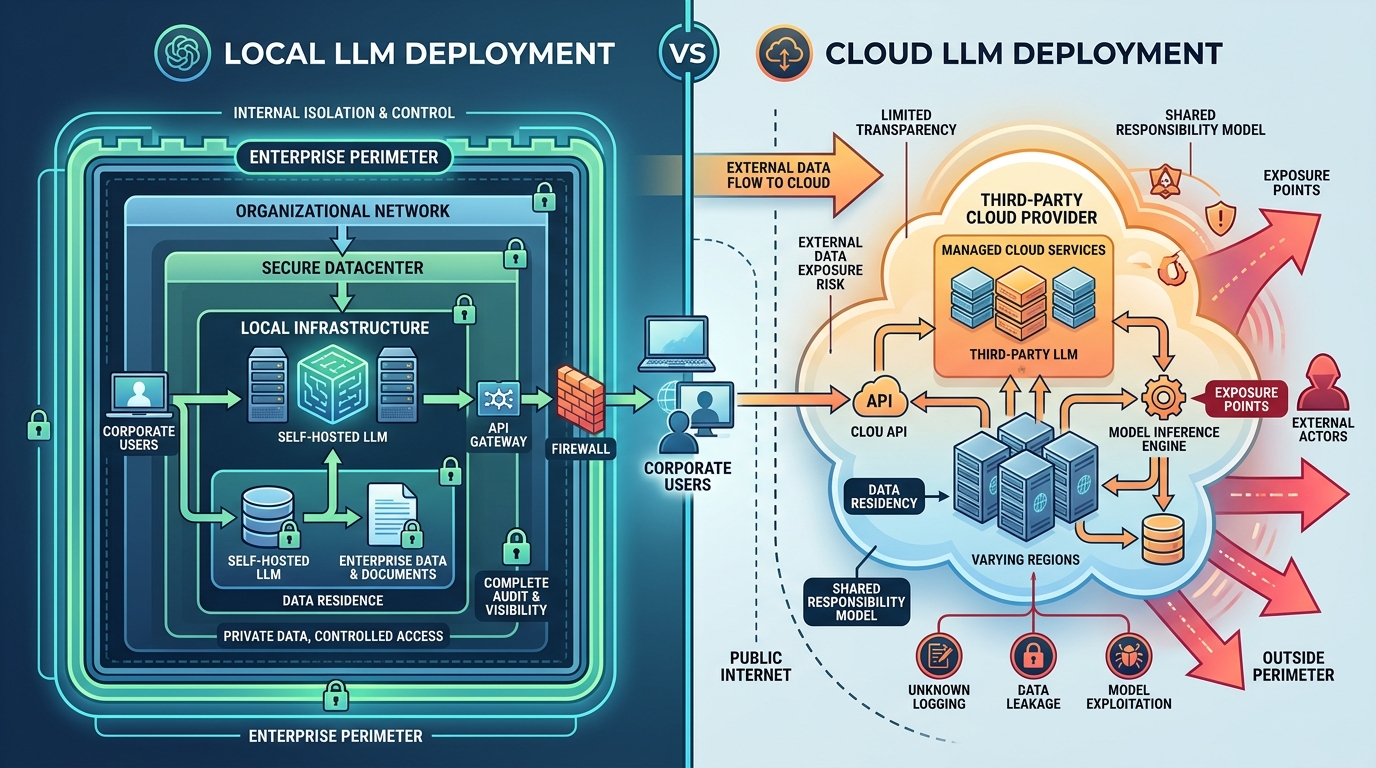
A visual representation of the architectural differences and security implications between deploying Large Language Models locally and in cloud environments.
Understanding AI Security Tradeoffs
Navigating enterprise deployment requires evaluating the foundational architectural divergence between centralized cloud API services and self-hosted infrastructure. Every architectural decision incurs trade-offs across performance, privacy, operational overhead, and threat resistance.
Why Cloud LLM Security Risks Matter
Cloud-hosted LLM services rely on API-driven multi-tenant cloud ecosystems. When an enterprise sends prompt vectors, proprietary context documents, or codebases to a cloud provider, that data leaves the organizational boundary.
The key security concerns associated with cloud LLM infrastructure include:
- Data Ingestion and Training Risks: Third-party providers may log prompt payloads, customer conversations, and context windows for quality assurance or downstream model tuning, raising critical generative AI security concerns regarding exposure of trade secrets.
- Third-Party Intermediary Attacks: External APIs expand the attack surface to include man-in-the-middle (MitM) interception, API key leakage, supply-chain compromises in cloud client SDKs, and side-channel threats operating on shared multi-tenant hardware.
- Regulatory & Residency Non-Compliance: Storing or processing sensitive user data in foreign cloud regions without rigorous spatial controls can immediately violate jurisdictional data protection mandates, complicating overall cloud AI data governance.
The Promise of On-Premise LLM Security
To counter the external perimeter exposure of public APIs, security architects increasingly advocate for on-premise LLM security. By hosting open-weights or fine-tuned open-source foundational models (such as Llama 3, Mistral, or custom enterprise weights) on local hardware or private air-gapped data centers, organizations establish complete control over the operational environment.
Key advantages of on-premise deployments include:
- Air-Gapped Isolation: Inference nodes can function completely disconnected from external internet access, blocking remote exfiltration vectors.
- Absolute Data Sovereignty: Prompts, system instructions, and vector database embeddings remain contained within company-owned memory banks and localized storage arrays.
- Custom Security Boundary Rules: Enterprises can enforce custom role-based access control (RBAC), prompt sanitization pipelines, and auditing hooks natively inside the system memory stack.
Core Cloud LLM Vulnerabilities
While cloud providers allocate substantial engineering resources toward securing physical infrastructure, the logic layer and access model of cloud LLM APIs expose unique systemic vulnerabilities.
       +-------------------------------------------------------+
       |               Cloud LLM Threat Vectors                |
       +-------------------------------------------------------+
       | 1. Prompt Injection & Indirect Vector Hijacking       |
       | 2. Third-Party Vendor Data Retention Policy Drift      |
       | 3. API Token Misconfiguration & Exfiltration          |
       | 4. Multi-Tenant Side-Channel & Memory Leakage         |
       +-------------------------------------------------------+
1. Indirect Prompt Injection
When cloud LLM agents process external web content, unverified emails, or shared cloud databases, malicious actors can insert hidden instructions within the data payload. In a cloud environment with broad web hooks or automated API integrations, indirect prompt injection can hijack model execution, forcing the LLM to output restricted enterprise data to unauthorized external endpoints.
2. Multi-Tenant Data Leakage
Although public cloud vendors implement isolation layers between tenant tenants, multi-tenancy inherent in managed AI clusters creates potential side-channel vulnerabilities. Memory remanence, GPU kernel leakage, or misconfigured caching layers in shared hardware accelerators present ongoing risk profiles for regulated industries.
3. Supply Chain and Dependency Hazards
Enterprise integrations rely on cloud client libraries, REST endpoints, and middleware tools. A vulnerability in any upstream python framework or middleware wrapper can expose cloud API keys, allowing attackers to manipulate or impersonate automated workflow pipelines.
Understanding these vulnerabilities is paramount when evaluating cloud LLM security risks against localized defensive strategies.
Local LLM Benefits for Security and Privacy
Deploying models locally—whether on dedicated enterprise hardware stacks or isolated sovereign clouds—fundamentally redefines the security baseline. Examining local llm benefits security highlights clear operational advantages:
| Security Parameter | Public Cloud LLM API | Private / Local LLM Deployment |
|---|---|---|
| Data Perimeter | Transmitted over public networks to vendor infrastructure | Contained within internal subnet or air-gapped network |
| Data Training Risk | Varies by terms of service; potential telemetry retention | Zero risk of external training reuse |
| Access Control | Managed via API keys, cloud IAM, and vendor gateways | Fully integrated with enterprise LDAP, Active Directory, & Zero-Trust IAM |
| Model Weight Auditability | Black-box access; architecture unknown | Full access to model weights, codebases, & pipeline logs |
| Outage & Dependency Risk | Susceptible to third-party outages & policy shifts | Sovereign operation regardless of external network stability |
Direct Privacy Controls and Memory Handling
With local deployments, memory allocations during inference are flushed according to internal enterprise parameters. System logs remain within native SIEM (Security Information and Event Management) tools like Splunk or Elasticsearch, ensuring seamless compliance logging without exposing telemetry to third-party observers.
Eliminating Exfiltration Paths
Because a local deployment can operate behind strict egress firewalls with outbound traffic disabled, standard exfiltration tactics—where an exploited model attempts to execute external HTTP POST calls—are structurally neutralized at the network layer.
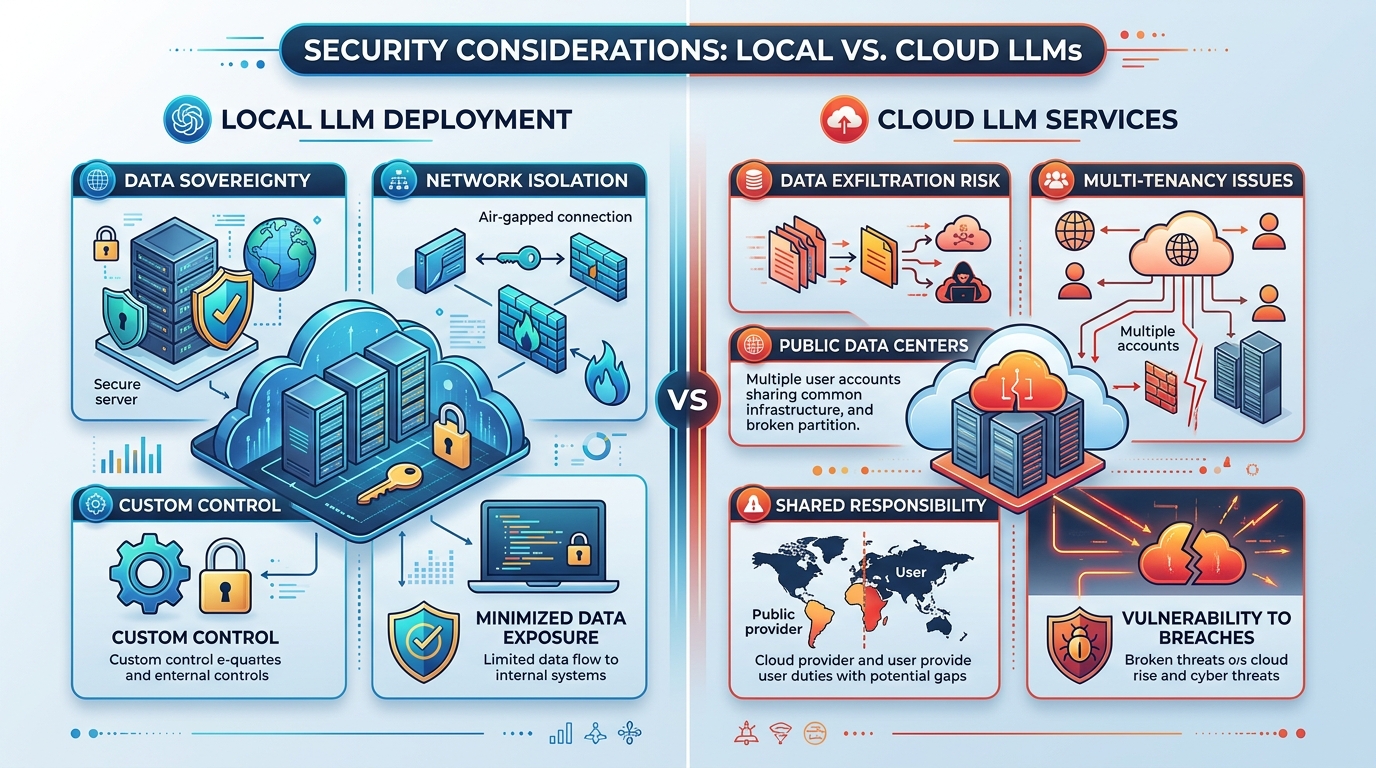
Key security parameters comparing public cloud LLM APIs with private/local LLM deployments, focusing on data perimeter, training risk, access control, and auditability.
Private LLM Security: Is Local Always Better?
Despite the clear control advantages of private llm security, assuming that local deployments are automatically secure is a dangerous oversight. Transitioning from cloud to local shifts the burden of hardware, infrastructure, and model lifecycle security entirely onto internal security teams.
The Hidden Risks of Self-Hosted AI Infrastructure
- Model Weight Integrity & Tampering: Open-weights downloaded from public repositories (e.g., Hugging Face) can contain malicious code or poisoned weights if not cryptographically verified before deployment. Model weight tampering or supply chain attacks on pickle/safetensor files present serious initial-access threats.
- Infrastructure & GPU Cluster Hardening: Managing physical or virtual GPU server clusters requires specialized knowledge. Misconfigured enterprise Kubernetes clusters, unpatched CUDA drivers, or exposed local REST ports can render on-premise LLMs even more vulnerable than enterprise-grade cloud endpoints.
- Prompt Injection Remains Real: Running an LLM locally does not neutralize direct or indirect prompt injection. If an internal user or automated system passes untrusted input to a local LLM that has read/write privileges to local internal databases, the LLM can still be coerced into unauthorized actions.
Achieving true security requires incorporating secure LLM deployment practices, regardless of physical hosting location.
How to Evaluate Local vs Cloud AI Data Safety
When conducting an enterprise risk assessment, security teams must systematically compare how each model architecture handles sensitive datasets.
Decision Framework: Local vs Cloud AI Data Safety
To determine the optimal architecture for your enterprise workflows, evaluate the following criteria:
-
Data Sensitivity Classification:
- Public / Marketing Data: Suitable for cloud LLM APIs.
- Confidential Business Records & Customer PII: Requires cloud models with strict zero-data-retention agreements or private enterprise cloud enclaves.
- Top-Secret IP, Healthcare PHI, Sovereign Defense Data: Requires strictly isolated on-premise local deployments.
-
Operational Overhead vs. In-House Expertise:
- Do you possess dedicated DevOps and SecOps engineers capable of maintaining GPU hardware, patch pipelines, and LLM serving stacks (e.g., vLLM, Ollama Enterprise, TGI)? If not, the administrative overhead of local security may introduce unmanaged vulnerabilities.
-
Threat Model & Egress Requirements:
- Does your threat model demand complete air-gapping? If total network isolation is required by policy, local deployment is the only compliant pathway.
Key Questions Answered
How does local llm security compare to cloud?
Local LLM security provides absolute perimeter isolation, total control over data logging, and zero exposure to vendor multi-tenancy risks. Cloud LLM security relies on third-party security controls, vendor SLA compliance, and robust encryption in transit and at rest, but exposes the organization to external API perimeters and potential vendor policy changes.
What are the security tradeoffs between local and cloud AI?
The main security tradeoffs revolve around control versus maintenance capability. Local deployments offer total data sovereignty and network air-gapping at the expense of higher operational complexity, internal hardware management, and self-managed model patch cycles. Cloud deployments provide turnkey scalability and state-of-the-art security teams, but introduce third-party data transmission risks, potential vendor lock-in, and multi-tenant threat vectors.
Frequently Asked Questions (FAQ)
1. Are local LLMs completely safe from prompt injection attacks?
No. Local deployments protect data from external transmission and vendor exposure, but the underlying neural network architecture remains susceptible to prompt injection. An attacker who controls input fed into a local LLM can still manipulate model output or trigger unauthorized internal tool executions if proper input sanitization and privilege limits are not applied.
2. Does using a commercial cloud LLM API expose my company’s data for training?
Not necessarily, but it depends heavily on your enterprise agreement. Standard consumer cloud subscriptions frequently opt users into data training pipelines by default. Enterprise-tier cloud contracts usually include explicit “zero data retention” (ZDR) and “no model training” clauses. However, data must still be transmitted over the internet and processed on vendor hardware.
3. What hardware is required to run secure local enterprise LLMs?
Running enterprise-grade local LLMs with parameters ranging from 13B to 70B+ requires high-performance accelerator hardware, typically featuring enterprise GPUs (e.g., NVIDIA H100, A100, or L40S) with sufficient VRAM to hold model weights and high-context KV caches in memory simultaneously.
Conclusion & Strategic Roadmap
Choosing between local and cloud LLM security is not a binary decision. Many modern enterprises adopt a hybrid approach: utilizing public cloud LLMs for non-sensitive, high-scalability tasks while anchoring sensitive core IP, customer PII, and regulated financial or medical records within secure, locally hosted private models.
By assessing data sensitivity, establishing robust access controls, and maintaining continuous monitoring pipelines, enterprise organizations can safely harness generative AI without compromising their risk posture.