
How to Execute Programmatic SEO with AI
Some keyword spaces can’t be won one article at a time. “Best CRM for dentists,” “best CRM for landscapers,” “best CRM for law firms” — hundreds of structurally identical queries, each with real search demand, each deserving its own page. Writing them manually is absurd; ignoring them leaves compounding traffic on the table.
This is the territory of programmatic SEO with AI: generating large sets of keyword-targeted pages from a dataset and a template, with AI filling the gaps that raw data can’t. Done well, it’s how startups build search footprints far beyond their headcount. Done carelessly, it’s how sites earn thin-content problems at industrial scale. This guide covers how to do it well.
The Difference Between AI Content Workflows and Programmatic SEO
The two approaches are cousins, not synonyms — and knowing which problem you have determines which one you build.
An AI content workflow produces editorial content: guides, comparisons, how-tos. Each piece targets a distinct topic, gets its own brief and structure, and flows through a multi-step generation pipeline. Output is measured in dozens of pieces; each is individually reviewed. (If that’s what you need, start with our guide to the automated content creation workflow instead.)
Programmatic SEO produces structural content: one page template instantiated across many rows of a dataset. The queries share a pattern — [category] for [industry], [tool A] vs [tool B], [service] in [city] — and so do the pages. Output is measured in hundreds or thousands; review happens at the template and sample level, because per-page review is impossible by design.
Where AI fits differs too:
- In content workflows, AI does the primary writing, guided by briefs and context.
- In programmatic SEO, the dataset does the heavy lifting, and AI writes the connective tissue — unique descriptions, summaries, and comparisons that raw data can’t express.
The decision rule: if your target queries are each unique topics, build a content workflow. If they’re one pattern with many values, build programmatic. Most mature SEO operations eventually run both on shared infrastructure — the same AI SEO content system foundation supports either output type.
How to Do Programmatic SEO with AI?
The build order matters. Founders who start by generating pages fail; founders who start with the dataset and template succeed. Work through these three stages in sequence.
Designing the Page Template
The template is the product. Every page inherits its strengths and its flaws at full scale, so design it against the actual search intent:
- Study the query pattern. What does someone searching
[your pattern]actually need? A price? A comparison table? Availability? Requirements? List the questions every page must answer. - Structure answer-first. Lead with the data that satisfies the query — a summary block, a table, key facts — then support with explanatory sections. Programmatic visitors came for an answer, not an essay.
- Define every slot explicitly. A good template is a schema: title pattern, H1 pattern, data-driven blocks, AI-written blocks, internal link modules, FAQ block. Each slot maps to either a dataset field or a generation step — nothing is vague.
- Design the internal linking module in from day one. Each page should link to sibling pages (related rows), parent hub pages, and relevant editorial content. At hundreds of pages, this linking structure is how authority and crawlability flow — retrofitting it later is painful.
- Set a minimum-viable-page rule. Define which fields are required for a page to exist at all. Rows that can’t fill the required slots don’t get pages — this single rule prevents most thin-content problems before they’re born.

Programmatic SEO relies on well-designed page templates that define the structure and content slots for dynamically generated pages.
Preparing Your Dataset
The dataset determines whether your pages have substance. Treat it as the core asset:
- Source data with real informational value. Your own product data, public datasets, structured research you compile — whatever the source, each row must contain facts a searcher genuinely wants. If the dataset is just a keyword list with no attributes, there’s nothing for pages to say.
- Aim for attribute richness. More meaningful fields per row means more distinct, useful content per page. A row with fifteen substantive attributes supports a real page; a row with two supports a stub.
- Clean before you generate. Deduplicate rows, normalize formats and units, fill or flag gaps. Every data flaw becomes a published flaw multiplied across the build — data QA is page QA done early and cheap.
- Plan for freshness. Data ages. Decide how the dataset gets updated and how updates flow to regenerated pages. A programmatic build with stale data quietly rots; one wired for regeneration compounds.
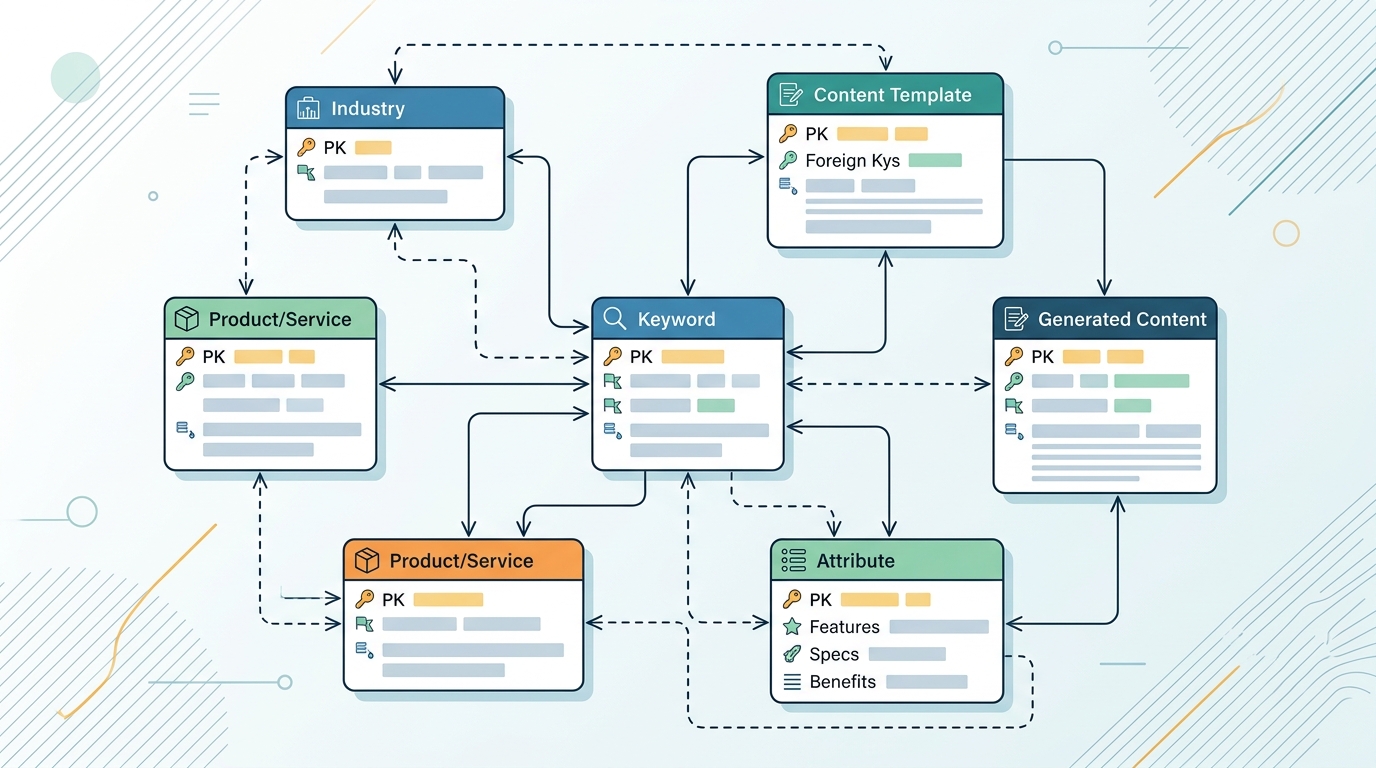
A robust database schema is fundamental for organizing and managing the vast datasets required to scale programmatic SEO effectively.
Using AI for Variable Descriptions
Here’s where AI earns its place — and where discipline separates useful builds from spam:
- Generate from the row, not the keyword. Each AI-written block should be produced from that row’s actual attributes: “Given these specific facts, write the overview section.” The model transforms data into readable prose; it doesn’t hallucinate substance the row lacks.
- Vary generation by segment. Instruct the workflow to derive angle and emphasis from the data itself — what’s notable about this row relative to others. This produces genuinely differentiated text instead of one paragraph with swapped nouns.
- Forbid invention. The generation prompt must prohibit claims not grounded in the row’s data. At programmatic scale, a hallucination rate of even a few percent means dozens of published falsehoods. Constrain the model to the dataset.
- Validate mechanically, sample manually. Automated checks: minimum length, required facts mentioned, no placeholder text, no cross-row duplication above a similarity threshold. Human checks: review a random sample per batch, plus every row flagged by validation.
Orchestration-wise, this is a classic pipeline: iterate over rows → generate per-slot content → validate → assemble → publish. You can run it in code or in a visual workflow tool like NORA, where the loop, the AI generation steps, and the validation gates are nodes in one locally-run graph — no per-row cloud task fees, which matters when rows number in the thousands. The publishing pattern is the same webhook/CMS integration used to automate landing page creation — programmatic SEO is that pipeline with a bigger loop and stricter gates.
Overcoming Thin Content & Duplicate Issues
Thin and duplicative pages are the failure mode that defines bad programmatic SEO — and every safeguard is an engineering control you can implement:
1. Enforce the minimum-viable-page rule ruthlessly. Publish only rows rich enough to genuinely answer the query. A programmatic build of 400 substantive pages beats 4,000 stubs in every metric that matters — and the stubs can drag down how search engines assess the whole site.
2. Measure cross-page similarity before publishing. Add a validation step comparing generated text across pages. Pages exceeding a similarity threshold get regenerated with stronger differentiation instructions or merged. Boilerplate template text is fine; identical variable content is not.
3. Ensure each page earns its existence. The test for any two pages: could a searcher tell which is which, and does each serve a query the other doesn’t? If two rows are distinctions without a difference, consolidate them into one stronger page.
4. Use canonical and index controls deliberately. Filtered variants and near-duplicate rows that must exist for users shouldn’t all compete in search — canonicalize secondary variants to the primary page, and keep genuinely low-value utility pages out of the index.
5. Ship in batches and watch the data. Don’t publish thousands of pages in one push. Release a batch, watch indexing and impressions in Search Console, fix what underperforms, then expand. Search data is your integration test — batching limits the blast radius of a template flaw.
6. Schedule regeneration. Wire data updates to page regeneration so the build stays accurate over time. Freshness is a quality signal to users first and search engines second.
The unifying principle: programmatic SEO fails when it’s treated as a volume trick and succeeds when it’s treated as a data product — a genuinely useful resource, delivered at scale, with quality enforced by the pipeline rather than promised by intentions.
FAQ
Is programmatic SEO against Google’s guidelines?
Scaled page generation isn’t inherently against guidelines — scaled low-value content is. Google’s guidance targets content created primarily to manipulate rankings rather than help users. Programmatic pages built on substantive data, answering real queries distinctly, are structurally aligned with that standard; empty template stubs are not.
How many pages do I need for programmatic SEO to be worth it?
There’s no magic threshold — the pattern matters more than the count. If your keyword space contains a repeating query structure with meaningful search demand across dozens-to-hundreds of values, and you can source rich data for each, the approach pays. If you’d struggle to fill 30 substantive rows, editorial content is the better investment.
Can I do programmatic SEO without a developer?
Increasingly, yes. The pipeline — dataset iteration, AI generation per row, validation, CMS publishing — can be assembled in visual workflow tools without code. What you can’t skip is the thinking: schema design, template design, and quality rules are the actual work, whoever implements them.
What’s the biggest cause of programmatic SEO failure?
Starting from keywords instead of data. Teams pick a query pattern, generate pages with AI filler, and discover they’ve published hundreds of pages that say nothing — then face cleanup. Inverting the order — dataset first, template second, generation last — prevents nearly all of it.
Should AI write entire programmatic pages?
No. The dataset should carry the substance; AI should write the connective prose that makes data readable — overviews, comparisons, summaries — strictly grounded in each row’s facts. Pages that are 100% free-form AI text with no data backbone converge on the thin, samey content this whole discipline exists to avoid.