
MCP Server vs REST API: Understanding Model Context Protocol
If you build AI agents, you have probably hit the same wall every engineering team hits: your model is smart, but it can’t do anything until you wire it to real systems. The traditional answer was a REST API plus a pile of glue code. The newer answer — and the one Anthropic designed specifically for agentic workloads — is the Model Context Protocol (MCP).
This guide breaks down the MCP server vs REST API question from an infrastructure engineer’s point of view: what MCP actually is, how MCP servers work with Claude, where the architectures genuinely differ, and how MCP compares to function calling APIs and LangChain tools. By the end, you’ll know exactly which pattern fits your stack.
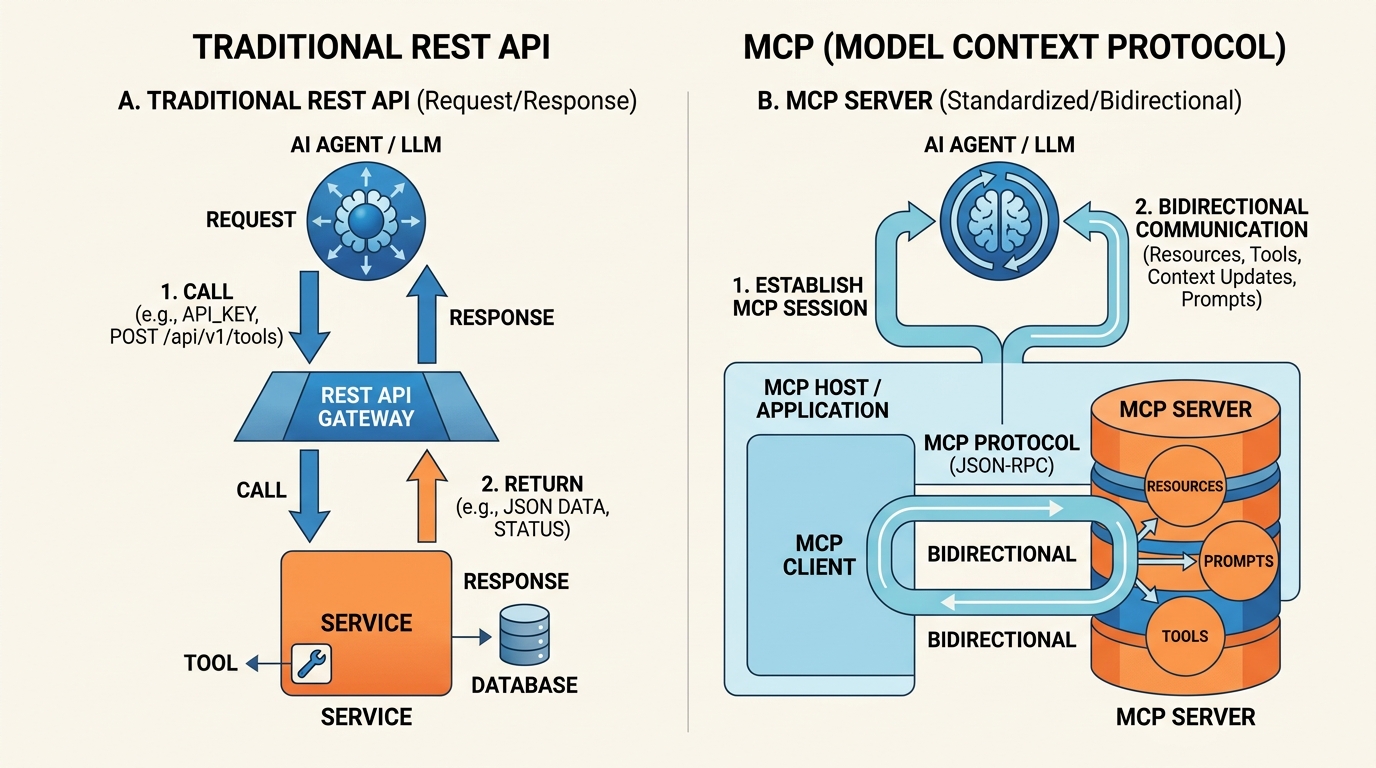
Architectural comparison: MCP servers offer a standardized, bidirectional protocol for AI agents, contrasting with the traditional request/response model of REST APIs.
What is Model Context Protocol (MCP)?
Model Context Protocol (MCP) is an open protocol, introduced by Anthropic, that standardizes how AI applications connect to external data sources and tools. Instead of every team writing bespoke integrations between their model and each internal system, MCP defines a common client-server contract:
- MCP hosts — AI applications like Claude Desktop or Claude Code that want access to external capabilities.
- MCP clients — the protocol layer inside the host that maintains a connection to each server.
- MCP servers — lightweight programs that expose specific capabilities (a database, a filesystem, an internal API) through the standardized protocol.
The classic analogy is the USB-C port for AI. Before USB-C, every device needed its own proprietary cable. Before MCP, every model-to-tool integration needed its own proprietary adapter code. MCP replaces the N×M integration problem (every model × every tool) with an N+M problem: build one MCP server per tool, and any MCP-compatible host can use it.
An MCP server can expose three primitive types to the model:
- Tools — executable functions the model can invoke (run a query, create a ticket, send a message).
- Resources — readable data the model can pull into context (files, records, documents).
- Prompts — reusable prompt templates the server offers to the client.
That last point matters: MCP is not just “function calling with extra steps.” It is a bidirectional, stateful protocol for context exchange, not merely command execution.
How MCP Servers Work with Claude
Understanding how MCP servers work with Claude clarifies most of the architectural differences that follow.
- Registration. You declare MCP servers in a configuration file (for example,
claude_desktop_config.jsonfor Claude Desktop, or viaclaude mcp addin Claude Code). Each entry tells the client how to launch or reach the server. - Transport. MCP supports multiple transports. Local servers typically run over stdio — the client spawns the server as a subprocess and exchanges JSON-RPC messages over standard input/output. Remote servers use HTTP-based transports (such as Streamable HTTP) for network access.
- Capability negotiation. On connection, the client and server perform a handshake. The server advertises which tools, resources, and prompts it exposes, along with JSON Schema definitions for each tool’s inputs.
- Discovery and invocation. Claude sees the advertised tool definitions in its context. When a user request requires external action, Claude selects a tool, the client sends a
tools/callrequest to the server, the server executes it, and the result flows back into Claude’s context. - Session lifecycle. The connection persists for the session. The server can update its capability list, and the client can re-query resources as the conversation evolves.
The critical insight: Claude discovers what a server can do at runtime. You don’t hardcode endpoint paths, request shapes, or response parsers into your agent. The protocol carries that metadata.
MCP Server vs REST API: Key Differences
Both patterns ultimately let software talk to other software, so where’s the real divergence? It comes down to who the consumer is. REST was designed for developers writing deterministic clients. MCP was designed for AI agents that reason about which capability to use.
Architecture & Connection Patterns
| Dimension | MCP Server | REST API |
|---|---|---|
| Consumer | AI model / agent | Human-written client code |
| Protocol | JSON-RPC 2.0 over stdio or HTTP | HTTP verbs (GET/POST/PUT/DELETE) |
| State | Stateful session with handshake | Typically stateless per request |
| Discovery | Built-in: server advertises tools + schemas at runtime | External: OpenAPI docs, manual integration |
| Direction | Bidirectional (server can push updates, request sampling) | Client-initiated request/response |
| Integration cost | One server works with any MCP host | One custom integration per client application |
| Schema contract | JSON Schema delivered in-protocol | Documented out-of-band |
Three architectural differences deserve emphasis:
- Runtime discovery vs compile-time integration. A REST client must be programmed against documentation before it runs. An MCP client asks the server “what can you do?” and receives machine-readable tool definitions the model can immediately reason over. Adding a new tool to an MCP server requires zero changes to the agent.
- Session state. REST’s statelessness is a feature for horizontally scaled web services, but agents operate in long-running conversational sessions. MCP’s persistent connection lets the server maintain context — open database transactions, authenticated sessions, subscribed resources — across many tool calls.
- Standardized wrapping. MCP doesn’t replace your REST APIs; in practice, many MCP servers are thin adapters in front of existing REST services. The protocol standardizes the last mile between the API and the model.
When to Use an MCP Server vs a Standard REST API
Use a REST API when:
- The consumer is deterministic application code, not a model.
- You need public, cacheable, stateless endpoints at web scale.
- Your clients are browsers, mobile apps, or third-party developers.
Use an MCP server when:
- The consumer is Claude or another MCP-compatible AI application.
- You want one integration to serve every MCP host in your organization.
- The agent needs to discover and choose among capabilities dynamically.
- You’re connecting Claude to internal tools like databases, ticketing systems, or internal services that were never designed for model access.
The pragmatic pattern for most teams: keep your REST APIs, and expose them to agents through an MCP server layer. These are complementary technologies, not competitors.
MCP vs Function Calling API & LangChain Tools
The comparison developers actually wrestle with isn’t only MCP vs REST — it’s MCP vs the two other ways of giving models tools.
MCP vs function calling API. Function calling (tool use) is a model capability: you pass tool definitions in each API request, the model returns a structured call, and your application code executes it. Function calling defines the “what” — the model’s structured intent. MCP defines the “how” — a standardized, reusable transport and lifecycle for executing that intent. In fact, when Claude uses MCP, function calling is still happening under the hood; MCP standardizes everything around it: discovery, execution, transport, and session management. With raw function calling, you own the execution plumbing for every integration. With MCP, the server owns it once, for every host.
Model Context Protocol vs LangChain tools. LangChain tools are Python/JavaScript abstractions bound to a specific framework and process. They’re excellent for building a single application quickly, but a LangChain tool is only usable inside a LangChain runtime. MCP is framework-agnostic and process-external: an MCP server written in any language can serve Claude Desktop, Claude Code, or any other MCP client — including LangChain itself, which can consume MCP servers through adapter packages. The distinction is library vs protocol: LangChain tools are code you import; MCP servers are services you connect to.
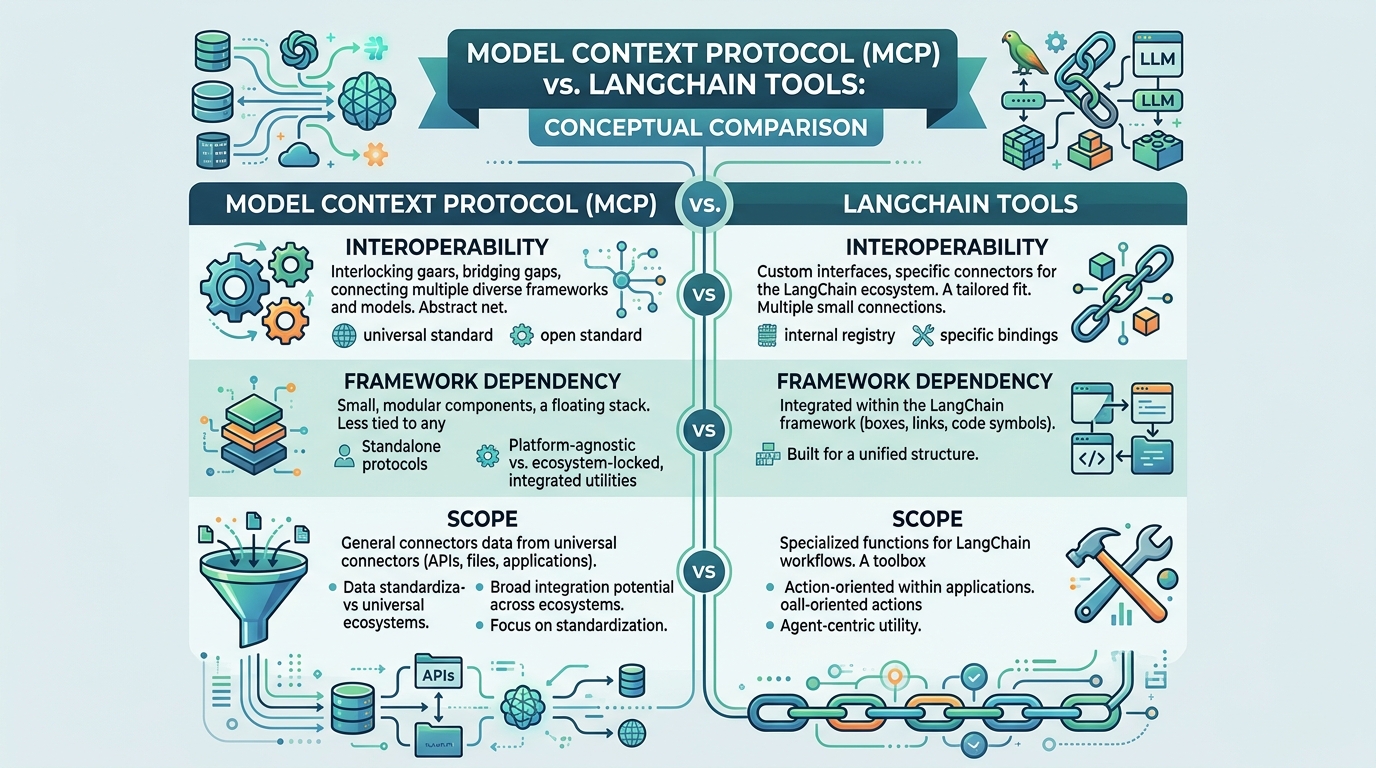
Understanding the distinctions: Model Context Protocol (MCP) provides a framework-agnostic interoperability layer, while LangChain tools are in-process and framework-specific implementations.
A useful mental model:
- Function calling = the model’s ability to emit structured tool invocations.
- LangChain tools = in-process, framework-specific tool implementations.
- MCP = the interoperability layer that makes tools portable across hosts, languages, and teams.
Core Use Cases for MCP Servers
Where does MCP earn its keep in production stacks?
- Internal database access. Expose read (or carefully scoped write) access to PostgreSQL, MySQL, or a data warehouse so Claude can answer questions against live data instead of stale exports.
- Developer tooling. Git operations, filesystem access, CI/CD triggers, and log retrieval for Claude Code — turning the model into a genuine engineering assistant.
- Enterprise knowledge. Wikis, document stores, and ticketing systems surfaced as MCP resources, so context flows into the model without manual copy-paste.
- SaaS integrations. Slack, GitHub, cloud providers, and monitoring platforms wrapped once and reused across every internal AI application.
- Workflow automation. Multi-step agent pipelines where Claude chains tools across several servers — query a database, draft a report, file the ticket — within one session.
If you’d rather adopt than build, the ecosystem already offers strong options — see our review of the best open source MCP servers for maintained implementations covering databases, filesystems, and developer tools.
Conclusion: The Future of AI Agents
The MCP server vs REST API debate resolves cleanly once you frame it correctly: REST remains the backbone of service-to-service communication, while MCP is emerging as the standard interface between AI agents and everything else. REST optimized for stateless web scale; MCP optimizes for stateful, discoverable, model-driven interaction.
For teams building on Claude, the strategic takeaway is simple: stop writing one-off glue code for every integration. Wrap your systems in MCP servers once, and every current and future MCP-compatible host in your organization inherits those capabilities.
Start small — one server, one internal tool, one measurable workflow — then expand as the pattern proves itself.
Frequently Asked Questions
Is MCP a replacement for REST APIs?
No. MCP standardizes how AI applications consume tools and data; REST remains ideal for conventional client-server communication. Most production MCP servers act as adapters in front of existing REST APIs, translating between the protocol and your services.
Does MCP only work with Claude?
MCP originated at Anthropic and has first-class support in Claude Desktop and Claude Code, but it is an open protocol. Any application can implement an MCP client, and servers written for one host work with any compliant host.
Is MCP the same thing as function calling?
No. Function calling is the model capability of emitting structured tool invocations. MCP is the protocol layer that standardizes tool discovery, transport, and execution around it. MCP uses function calling; it doesn’t replace it.
Can I use MCP servers with LangChain?
Yes. Adapter packages allow LangChain agents to consume MCP servers as tools, which means an MCP server you build for Claude can also serve framework-based agents — one integration, multiple runtimes.
How hard is it to build an MCP server?
A minimal server exposing a few tools can be written in an afternoon using the official Python or TypeScript SDKs. For production deployments with authentication and containerization, follow a structured approach like our self-hosted setup and security guide.