
Building Modern Node.js Async Automation Workflows in 2026
Node.js has quietly become the default runtime for internal automation. Its async-first model, enormous package ecosystem, and low operational footprint make it ideal for the unglamorous work that keeps businesses running: scheduled reports, file ingestion, API syncs, notification pipelines, and AI-assisted data processing.
But there’s a wide gap between a script that works on your laptop and a nodejs async automation workflow that runs unattended for months. This pillar guide covers the architecture, best practices, and boilerplate structure for automation that’s still working when nobody’s watching — and links out to deep dives on each major building block.
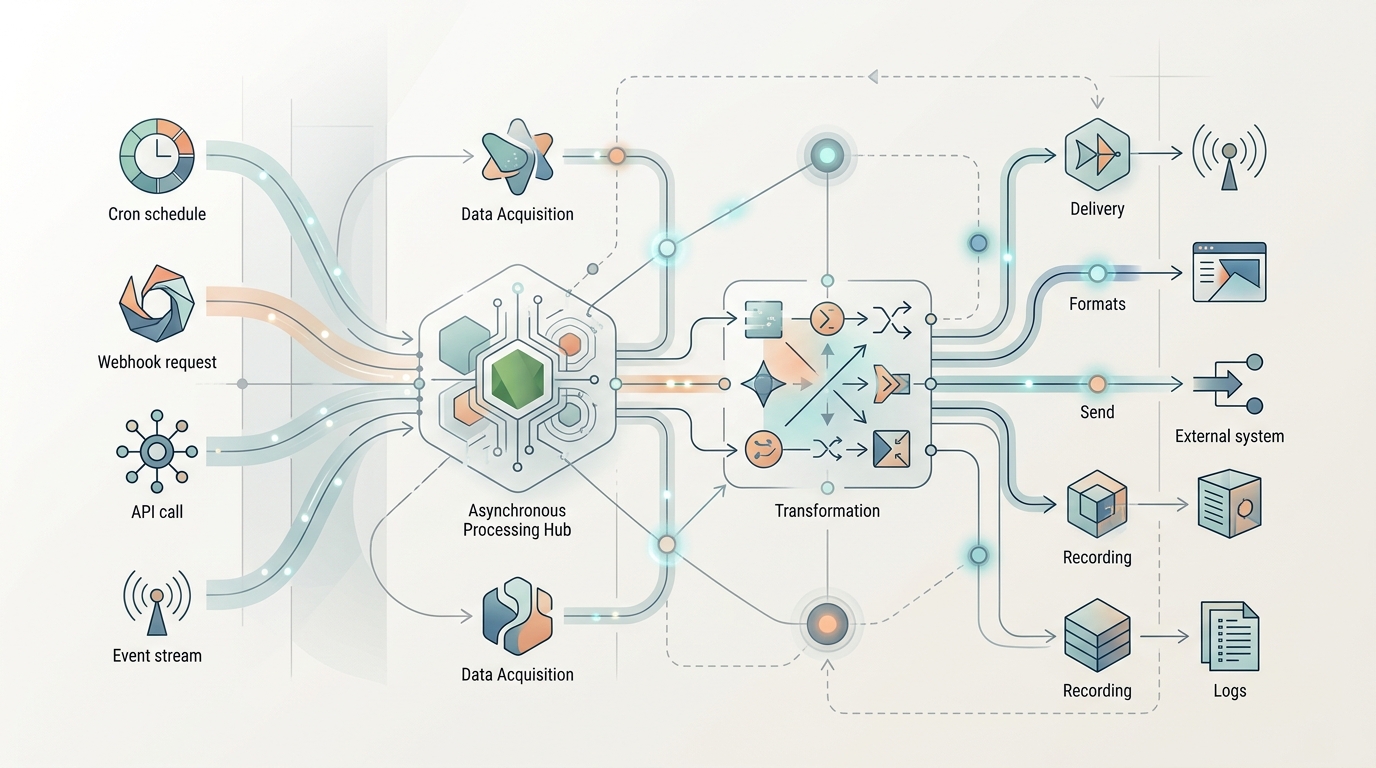
A high-level architecture for a robust Node.js asynchronous automation workflow.
What Are the Best Practices for Node.js Automation Workflows in 2026?
Whether you’re writing a one-file nodejs automation script 2026 style or a multi-worker pipeline, the same principles separate durable automation from fragile scripts:
-
Design for failure, not for the happy path. Networks flake, APIs rate-limit, credentials expire, and disks fill. Every external interaction needs a timeout, an error path, and a decision about retry vs. abort.
-
Make every task idempotent. If a task can run twice without causing harm — duplicate emails, double-charged invoices, re-processed files — then retries, restarts, and at-least-once delivery all become safe. Idempotency is the single highest-leverage property in automation design.
-
Persist state outside the process. In-memory state dies with the process. Last-run timestamps, processed-item ledgers, and queue contents belong in a database, Redis, or at minimum durable files.
-
Separate triggers from work. Cron ticks, webhooks, and manual runs should all invoke the same well-tested task function. Thin triggers, fat (but testable) tasks.
-
Log structurally, alert on absence. JSON-structured logs make runs queryable; heartbeat monitoring catches the deadliest failure mode — the workflow that silently stopped running entirely.
-
Configure via environment, fail fast on misconfiguration. Validate all required environment variables at startup and crash immediately with a clear message rather than failing mysteriously mid-run.
-
Keep secrets out of code. API keys and credentials live in environment variables or a secrets manager, never in the repository. (secrets manager)
-
Prefer boring technology. A Postgres-backed job table and a
setTimeoutloop, done correctly, outlast a clever distributed system done hastily.
How to Build an Asynchronous Automation Workflow in Node.js
Most automation workflows decompose into the same five stages:
Trigger → Acquire → Transform → Deliver → Record
- Trigger: a schedule, a webhook, a queue message, or a manual invocation.
- Acquire: fetch the inputs — scrape a page, call an API, read files.
- Transform: parse, validate, enrich, summarize.
- Deliver: send the email, write to the database, call the downstream API.
- Record: persist what happened — success, failure, duration, and outputs.
Modeling your workflow explicitly in these stages pays off immediately: each stage can be retried independently, tested in isolation, and observed separately.
Managing Async Tasks and Promises Effectively
Async control flow is where most Node.js automation bugs live. The patterns that matter:
Sequential vs. parallel — choose deliberately.
// Sequential: when order matters or the target can't handle concurrency
for (const item of items) {
  await processItem(item);
}

// Parallel: independent work, all-or-nothing
await Promise.all(items.map(processItem));

// Parallel with individual failure tolerance
const results = await Promise.allSettled(items.map(processItem));
const failed = results.filter((r) => r.status === 'rejected');
Bound your concurrency. Unbounded Promise.all over 5,000 items will exhaust connections, memory, or downstream rate limits. Use a limiter:
const pLimit = require('p-limit');
const limit = pLimit(5); // at most 5 concurrent

const results = await Promise.allSettled(
  items.map((item) => limit(() => processItem(item)))
);
Timeout everything external. A hung request should fail loudly, not stall the workflow forever:
async function withTimeout(promise, ms, label) {
  let timer;
  const timeout = new Promise((_, reject) => {
    timer = setTimeout(() => reject(new Error(`${label} timed out after ${ms}ms`)), ms);
  });
  try {
    return await Promise.race([promise, timeout]);
  } finally {
    clearTimeout(timer);
  }
}
Retry with exponential backoff and jitter for transient failures — and classify errors first, because retrying a 401 Unauthorized forever helps no one:
async function retry(fn, { attempts = 4, baseMs = 1000 } = {}) {
  for (let i = 0; i < attempts; i++) {
    try {
      return await fn();
    } catch (err) {
      if (!isTransient(err) || i === attempts - 1) throw err;
      const delay = baseMs * 2 ** i + Math.random() * 300;
      await new Promise((r) => setTimeout(r, delay));
    }
  }
}
Never leave a rejection unhandled. Register process-level guards so nothing fails invisibly:
process.on('unhandledRejection', (err) => {
  logger.fatal({ event: 'unhandledRejection', err });
  process.exit(1); // let the supervisor restart cleanly
});
Essential Components of a Node.js Automation Script
Every dependable automation script — from a 100-line utility to a full pipeline — needs the same components:
- Configuration loader with validation. Read environment variables once at startup, validate presence and shape, and export a frozen config object.
- Structured logger. A JSON logger (e.g.,
pino) with run IDs, so every log line from a given run is correlatable. - HTTP/API client wrapper. Centralize timeouts, retries, and auth headers in one module rather than sprinkling
fetchcalls everywhere. - Task runner envelope. A standard wrapper that logs start/end, measures duration, catches errors, and reports outcomes — every task runs inside it.
- State store. Wherever last-run timestamps, processed IDs, and job statuses live. A single small table often suffices.
- Alerting hook. One function —
notify(message, severity)— wired to email, Slack, or your paging tool, called from every failure path. - Graceful shutdown. Handle
SIGTERM/SIGINT: stop accepting new work, finish or checkpoint in-flight tasks, close connections, exit.
async function runTask(name, fn) {
  const runId = crypto.randomUUID();
  const started = Date.now();
  logger.info({ runId, task: name, event: 'start' });
  try {
    const result = await fn({ runId });
    logger.info({ runId, task: name, event: 'success', ms: Date.now() - started });
    return result;
  } catch (err) {
    logger.error({ runId, task: name, event: 'failure', err: err.message });
    await notify(`Task ${name} failed (run ${runId}): ${err.message}`, 'high');
    throw err;
  }
}
Creating a Reliable Node.js Automation Boilerplate
A consistent project structure means every new automation starts at 80% done. A proven nodejs automation boilerplate 2026 layout:
automation-project/
├── src/
│   ├── config/
│   │   └── index.js          # env loading + validation, frozen config
│   ├── lib/
│   │   ├── logger.js         # structured logger factory
│   │   ├── http.js           # fetch wrapper: timeout, retry, auth
│   │   ├── notify.js         # alerting (Slack/email) hook
│   │   └── store.js          # state persistence (DB/Redis/file)
│   ├── tasks/
│   │   ├── sync-report.js    # one file per task, pure & testable
│   │   └── ingest-files.js
│   ├── triggers/
│   │   ├── schedule.js       # cron definitions → task invocations
│   │   └── webhook.js        # Express listener → task invocations
│   ├── runner.js             # runTask envelope: logging, timing, alerts
│   └── index.js              # entry point: config check, wire triggers
├── test/
├── .env.example              # documented required variables
├── Dockerfile
└── package.json
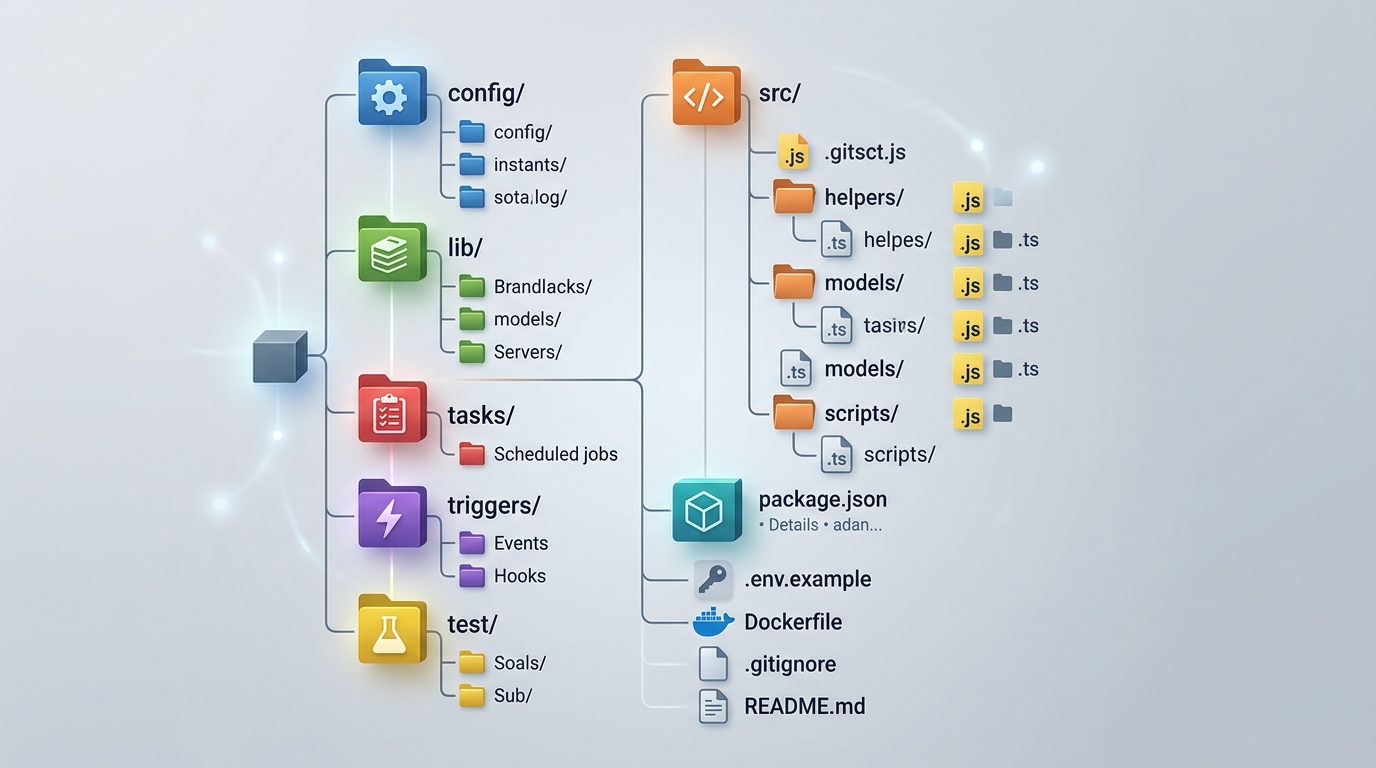
A recommended directory structure for a reliable Node.js automation boilerplate project.
Conventions that make this structure work:
- Tasks are pure and trigger-agnostic. A task in
tasks/takes inputs and a context object; it doesn’t know whether cron or a webhook invoked it. This makes tasks directly testable and manually runnable (node src/index.js --task=sync-report). - Triggers contain no business logic. They validate the trigger event, then call the task through the runner envelope. Nothing else.
- Everything external goes through
lib/. One HTTP wrapper, one store, one notifier — so cross-cutting policies (timeouts, retries, logging) are changed in exactly one place. .env.exampledocuments every variable and startup fails fast if any are missing.- Ship a Dockerfile from day one. Automation that only runs on one developer’s machine is a liability; containerizing early forces dependency honesty.
Modern Node.js also gives you more built-in tooling than ever — native fetch, node:test for testing, stream/promises for safe piping, and native .env file support in recent releases — meaning a lean boilerplate needs fewer dependencies than it did a few years ago.
Integrating APIs and Background Jobs
Real workflows are compositions. Here’s how the building blocks connect — and where to go deeper on each:
Scheduled jobs are your workflow heartbeat. Almost every pipeline has recurring components: nightly syncs, hourly checks, weekly digests. Getting scheduling right — no drift, no overlaps, explicit missed-run policies, and heartbeat monitoring — is foundational, and it’s covered in depth in our guide to reliable Node.js cron jobs.
Event-driven inputs arrive as webhooks. When external systems push data — file uploads, payment events, form submissions — your workflow’s entry point is a hardened HTTP listener that persists first and processes later. Our tutorial on how to handle webhook files walks through the acknowledge-then-process architecture that prevents silently dropped payloads.
Some data has no API. For metrics locked inside browser-rendered internal tools, headless scraping is the pragmatic bridge. See the full walkthrough of dashboard scraping and email reporting for authenticating with Puppeteer, extracting data, and delivering formatted email summaries.
AI turns raw data into decisions. Increasingly, automation pipelines include an LLM stage — summarizing scraped metrics, classifying documents, or extracting structured data from messy text. Our guide on how to integrate the Claude API covers secure authentication, structured outputs, and the rate-limit handling these pipelines need.
Queues decouple the stages. For anything beyond trivial volume, put a persistent queue between acquisition and processing:
Webhook/Cron → enqueue(job) → [persistent queue] → worker pool → deliver → record
Benefits of queue-centric design:
- Backpressure: bursts of incoming work buffer safely instead of overwhelming workers.
- Retry semantics: failed jobs requeue with backoff; permanently failed jobs land in a visible dead-letter state instead of vanishing.
- Horizontal scaling: add workers without touching triggers.
- Observability: queue depth is a single, honest metric of pipeline health.
For a single-instance internal tool, a simple database-table queue (rows with status, attempts, run_after) is entirely adequate. Redis-backed queue libraries earn their complexity when you need throughput, delayed jobs, and multi-worker coordination at scale.
A composed example. A realistic 2026 internal automation might look like: a cron trigger fires each morning → a Puppeteer task scrapes three internal dashboards → results are enqueued → a worker calls the Claude API to generate a natural-language summary → the report is emailed to stakeholders → the run is recorded, and a heartbeat ping confirms completion. Every stage is idempotent, retried on transient failure, logged with a shared run ID, and alerting fires if the heartbeat goes missing. That’s the whole discipline in one pipeline.
FAQ
What is an async automation workflow in Node.js?
It’s a pipeline of asynchronous tasks — triggered by schedules, webhooks, or queues — that acquires data, transforms it, delivers results, and records outcomes without manual intervention. Node.js’s non-blocking model makes it well suited to these I/O-heavy workloads.
Is Node.js good for automation in 2026?
Yes. Its async-first runtime, mature ecosystem (schedulers, queues, headless browsers, email, AI SDKs), native tooling like built-in fetch and node:test, and low resource footprint make it one of the most practical choices for internal automation and integration work.
How do I handle errors in a Node.js automation workflow?
Classify errors as transient or permanent, retry transient ones with exponential backoff and jitter, cap attempts, and route permanent failures to a visible dead-letter state with alerting. Wrap every task in a standard envelope that logs start, outcome, and duration, and register unhandledRejection handlers so nothing fails invisibly.
Should I use a job queue or cron for Node.js automation?
Use both for what they’re good at: cron for time-based triggers, queues for decoupling work from triggers, absorbing bursts, and managing retries. A common pattern is cron enqueuing jobs that workers process — triggers stay thin, and the queue provides the reliability semantics.
What should a Node.js automation boilerplate include?
Validated environment configuration, a structured logger, a centralized HTTP wrapper with timeouts and retries, a task-runner envelope with logging and alerting, a state store, graceful shutdown handling, a documented .env.example, and a Dockerfile. Tasks should be pure and separated from their triggers so they’re testable and reusable.
How many concurrent async tasks should a Node.js script run?
Bound concurrency explicitly rather than firing unbounded Promise.all calls — a limiter set between roughly 3 and 10 concurrent operations is a sensible starting point for most API and scraping workloads, then tune based on downstream rate limits, memory, and observed error rates.