
How to Deploy a HIPAA Compliant LLM for Healthcare Operations
Healthcare organizations in 2026 are under intense pressure to modernize operations through artificial intelligence while maintaining non-negotiable standards for patient privacy and regulatory compliance. Large Language Models (LLMs) offer unprecedented capabilities for automating clinical documentation, summarizing patient charts, accelerating administrative workflows, and facilitating complex medical information retrieval. However, traditional public cloud-based AI tools pose severe regulatory and security risks under the Health Insurance Portability and Accountability Act (HIPAA).
Deploying a HIPAA compliant LLM requires moving away from multi-tenant cloud APIs and transitioning toward localized, privacy-first architectures. By hosting generative models within private, air-gapped, or strictly controlled on-premise environments, healthcare providers can harness state-of-the-art AI without exposing Protected Health Information (PHI) to third-party subprocessors.
This comprehensive guide examines what actually constitutes a HIPAA compliant LLM, why traditional cloud architectures fall short, the technical requirements for local deployment, and practical evaluation criteria for hospital IT leaders and clinical leaders.
What is a HIPAA Compliant LLM?
A HIPAA compliant LLM is not simply a foundational model that has signed a legal contract; it is an entire artificial intelligence system—comprising model weights, inference software, database layers, networking, and access interfaces—designed and configured to adhere strictly to the HIPAA Privacy, Security, and Breach Notification Rules.
Under HIPAA, any electronic system that creates, receives, maintains, or transmits Electronic Protected Health Information (ePHI) must incorporate administrative, physical, and technical safeguards. For a Large Language Model to meet these rigorous standards, it must ensure the following baseline conditions:
- Zero External Data Retention & Exposure: Patient prompts and model responses containing ePHI must never be cached, logged, or retained on external servers or used by third parties to fine-tune foundational models.
- End-to-End Encryption: ePHI must be encrypted both in transit (using TLS 1.3 or equivalent protocols) and at rest (using AES-256 standards) across all storage volumes, vector databases, and memory buffers.
- Role-Based Access Controls (RBAC): Access to the LLM interface and underlying endpoints must be restricted based on the principle of least privilege, integrated with enterprise identity providers (e.g., SAML 2.0, Active Directory, OAuth 2.0).
- Comprehensive Audit Logging: Every interaction with the model—including user identity, timestamps, query metadata, and response hashes—must be logged in an immutable, centralized audit trail for compliance monitoring and forensic analysis.
- Business Associate Agreement (BAA): If any third-party infrastructure, cloud vendor, or managed service vendor touches ePHI in conjunction with the model, a legally binding BAA must be in place.
When deployed locally within an organization’s existing secure perimeter, open-weight foundational models (such as Llama 3, Mistral, or specialized clinical models) transform into inherently compliant solutions by keeping all data processing completely within the covered entity’s direct administrative control.
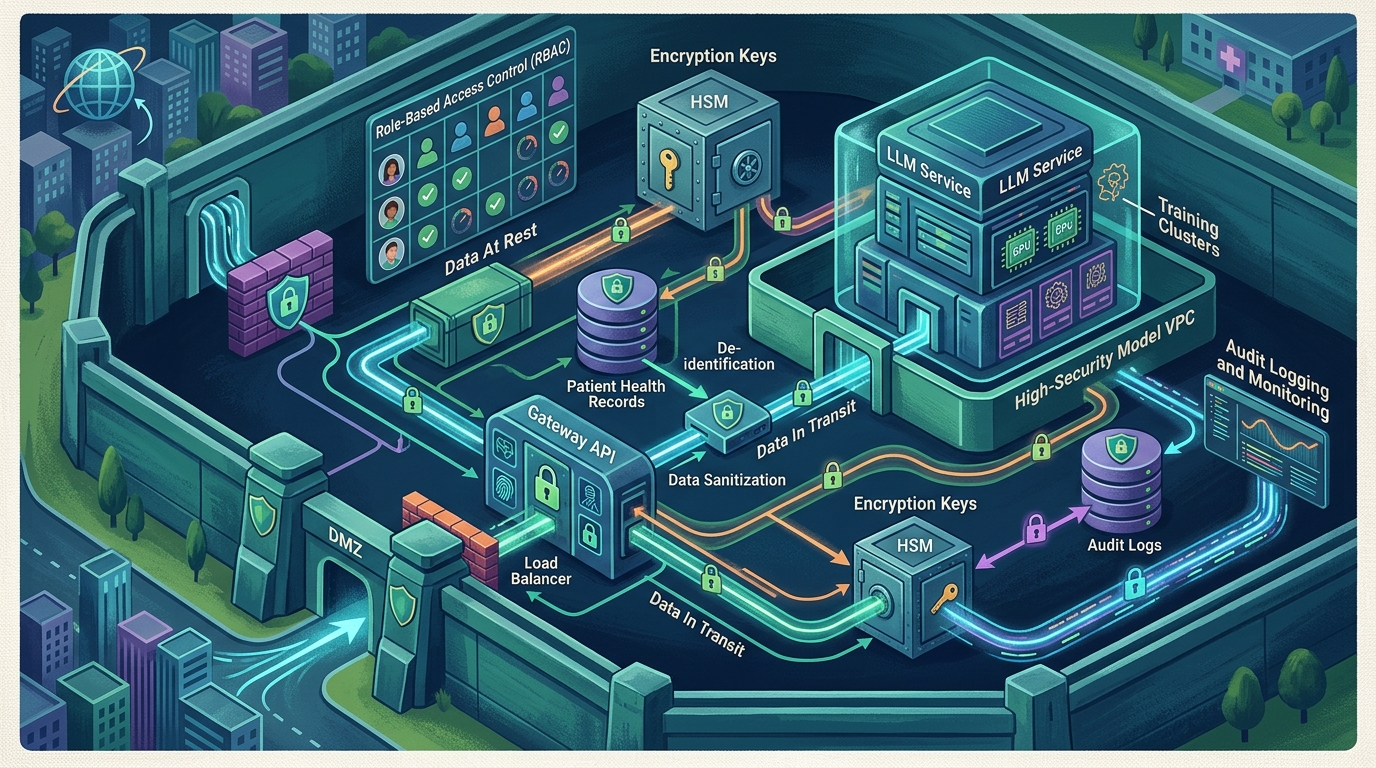
An architectural overview of a HIPAA compliant LLM system, emphasizing local data processing and security safeguards.
Why Cloud LLMs Struggle with Healthcare Data Privacy
The public cloud paradigm that fueled the generative AI boom presents fundamental conflicts with healthcare data privacy laws. Standard public LLM APIs operated by major commercial vendors present significant operational and legal risks for covered entities and business associates:
1. Multi-Tenant Vulnerabilities and Data Leakage
Public cloud AI endpoints operate on shared multi-tenant infrastructure. While logical isolation is maintained through software controls, shared GPU resources, caching layers, and central prompt processing engines carry inherent risks of cross-tenant data leaks, side-channel attacks, or misconfigured storage buckets.
2. Model Training and Unintentional Retention
By default, consumer-facing cloud AI services often utilize input prompts and generated responses to retrain, evaluate, or refine future model iterations. Even when enterprise tiers offer “no training” guarantees, third-party sub-processors or human review teams (employed for content moderation and model alignment) may still access unencrypted prompt logs containing ePHI.
3. Supply Chain Complexity & Missing BAAs
Deploying cloud LLM solutions often involves a chain of subprocessors—model hosting providers, vector database hosts, API gateways, and monitoring services. Achieving full compliance requires executed Business Associate Agreements with every link in that software supply chain. If a single third-party component lacks a BAA, the entire deployment violates HIPAA rules.
4. Loss of Data Sovereignty
When a clinician inputs a patient summary into a public cloud API, that data leaves the health system’s firewall, traverses the public internet, and resides temporarily in remote RAM and cache storage across variable geographical regions. This loss of physical and network control makes enforcing organizational data governance policies virtually impossible.
Because of these persistent challenges, healthcare systems are increasingly turning to running an LLM on-premise to establish complete control over their medical data ecosystem.
Top Features of HIPAA-Ready AI Models & Local Solutions
To safely implement HIPAA local AI solutions, healthcare IT teams must evaluate both hardware and software feature sets. A true HIPAA-ready AI model solution combines robust open-weight weights with enterprise-grade infrastructure containment.
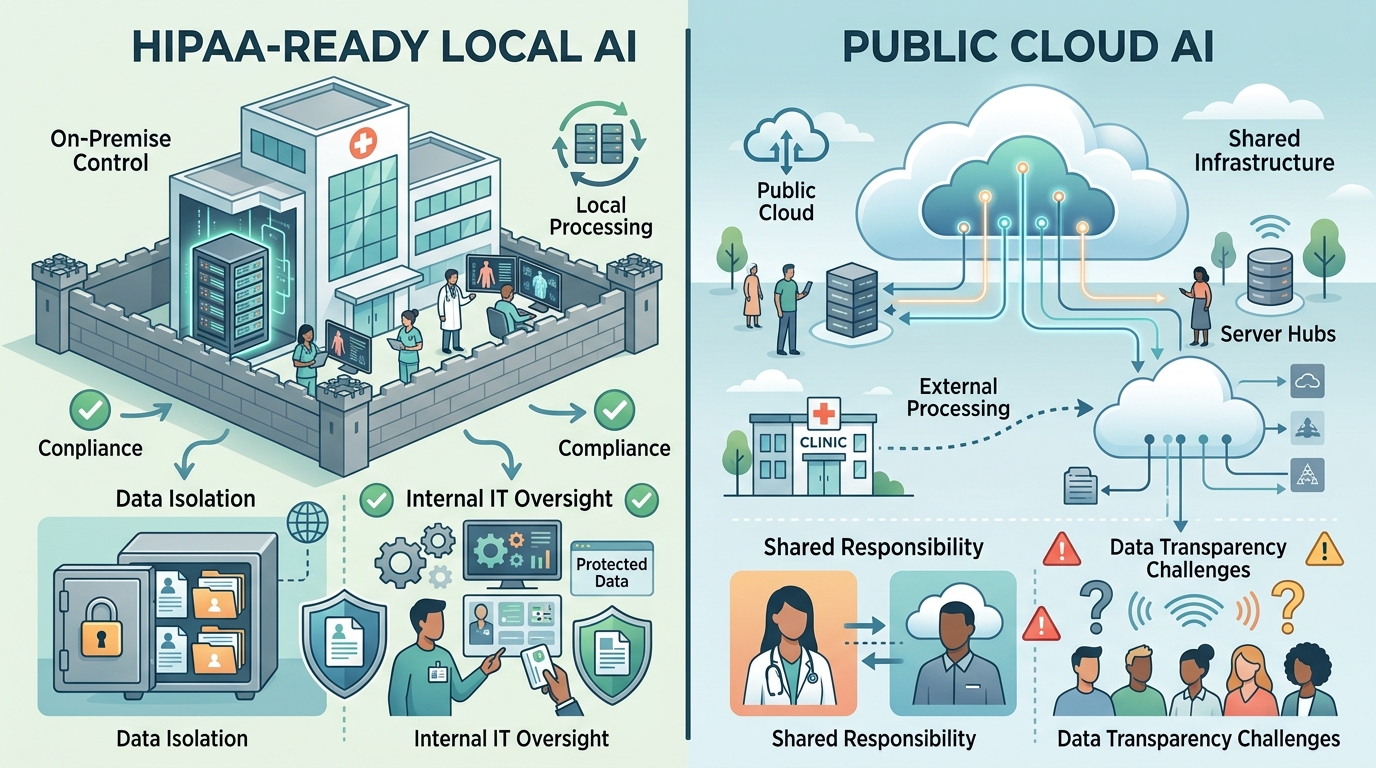
Key distinctions between local, HIPAA-ready AI models and public cloud AI solutions, focusing on data privacy and control.
On-Premise Infrastructure Needs
Deploying HIPAA-ready AI models locally requires careful hardware sizing and infrastructure design to ensure high performance and zero external dependencies:
- Dedicated GPU Hardware: Local LLM inference relies on dedicated enterprise GPUs (such as NVIDIA H100, A100, L40S, or RTX 6000 Ada series) equipped with sufficient High Bandwidth Memory (HBM) to host full model parameters directly in VRAM. (NVIDIA H100, A100, L40S, or RTX 6000 Ada series)
- Air-Gapped or Firewalled Clusters: Compute nodes should reside within localized VLANs isolated from public internet ingress and egress, ensuring that model calls cannot route outside the intranet under any operational condition.
- Encrypted Local Storage: High-speed NVMe arrays storing model weights, vector databases for Retrieval-Augmented Generation (RAG), and local log repositories must be encrypted using enterprise Key Management Services (KMS).
Data Isolation vs. External API Calls
The defining engineering distinction between local HIPAA compliant AI tools and cloud solutions lies in network topology and data path isolation:
- External API Calls: Input data is serialized, sent over public networks, processed in shared vendor clouds, and returned. Compliance relies entirely on external vendor contracts, third-party attestations, and distant operational security.
- Data Isolation (Local AI): Input data never leaves the local network interface. The LLM runs as a local containerized service (e.g., via Docker, Kubernetes, or specialized inference servers like vLLM or Ollama Enterprise) inside the hospital’s private data center or private cloud instance. Data transmission occurs over internal virtual networks behind physical firewalls.
By prioritizing strict data isolation, healthcare organizations maintain total data governance while drastically reducing regulatory exposure.
What are the best local LLMs for hospitals and clinics?
Selecting the optimal base model for clinical and operational workloads involves balancing model parameters, context window sizes, task-specific accuracy, and hardware footprints. As of 2026, several leading open-weight model families serve as excellent foundations for local healthcare deployment:
1. Llama 3 Series (Meta)
The open-weight Llama 3 ecosystem (including 8B, 70B, and larger parameter variants) is widely regarded as an enterprise benchmark. Llama 3 models excel at general language understanding, structured output generation (JSON/XML), clinical note summarization, and complex reasoning when integrated with RAG architectures.
2. Mistral / Mixtral Series (Mistral AI)
Mistral’s open models, particularly Mixtral Mixture-of-Experts (MoE) architectures, provide exceptionally high inference speed and resource efficiency. They are ideal for real-time clinical assistant tools where low latency is critical, allowing clinics to achieve high throughput on moderate GPU infrastructure.
3. Open Clinical & Fine-Tuned Models (Med-PaLM alignment concepts, BioMistral)
Specialized open-weight models fine-tuned on medical domain literature, PubMed databases, and anonymized medical records offer enhanced understanding of medical terminology, ICD-10 coding, and clinical reasoning, minimizing hallucinations in specialized healthcare contexts.
Note: Selecting model weights is only step one. Ensuring full compliance depends entirely on the deployment wrapper, environment security, and healthcare AI data security protocols surrounding the inference engine.
How to Evaluate HIPAA Compliant AI Tools for Your Clinic
When evaluating commercial or open-source HIPAA compliant AI tools, healthcare IT evaluation committees should utilize a rigorous multi-point framework before approval:
| Evaluation Criteria | Key Verification Questions | Compliance Requirement |
|---|---|---|
| Data Processing Location | Where does model inference occur? Are any inputs sent externally? | Must process 100% locally or inside dedicated private VPC. |
| Business Associate Agreement | Is the vendor willing to sign a formal BAA covering all components? | Mandatory if any vendor managed service touches ePHI. |
| Access Control Capabilities | Does the tool support SAML/SSO, Role-Based Access, and MFA integration? | Mandatory under HIPAA Security Rule (45 CFR § 164.312). |
| Audit Logging & Telemetry | Are full interaction logs captured, encrypted, and exportable to SIEM? | Mandatory for compliance audits and incident monitoring. |
| Model Transparency & Control | Can the organization inspect, swap, or fine-tune model weights internally? | Essential for long-term governance and risk management. |
| Regulatory Alignment | Does the deployment model follow clear HIPAA guidelines for local AI? | Required for risk mitigation and organizational sign-off. |
Frequently Asked Questions (FAQ)
Can an open-source LLM be HIPAA compliant?
Yes. Open-source or open-weight models themselves are software code and mathematical parameters. When hosted within a secure, encrypted, and access-controlled local infrastructure that complies with HIPAA Security Rule requirements, the overall deployment becomes fully HIPAA compliant.
Do we need a Business Associate Agreement (BAA) for a self-hosted local LLM?
If your organization owns and operates the local infrastructure entirely in-house without third-party vendor access, a BAA is not required because no third party is processing your ePHI. However, if you use a third-party managed service provider or local hardware contractor who has access to the systems, a BAA is required.
How do local LLMs prevent medical record hallucinations?
Local LLMs are typically paired with Retrieval-Augmented Generation (RAG) systems connected to internal, validated clinical databases and Electronic Health Record (EHR) repositories. By constraining model responses strictly to retrieved source documents, organizations minimize hallucinations while maintaining data privacy.
Conclusion: Taking the First Step Toward Secure AI
Integrating artificial intelligence into healthcare workflows no longer requires compromising patient privacy or taking on unmanageable legal liabilities. Local LLMs offer a proven pathway for hospitals and medical clinics to leverage cutting-edge generative AI capabilities while maintaining total control over electronic Protected Health Information.
By selecting robust open-weight models, deploying them on dedicated local compute infrastructure, enforcing strict role-based access, and implementing full audit telemetry, your organization can lead the transition into privacy-first healthcare AI. To build an implementation roadmap tailored to your technical ecosystem, explore our step-by-step technical guides on local deployment and security frameworks.