
Automating Real Estate Lead Generation and CRM Workflows with Python
In competitive real estate markets, lead generation velocity and immediate client engagement determine market share. High-producing agents and growth-focused brokerages invest heavily in marketing across digital advertising, social media campaigns, and web landing pages. However, acquiring leads is only half the battle. If inquiries sit unaddressed in an inbox for hours, lead conversion rates drop precipitously.
Implementing real estate lead generation python workflows allows real estate businesses to capture, qualify, route, and engage leads in real time. By connecting acquisition channels directly to Customer Relationship Management (CRM) platforms, email dispatchers, and SMS engines, Python automation ensures that every prospective buyer and seller receives immediate, personalized attention.
In this strategy guide, we examine how to use Python scripts and API integrations to automate client acquisition and build automated marketing pipelines.
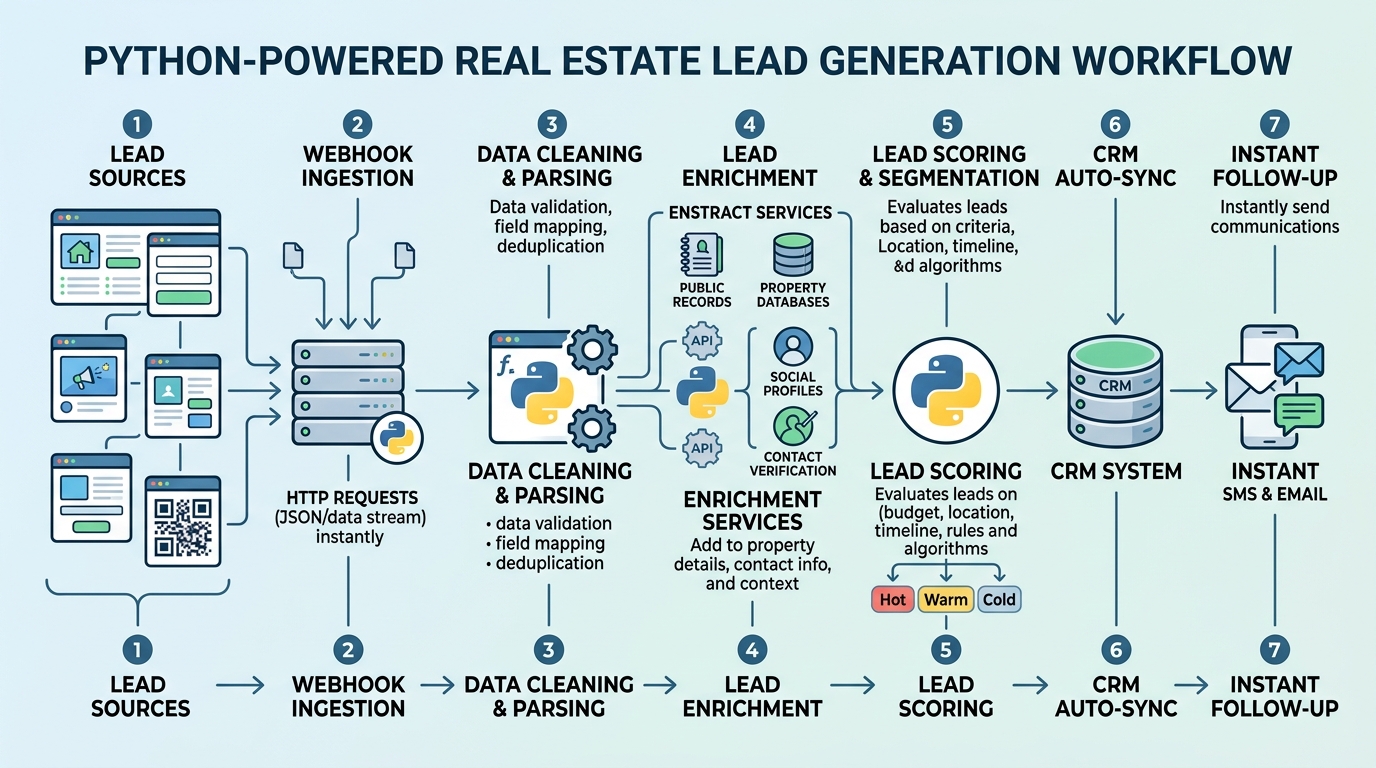
An automated Python workflow streamlines real estate lead generation, from initial capture to CRM integration and instant client engagement.
How to Automate Real Estate Lead Generation Workflows with Python
Traditional lead generation workflows frequently suffer from operational fragmentation. Leads arrive from multiple channels—including Facebook Lead Ads, Google Search campaigns, portal forms, and website landing pages—and are often compiled into separate CSV files or email inboxes before being manually re-entered into a central database.
Python automation unifies this process into an integrated, real-time lead capture engine.
[Lead Sources: Ads / Portal / Form] ──► [Python Webhook / API Listener] ──► [Lead Enrichment] ──► [CRM Auto-Sync] ──► [Instant SMS / Email]
Core Components of an Automated Python Lead Pipeline
- Webhook Ingestion: A lightweight Python web service (built using micro-frameworks like
FastAPIorFlask) listens for incoming webhooks dispatched whenever a prospect submits a contact form. - Data Cleaning & Normalization: The script cleans phone numbers, standardizes email addresses, capitalizes names properly, and formats location preferences.
- Lead Enrichment: Before creating a CRM contact record, the Python script can cross-reference public property tax records to identify whether the prospect currently owns a property in the area, automatically flagging potential listing leads.
- Instant Distribution & Alerting: The enriched lead is pushed directly to your CRM, and an instant SMS or Slack notification is routed to the on-duty agent, ensuring response times remain under two minutes.
Automating lead capture eliminates response delays and provides the foundation to scale your real estate business efficiently.
How Does Python Integrate with a Real Estate CRM System?
A CRM system serves as the operational hub for any real estate sales team. However, CRMs often become stale when agents are required to enter contact notes, pipeline stages, and communication histories manually.
Leveraging python CRM integration real estate techniques turns your CRM into an active engine that processes data automatically across your software stack.
API Connections and Data Syncing
Most enterprise real estate CRMs (such as Follow Up Boss, Salesforce, HubSpot, KvCORE, and LionDesk) offer RESTful APIs. Python’s requests library allows developers to authenticate, query, update, and manage contact records programmatically.
Conceptual Python Example: Pushing Enriched Lead Data to a CRM API
import requests
import json

def push_lead_to_crm(api_key, lead_data):
    # API endpoint configuration for CRM contact creation
    endpoint = "https://api.example-crm.com/v1/contacts"

    headers = {
        "Authorization": f"Bearer {api_key}",
        "Content-Type": "application/json"
    }

    # Payload structured according to CRM API schema
    payload = {
        "firstName": lead_data.get("first_name"),
        "lastName": lead_data.get("last_name"),
        "email": lead_data.get("email"),
        "phone": lead_data.get("phone"),
        "source": lead_data.get("source", "Python Lead Pipeline"),
        "tags": ["Buyer Lead", "Automated Import"],
        "customFields": {
            "Target Zip Code": lead_data.get("zip_code"),
            "Estimated Budget": lead_data.get("budget")
        }
    }

    response = requests.post(endpoint, headers=headers, data=json.dumps(payload))

    if response.status_code == 201:
        print("Lead successfully created in CRM!")
        return response.json().get("id")
    else:
        print(f"Failed to sync lead. Status code: {response.status_code}")
        return None

# Sample execution with sanitized inputs
sample_lead = {
    "first_name": "Marcus",
    "last_name": "Vance",
    "email": "marcus.vance@example.com",
    "phone": "+15550192834",
    "zip_code": "90210",
    "budget": 1250000
}

# push_lead_to_crm("YOUR_API_KEY_HERE", sample_lead)
Syncing communication records automatically across platforms helps agencies streamline property management tasks and maintain complete buyer and seller histories.
What is the Most Efficient Way to Automate Client Emails in Real Estate?
Generic email blasts yield declining engagement. Modern buyers and sellers expect timely, hyper-relevant information tailored to their specific market segment and transaction stage.
Implementing real estate email automation python workflows allows marketing teams to replace static broadcast newsletters with dynamic, event-triggered communication sequences.

Python integration enables dynamic, event-triggered email sequences for real estate, moving beyond generic broadcasts to personalized client communication.
Comparing Generic Broadcasts vs. Python Dynamic Sequences
| Feature / Capability | Standard Generic Broadcasts | Python Dynamic Email Sequences |
|---|---|---|
| Trigger Mechanism | Manual send dates chosen by staff | Real-time events (e.g., price drop on favorited home, inquiry submission) |
| Personalization Level | Basic tags (First Name merge tags) |
Deeply custom (auto-attaching hyper-local sales data, active listing links) |
| Data Integration | Static subscriber list | Real-time database queries matching exact lead criteria |
| Delivery Optimization | Bulk dispatches subject to spam filters | Programmatic throttling via direct transactional email APIs (SendGrid/Mailgun) |
Using Python libraries like smtplib or integrating transactional email APIs (such as SendGrid, AWS SES, or Postmark), marketers can send personalized emails containing newly matched listings, recent neighborhood sold comps, and updated home valuation estimates based on each client’s stored search parameters.
Automate Client Communication and Marketing Pipelines
Beyond initial lead capture and transactional email delivery, full-funnel automation requires maintaining long-term engagement across your client database. Real estate decision cycles often range from 3 to 12 months; staying top-of-mind without manual effort is critical.
To automate real estate marketing python infrastructure, top-producing teams implement three core communication pipelines:
1. Behavior-Driven Drip Campaigns
When a prospective buyer views a property listing multiple times or requests showing details on your site, a Python background monitor detects the activity, updates the client’s record in your CRM, and triggers a personalized follow-up message from the assigned agent.
2. Automated Past-Client Anniversary Touchpoints
Client retention depends on consistent long-term engagement. Python scripts running daily checks against transaction historical records can automatically trigger customized home anniversary emails, annual equity statements, and birthday greetings without agent intervention.
3. Hyper-Local Market Digest Automation
Instead of manually compiling neighborhood market reports each month, Python scripts can query public transaction databases, compute median pricing updates, populate standardized email templates, and dispatch hyper-local market digests to clients based on their specific zip codes.
These sophisticated communication workflows represent key tools tailored for top-producing brokers seeking to increase marketing ROI while maintaining personalized client relationships.
Take Your Real Estate Lead Gen to the Next Level
Transitioning to automated lead generation and CRM management requires a clear execution plan:
- Audit Current Lead Sources: Document every entry point where prospective client inquiries enter your business (e.g., website forms, lead platforms, social media campaigns).
- Standardize API Connectors: Ensure your primary CRM platform provides active API access or webhook endpoints to accept incoming data payloads.
- Deploy Webhook Listeners: Build and host lightweight Python scripts on cloud infrastructure to process incoming leads instantly.
- Implement Multi-Channel Follow-Up: Combine instant email dispatchers with SMS gateway integrations to deliver immediate, multi-channel responses to every lead.
- Analyze Conversion Metrics: Track time-to-first-touch, email open rates, and appointment conversion rates to continually refine lead messaging and automated schedules.
Frequently Asked Questions (FAQ)
How fast can Python route incoming web leads to agents?
Python webhook listeners process and route lead data almost instantaneously—typically in less than two seconds from form submission. The script receives the payload, enriches the data, updates the CRM, and dispatches SMS alerts instantly.
Do I need specialized software to integrate Python with my CRM?
No. Standard Python installation along with popular HTTP libraries like requests or httpx is all that is required to communicate with any CRM offering a standard REST API.
Is automated client communication compliant with email and SMS privacy laws?
Yes, provided standard regulatory guidelines (such as CAN-SPAM, TCPA, and GDPR) are observed. Your Python scripts should enforce opt-in requirements, provide explicit unsubscribe options, and respect contact time windows for automated text messages.
Can Python automate social media marketing for real estate listings?
Yes. Python can interact with social media APIs (such as Meta Graph API, LinkedIn API, or YouTube API) to auto-post listing announcements, market updates, and video walkthroughs directly from your master listing database on set schedules.