
Preventing Data Exfiltration & Leakage in Local LLMs
As enterprise security teams deploy Large Language Models (LLMs) on internal servers and local workstations, the threat model surrounding data security changes significantly. While running models locally mitigates the risk of sending proprietary data to public cloud vendors, local execution creates new attack vectors that can lead to internal data leakage and unauthorized data exfiltration.
When AI agents and local inference runtimes are integrated into corporate networks, local document stores, and internal databases, malicious prompt injection, compromised model plugins, or misconfigured API endpoints can convert an internal model into a channel for covert data extraction. Implementing comprehensive LLM data leakage prevention strategies is vital for protecting sensitive intellectual property, employee records, and confidential operational data.
This technical guide provides DevOps engineers, system administrators, and security specialists with a framework to prevent data exfiltration from a local LLM, enforce strict isolation boundaries, and maintain system integrity in 2026.
What is Local AI Data Exfiltration?
Local AI data exfiltration occurs when an internal user, autonomous AI agent, or external adversary uses a local language model to extract unauthorized data from secured network segments or internal host storage and transmit it across permission boundaries.
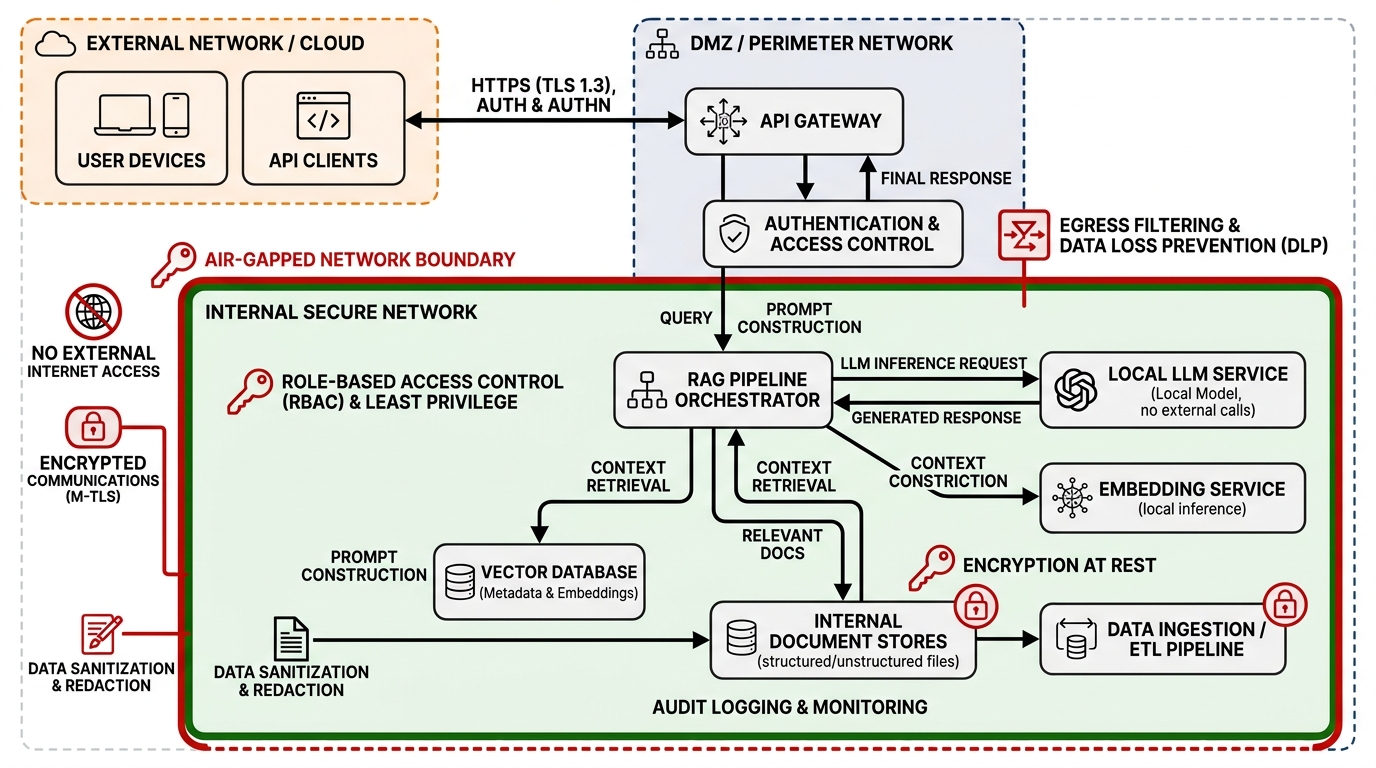
A secure network architecture designed to prevent data leakage from local LLMs by enforcing strict boundaries and monitoring.
Unlike traditional data exfiltration—which often involves direct database dumping or bulk file transfer—AI-driven exfiltration frequently operates via indirect, semantic channels. Common exfiltration mechanisms include:
- Indirect Prompt Injection: An attacker embeds malicious instructions inside an internal document (e.g., a PDF or code repository). When a local LLM or RAG pipeline processes the document, the hidden prompt instructs the model to summarize confidential files and encode the output inside dynamic URLs or external API calls.
- Malicious Plugin or Tool Egress: If a local AI runner supports tool-use functions (such as web browsing, Python code execution, or SQL querying), a compromised model agent can issue HTTP GET/POST requests containing sensitive context payloads to external servers.
- Covert Timing and Side-Channel Attacks: In multi-tenant internal deployments, an unauthorized user can infer sensitive information from another department’s prompt history or context memory by observing token generation latencies or GPU memory usage patterns.
- Unmonitored Local Output File Writes: AI agents configured with file writing privileges can write sensitive system secrets to public local directories or web-server root folders accessible without authentication.
Securing self-hosted AI requires understanding that local inference servers are active compute entities capable of interacting dynamically with system resources.
How to Prevent Data Exfiltration from a Local LLM
Eliminating data leakage risks requires implementing strict technical boundaries at the runtime, network, and application layers. Security engineering teams can effectively prevent data exfiltration from a local LLM by applying multi-layered defense controls.
Implementing Data Access Controls for Local LLMs
Establishing robust data access control for local LLM workflows ensures that models operate strictly under the principle of least privilege:
- Scoped API Token Permissions: Place an API gateway (e.g., LiteLLM Proxy, Envoy, or Kong) in front of model runtimes. Enforce authentication via OAuth2 or scoped bearer tokens tied to user identities.
- Document-Level Access Control (RAG Security): Vector databases (such as Qdrant, Milvus, or Chroma) must mirror host filesystem security groups. When an employee queries a local RAG system, vector retrieval searches must be filtered using metadata security tags matching the requesting user’s active Directory groups.
- Restricting Agent Execution Privileges: If your environment deploys autonomous AI agents, avoid giving agent runtimes raw host execution privileges. When configuring file system tools, refer to our technical guide on how to give an AI agent secure file system access using sandbox container mount points.
Ensuring Local LLM Data Isolation
Achieving true ensure local LLM data isolation requires segmenting the model execution environment away from critical corporate networks and sensitive storage pools:
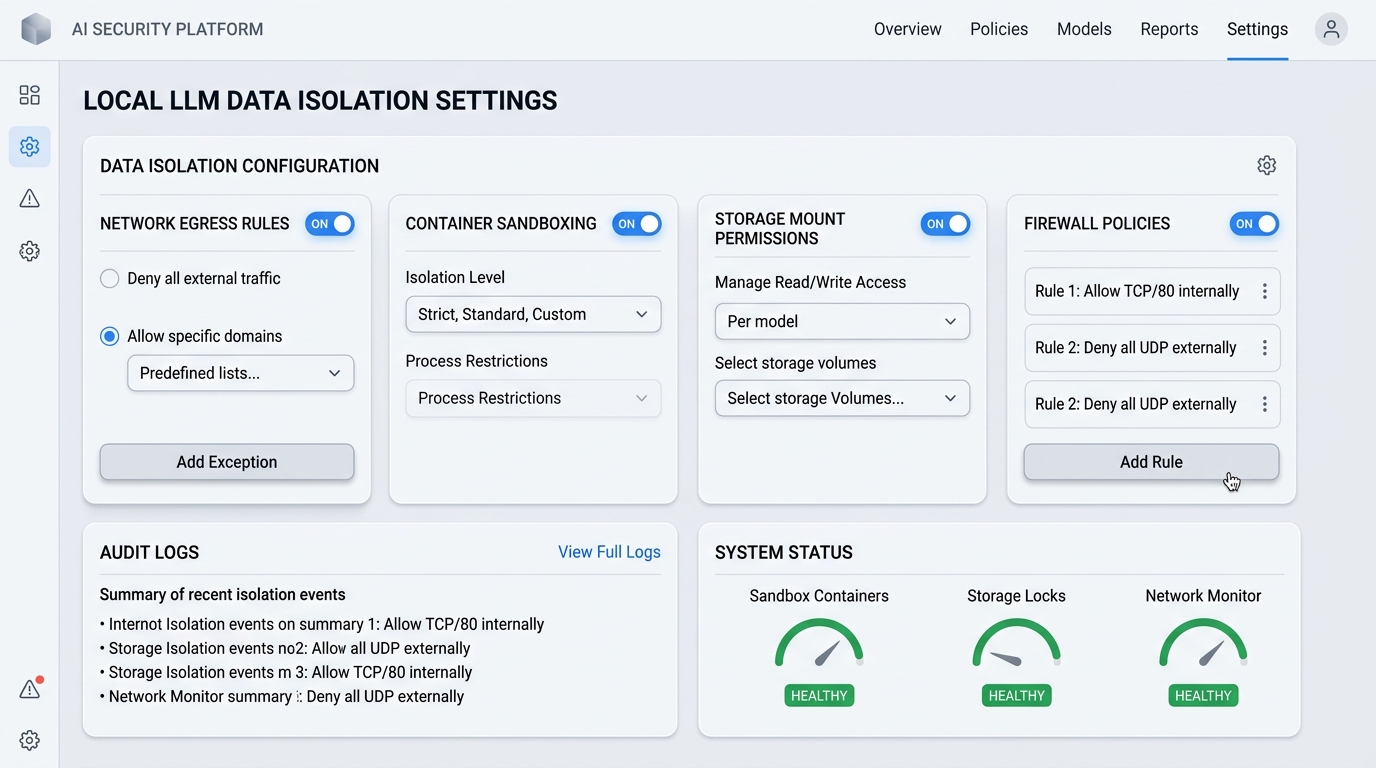
A configuration screen showing settings to ensure local LLM data isolation and prevent exfiltration, highlighting network rules and access controls.
- Air-Gapped Network Topology: For maximum security environments, eliminate internet access entirely. System administrators should configure isolated network interfaces by setting up a full air-gap setup that physically or logically prevents external network egress.
- Host Process Sandboxing: Run model serving binaries (such as vLLM, Ollama, or llama.cpp) inside non-privileged Docker containers or systemd sandboxes (
PrivateTmp=true,ProtectSystem=full,NoNewPrivileges=true). - Storage Mount Restrictions: Mount storage volumes containing source documents as read-only (
ro). Inference processes should never hold write access to root file directories or configuration stores. - Firewall Egress Filtering: For environments requiring partial network access, enforce strict egress rules using
iptablesor cloud security groups. If you are running a local LLM behind a corporate firewall, block all outbound connections originating from the model execution container except explicitly whitelisted internal endpoints.
Maintaining Local AI Data Integrity
Protecting against exfiltration is only half the security challenge; organizations must also maintain local AI data integrity. If input context files or vector embeddings are maliciously tampered with, model outputs become unreliable, leading to compromised decision-making or severe system vulnerabilities.
Key practices for maintaining data integrity include:
- Cryptographic Hash Verification: Periodically verify the SHA-256 hashes of base model weights, tokenizer configs, and system prompt templates to ensure they have not been modified or replaced by unverified third-party binaries.
- Immutable Vector Database Snapshots: Store vector database indexes on read-only snapshots during production runtime to prevent indirect prompt injection attacks from altering stored embeddings.
- Input and Output Sanitization Filters: Implement regex and heuristic middleware to scan both incoming user prompts and outgoing model responses. Automatically block prompts containing known jailbreak signatures, and redact system keys or PII patterns before outputs reach client applications.
Building a Self-Hosted AI Exfiltration Strategy
Security teams should formalize their governance rules into a cohesive, enterprise-wide self-hosted AI exfiltration strategy. Follow this four-stage implementation roadmap:
[ Phase 1: Perimeter Hardening ] ──► [ Phase 2: Access & Identity ]
                                                 │
                                                 ▼
[ Phase 4: Continuous Auditing ] ◄── [ Phase 3: Runtime Isolation ]
Phase 1: Perimeter Hardening & Network Isolation
- Deny all default outbound internet traffic from AI dedicated servers.
- Bind model API ports (
11434,8000,5000) strictly to127.0.0.1or isolated internal VLAN interfaces. - Disable web-browsing plugins and unverified external code execution tools in agent configurations.
Phase 2: Identity & Access Management (IAM)
- Require mutual TLS (mTLS) or OAuth2 authentication for all internal service-to-service calls reaching model inference gateways.
- Implement user-level rate limiting and request size caps to prevent automated data scraping via model APIs.
Phase 3: Runtime Isolation & Environment Sandboxing
- Execute all inference workers inside unprivileged containers without root privileges.
- Apply strict Linux kernel capabilities (
CAP_DROP_ALL) and enforce AppArmor / SELinux security profiles. - Configure ephemeral GPU memory handling to flush context buffers between distinct user sessions.
Phase 4: Continuous Telemetry & Anomaly Detection
- Export API gateway logs, container telemetry, and audit daemon events to a centralized SIEM (Security Information and Event Management) platform.
- Configure automated alert thresholds for abnormal token output volumes, repeated permission denied errors, or unexpected process execution attempts.
Frequently Asked Questions (FAQ)
How can a local LLM leak data if it has no internet access?
Even without direct internet access, a local LLM can leak data internally across permission boundaries. For example, if a low-privilege employee queries a local LLM connected to a shared vector database, the model might retrieve and present confidential executive compensation data or unreleased source code if access controls are not enforced at the vector retrieval layer.
What is indirect prompt injection, and how does it cause data exfiltration?
Indirect prompt injection occurs when a model reads external text (e.g., an email, document, or webpage) containing hidden instructions designed to hijack the model’s behavior. If the model has access to external tools or web search extensions, the injected prompt can command the model to fetch sensitive files and transmit them inside HTTP parameters to an attacker’s server.
How do I prevent local AI agents from executing dangerous terminal commands?
You can prevent unauthorized command execution by confining AI agents inside secure container sandboxes (such as Docker or gVisor) with restricted privileges. Disable raw shell access plugins, implement strict command whitelisting microservices, and require explicit human-in-the-loop (HITL) confirmation for any operation involving file deletion, system modification, or network requests.
Can model weights themselves contain hidden malicious code?
Yes. Model weight files saved in unsafe formats (such as Python pickle files like .bin or .pt) can execute arbitrary code during deserialization. Security teams should exclusively download and execute model weights saved in secure, non-executable binary formats like safetensors or GGUF. (safetensors)
Conclusion
Transitioning to local AI infrastructure offers powerful security advantages, but hosted models are not inherently immune to security threats. Preventing data exfiltration requires an active, defense-in-depth posture combining network microsegmentation, granular access controls, container sandboxing, and continuous output monitoring. By deploying robust LLM data leakage prevention controls, enterprise security teams can safely harness the full power of local language models while keeping confidential data completely protected.