
Streamlining Operations with Python Property Management Automation
Managing residential or commercial property portfolios requires balancing client communications, lease compliance, listing maintenance, and maintenance tracking. For property management firms and busy leasing agents, administrative routines consume a significant portion of the working week. Manually updating property statuses across portals, drafting lease renewal disclosures, and coordinating open house schedules manually creates operational friction that limits portfolio growth.
Implementing python property management automation offers a direct solution to these administrative challenges. By connecting property databases, communication APIs, and document generation modules through Python scripts, property managers can eliminate repetitive data entry, accelerate lease processing, and deliver consistent service to property owners and tenants alike.
In this guide, we detail practical strategies for automating key property management workflows using custom Python scripts.

A centralized dashboard provides a comprehensive overview of property portfolios, powered by Python automation for efficient management and listing updates.
What are the Top Python Tools for Property Management?
To construct a reliable property management automation architecture, firms leverage a targeted set of open-source Python frameworks designed for file handling, API connectivity, and calendar coordination:
| Functional Area | Recommended Python Framework | Operational Application |
|---|---|---|
| Document Generation | python-docx, ReportLab, PyPDF2 |
Auto-filling standardized lease templates, tenant notices, and disclosures |
| Calendar & Scheduling | google-api-python-client, icalendar |
Automating open house appointments and tenant inspection schedules |
| API Integration | Requests, FastAPI |
Syncing tenant lead applications and payment updates across web platforms |
| Data Organization | Pandas, OpenPyXL |
Cleaning rental ledger sheets, parsing tenant rosters, and tracking rent rolls |
| Notification Dispatch | Twilio Python SDK, SMTPLib |
Sending automated SMS reminders for rent dues, open houses, and maintenance alerts |
By integrating these libraries into lightweight backend workflows, property managers can automate processes that previously required manual oversight. To review how these tools integrate into broader brokerage automation strategies, explore our guide to general real estate automation techniques.
Python Listing Management Automation Explained
Publishing and updating active rental or sales listings across multiple platforms is a primary administrative burden. When a home’s pricing changes, lease terms are updated, or a deposit is accepted, staff must manually update each individual website portal.
Python listing management automation streamlines this workflow by establishing a single source of truth:
[Master Listing Database / Airtable] ──► [Python Integration Script] ──► [Listing Portal APIs / Webhooks]
Key Workflow Components
- Centralized Data Input: Property details, photos, rental terms, and screening criteria are entered once into a master database (e.g., PostgreSQL, Airtable, or a centralized Google Sheet).
- Automated Validation: A Python validation script verifies that required fields—such as square footage, deposit requirements, pet policies, and high-resolution image URLs—are present and properly formatted.
- Multi-Portal Syndication: The script uses REST API endpoints or browser automation tools like Playwright to push listing updates simultaneously across rental portals, local social media pages, and agency websites.
- Instant Status Synchronization: When a lease is signed and updated to “Leased” in the master database, the Python script instantly broadcasts removal requests across all active listing channels, preventing inquiries on unavailable units.
Keeping property data synced accurately across all channels also helps managers track regional property data trends and monitor competitive rental pricing in real time.
How to Auto-Generate Real Estate Documents Using Python
Drafting lease contracts, addendums, move-in checklists, and late-rent notices manually introduces risk. Missing legal disclosures or miskeying monthly rental amounts can create compliance vulnerabilities.
With real estate document automation python scripts, lease agreements and legal disclosures are populated programmatically using verified system inputs.
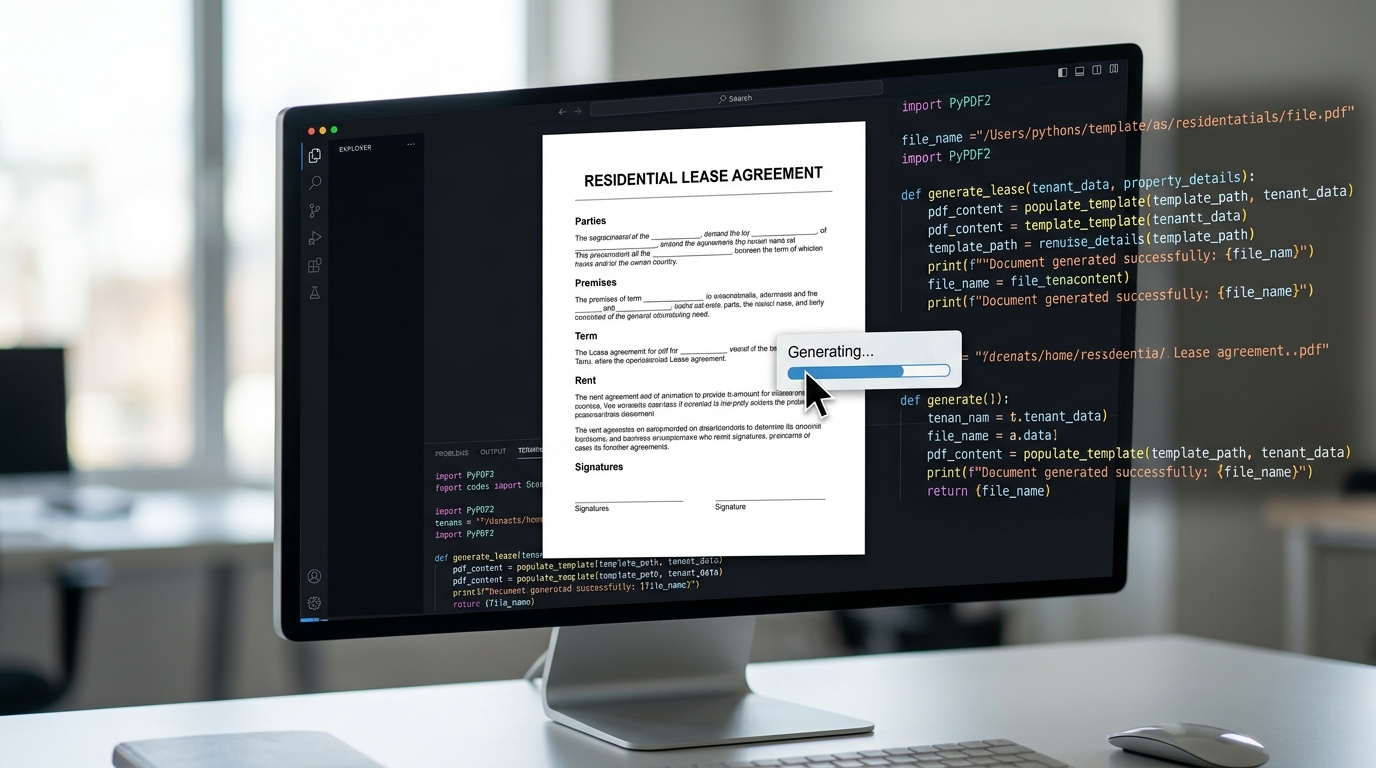
Python scripts streamline the creation of essential real estate documents, ensuring accuracy and compliance through automated data population.
Conceptual Workflow: Automated Lease Contract Generation
Using the python-docx library, property managers can load a master Microsoft Word template containing predefined placeholders (such as {{TENANT_NAME}}, {{PROPERTY_ADDRESS}}, {{MONTHLY_RENT}}, and {{LEASE_START_DATE}}) and replace them dynamically:
from docx import Document

def generate_lease_agreement(template_path, output_path, lease_data):
    # Load the standardized lease agreement document template
    doc = Document(template_path)

    # Iterate through paragraphs to replace placeholders with verified data
    for paragraph in doc.paragraphs:
        for key, value in lease_data.items():
            placeholder = f"{{{{{key}}}}}"
            if placeholder in paragraph.text:
                paragraph.text = paragraph.text.replace(placeholder, str(value))

    # Save the custom, auto-filled document ready for e-signature dispatch
    doc.save(output_path)
    print(f"Successfully generated lease agreement: {output_path}")

# Sample tenant dataset parsed from an online application
tenant_info = {
    "TENANT_NAME": "Sarah Jenkins",
    "PROPERTY_ADDRESS": "742 Evergreen Terrace, Suite 4B",
    "MONTHLY_RENT": "2,450",
    "LEASE_START_DATE": "September 1, 2026"
}

# Execution
# generate_lease_agreement("templates/lease_template.docx", "output/Lease_Jenkins.docx", tenant_info)
Once generated, the Python script can automatically send the resulting PDF directly to the prospective tenant via e-signature APIs (such as DocuSign or HelloSign), reducing lease execution timelines from days to minutes.
How to Schedule Open Houses Automatically Using Python Scripts
Coordinating open houses and private showing appointments involves constant back-and-forth communication between agents, current occupants, and prospective buyers or tenants.
By implementing custom scripts to automate open house scheduling python workflows, managers can eliminate manual scheduling conflicts entirely:
- Calendar Availability Sync: Python scripts query agent calendar APIs (such as Google Calendar or Microsoft Outlook) to determine real-time showing availability windows.
- Automated Showing Triggers: When a prospect requests a showing via a web form or email, a Python script evaluates available time slots, reserves the calendar event, and sends an immediate calendar invitation with showing instructions.
- Automated Confirmation & Lockbox Access: 24 hours prior to the showing, the Python script dispatches an automated SMS reminder. Once the prospect confirms via text reply, the script automatically sends temporary lockbox access codes or entry instructions.
Integrating these showing workflows directly into your client management pipeline allows your team to automate your lead generation CRM systems and track showing conversion rates seamlessly.
Getting Started with Admin Workflow Automation
To begin introducing Python property management automation into your operations, follow this phased implementation path:
[1. Select One High-Volume Task] ──► [2. Standardize Document Templates] ──► [3. Build & Test Script Locally] ──► [4. Deploy to Cloud]
- Identify High-Frequency Manual Pain Points: Focus initial efforts on single, repetitive tasks that consume significant staff time, such as generating monthly rent invoices or updating listing statuses.
- Standardize Documents and Templates: Ensure all Word lease documents, email templates, and spreadsheet rosters use consistent field names and placeholders.
- Develop and Validate Modular Scripts: Write focused Python scripts locally, testing thoroughly with sample datasets before deploying into active operations.
- Deploy to Scheduled Cloud Infrastructure: Host completed automation scripts on cloud services to ensure reliable execution 24/7 without manual supervision.
Frequently Asked Questions (FAQ)
Can Python property management scripts run alongside my existing management software?
Yes. Python scripts interact with most major property management platforms via REST APIs or file import/export hooks. Rather than replacing your current software, Python acts as an automation bridge that handles manual data entry and document assembly tasks between systems.
Is document automation legally binding for real estate leases?
Yes, generated lease documents are legally binding, provided the text complies with local, state, and national housing laws. Using Python to populate standardized legal forms ensures that required clauses and disclosures are included consistently without manual omissions.
How do Python scripts send automated SMS reminders to prospective tenants?
Python scripts use communication APIs such as Twilio or Plivo. By adding a few lines of Python code, your script can trigger personalized SMS messages based on database events, such as upcoming open house showings or lease renewal dates.
Do I need a dedicated server to run Python automation scripts?
While you can run scripts manually on any laptop, deploying them to lightweight cloud environments (such as AWS Lambda, Google Cloud Functions, or DigitalOcean) costs very little per month and ensures your scripts run reliably on schedule around the clock.