
The Best On-Premise Automation Software (No SaaS Required)
Workflow automation has become standard practice in modern operations — but for many organizations, the standard delivery model has not kept up with their security requirements. The dominant automation platforms are SaaS products, which means every automated workflow routes your data through infrastructure you don’t own, under terms you don’t fully control.
If you are a sysadmin, ops lead, or security-conscious engineer searching for on-premise automation software with no SaaS dependency, this guide is for you. We’ll cover why SaaS automation is a governance problem, which tools genuinely run without phoning home, and how to get modern low-code convenience without surrendering data control.
The Problem with SaaS Workflow Automation
SaaS automation platforms like Zapier and Make are convenient, but that convenience has a structural cost: your data becomes their data in transit. Every record synced, every document processed, every credential stored passes through the vendor’s cloud.
For a small business automating newsletter signups, that may be acceptable. For organizations handling regulated, confidential, or competitively sensitive information, it raises hard questions:
- Where does the data physically reside, and in which jurisdictions?
- Who at the vendor can access execution logs that may contain payload data?
- What happens to workflows and stored credentials if the vendor changes terms, suffers a breach, or is acquired?
- How do per-task pricing and rate limits constrain what you can automate?
Why Enterprise Security Requires On-Prem
For many enterprises, these aren’t philosophical concerns — they are compliance blockers. Common drivers for an on-premise requirement include:
- Regulatory frameworks (healthcare, finance, government, defense) that restrict where data may be processed and stored.
- Data residency obligations requiring information to remain in specific jurisdictions or entirely within corporate infrastructure.
- Contractual commitments to customers promising that their data never touches third-party processors.
- Network isolation policies — some environments are air-gapped or restricted to allow-listed egress, making cloud-dependent tooling literally unusable.
In these environments, “we use a well-known SaaS vendor” does not pass a security review. The only automation architecture that fully answers the question “where is our data?” is one that runs on infrastructure you control.
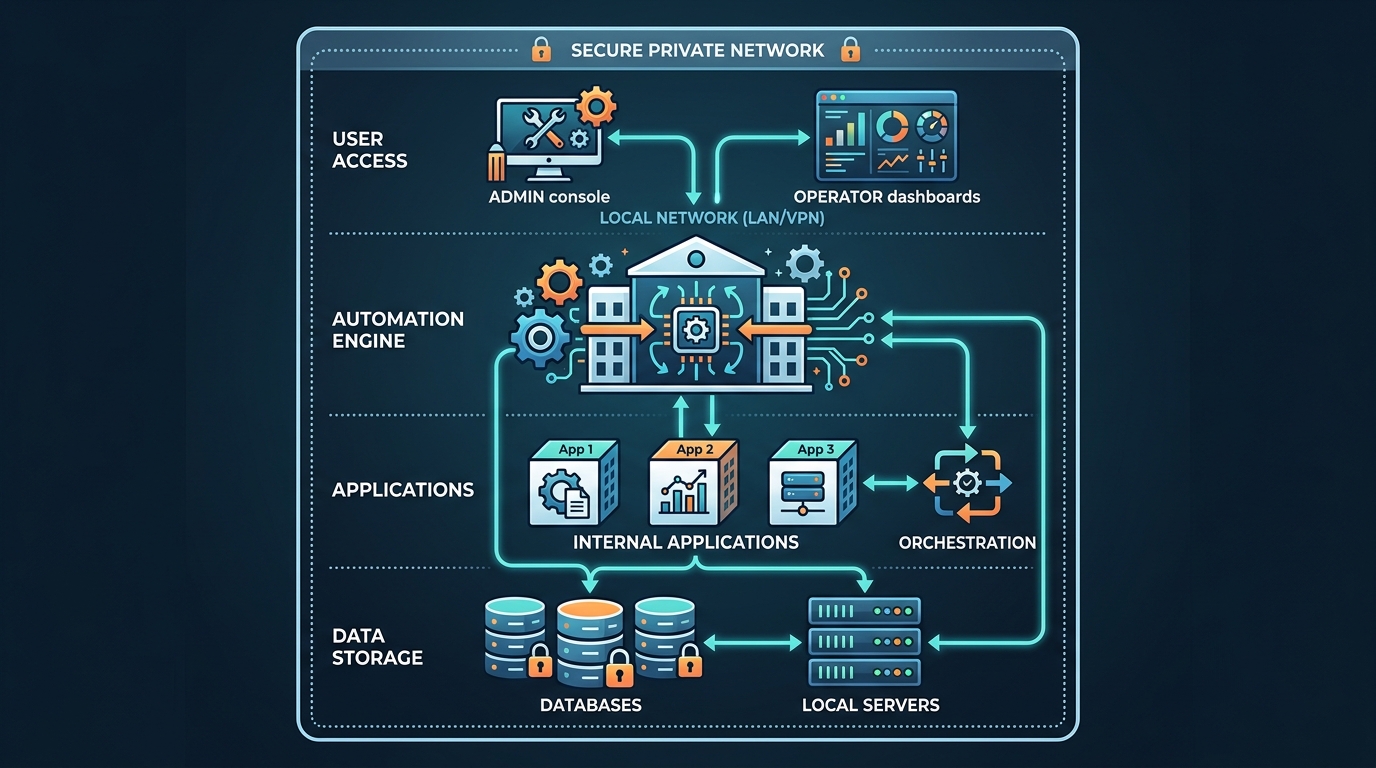
An on-premise automation architecture keeps all data and workflows within the enterprise’s controlled infrastructure, ensuring complete data residency and security.
Are There Automation Tools That Don’t Phone Home?
Yes — but you have to read the fine print, because “self-hosted” and “doesn’t phone home” are not the same thing. Some self-hostable products still require license validation callbacks, cloud-based account login, or telemetry by default.
When evaluating automation tools that don’t phone home, apply this checklist:
- Can it run fully offline or behind an egress-restricted firewall? The strongest test: does the platform function in a network with no outbound internet access (aside from the integrations you deliberately configure)?
- Is telemetry opt-out (or absent)? Look for documented configuration flags that disable usage analytics and update checks. n8n, for example, documents environment variables for disabling telemetry in self-hosted instances.
- Is the source code available for inspection? Open-source and source-available tools let your security team verify network behavior rather than take the vendor’s word for it.
- Are credentials stored locally and encrypted? Your API keys and passwords should live in your own database, encrypted with a key you hold.
- Does licensing work offline? A self-hosted product that refuses to start without contacting a license server is a soft dependency on the vendor’s cloud.
Platforms that pass this evaluation well include n8n (self-hosted, telemetry can be disabled, credentials encrypted in your own database), Node-RED, Huginn, and Activepieces — all of which can run entirely inside your network perimeter.
Benefits of Privacy-First Workflow Automation
Moving to privacy-first workflow automation is not just risk avoidance — it delivers positive operational advantages:
- Complete data residency. Payloads, logs, and credentials never leave your servers. Compliance questionnaires get dramatically shorter.
- Predictable, usage-independent cost. You pay for a server, not per task. High-frequency workflows — polling, syncing, log processing — cost the same as idle ones. Automation decisions stop being budget decisions.
- No artificial rate limits. Your throughput ceiling is your hardware, not a pricing tier.
- Auditability. With open-source platforms, your security team can review the code that touches your data — and your execution logs live in your own database, queryable on your terms.
- Vendor independence. No forced migrations when a SaaS vendor sunsets a plan, raises prices, or removes a feature. Your automation stack has the lifespan you choose.
- Deep internal integration. On-prem automation can reach systems that a cloud SaaS never could safely: internal databases, intranet APIs, file shares, and services that are deliberately not exposed to the internet. This is what makes workflow automation for internal tools genuinely powerful — the automation platform lives on the same network as the systems it automates.

A privacy-first workflow automation dashboard provides a clear overview of operations, ensuring that all data remains within the enterprise’s secure perimeter.
Top Open Source Automation Platforms for Enterprise
The strongest candidates for an open source automation platform in enterprise settings share three traits: active development, credible security posture, and enough usability that adoption spreads beyond the platform team.
- n8n — The leading choice for most teams. A node-based visual editor, hundreds of integrations, native code steps (JavaScript/Python), PostgreSQL-backed persistence, and Docker-first deployment. Its fair-code license permits free self-hosting for internal use, with paid enterprise tiers adding SSO and collaboration features. See our full breakdown of self-hosted open source alternatives for how it stacks up against SaaS incumbents.
- Node-RED — Battle-tested, fully open source, and lightweight. Excellent for event wiring, IoT, and infrastructure glue; less oriented toward business-app integration catalogs.
- Huginn — A veteran open-source “agent” platform for monitoring and reacting to events. Powerful, but configuration is code/JSON-heavy — best for developer-only teams.
- Activepieces — A newer, permissively licensed platform with a clean, approachable UI. A good fit when simplicity and strict open-source licensing outweigh ecosystem depth.
Visual Workflow Automation & Low-Code Internal Tools
A key reason n8n leads this category: it brings visual workflow automation and low-code development to on-prem environments without sacrificing engineering rigor. Ops staff assemble workflows on a drag-and-drop canvas; engineers extend them with real code when logic gets complex. That means your internal tooling — employee onboarding flows, report generation, data syncs between internal systems — can be built and maintained by the ops team itself, on infrastructure that is already inside your security boundary.
No-Code Automation with On-Prem Security
The perceived trade-off — “no-code convenience requires SaaS” — is now simply false. No-code automation with on-prem security is a mature, practical option in 2026:
- Deployment is a solved problem. Modern platforms ship as Docker images; a production instance takes an afternoon, not a quarter. Our guide to deploying your own n8n instance walks through the entire production setup, from Docker to Postgres to TLS.
- Security controls stay in your hands. Put the platform behind your VPN or SSO proxy, restrict egress at the firewall, encrypt at rest, and back up to your own storage.
- Non-technical users still get no-code. The visual builder experience your business users expect from SaaS tools exists on-prem — with the crucial difference that the data behind those workflows never leaves your network.
And it extends to advanced use cases: with self-hosted AI models, even machine-learning-powered workflows can stay entirely in-house. Our document ingestion automation pipeline guide shows how to build a private, AI-assisted document workflow without sending a single file to an external API.
The bottom line: if your organization needs automation but cannot accept SaaS data exposure, you no longer have to choose. Self-hosted, privacy-first platforms — with n8n at the front of the pack — deliver both.
FAQ
Are there automation tools that don’t phone home or use SaaS?
Yes. Self-hostable platforms such as n8n, Node-RED, Huginn, and Activepieces can run entirely within your network. Verify each tool’s telemetry settings and licensing behavior: the best candidates function behind an egress-restricted firewall and document how to disable analytics and update checks.
What is on-premise automation software?
It is workflow automation that runs on servers you control — a VPS, your data center, or a private cloud — rather than on a vendor’s multi-tenant SaaS infrastructure. Workflow definitions, credentials, execution logs, and data payloads all remain within your own environment.
Is on-premise automation more expensive than SaaS?
Usually the opposite at scale. SaaS platforms bill per task or operation, so costs grow with usage. On-premise platforms cost a fixed amount of infrastructure plus administration time, regardless of how many executions you run. Teams with high-frequency workflows typically see substantial savings.
Can non-technical staff use on-premise automation tools?
Yes. Platforms like n8n and Activepieces provide visual, low-code/no-code builders comparable to SaaS tools. A technical owner handles the initial deployment and maintenance; after that, ops and business users can build workflows through the browser-based editor.
Which open source automation platform is best for enterprise use?
For most organizations, n8n offers the best combination of visual usability, integration breadth, code-level extensibility, and production-grade deployment options (Docker, PostgreSQL, queue mode). Node-RED and Activepieces are strong alternatives for specific niches — infrastructure/IoT wiring and simplicity-first teams, respectively.