
Using Python for Lead Enrichment and Advanced Scoring
In modern B2B sales, raw contact lists containing only a name and email address are rarely sufficient to drive revenue. High-performing sales teams need contextual data—such as company headcount, employee growth trends, technology stacks, funding history, and job titles—to prioritize high-value prospects and personalize communication. Implementing Python lead enrichment and programmatic Python lead scoring enables sales operations teams to transform minimal contact records into actionable sales intelligence automatically.
By leveraging Python scripts to query enrichment APIs, execute custom qualification algorithms, and analyze market trends, organizations can focus sales rep outreach on high-propensity leads, shorten sales cycles, and maximize conversion rates.
In this guide, we break down how lead enrichment works in Python, explore programmatic scoring methodologies, demonstrate how Python powers modern sales intelligence, and examine market research application workflows.
What Is Python Lead Enrichment and How Does It Work?
Python lead enrichment is the automated process of using Python scripts to query external data providers and append detailed firmographic, demographic, and technographic metadata to raw lead records.
When a raw contact record enters a database (e.g., via a website form or web scraper), Python enrichment scripts intercept the record, extract key identifiers like company domains or corporate email addresses, query third-party enrichment APIs, and append returned attributes before saving the record into your CRM.

A data flow diagram illustrating how Python scripts automate lead enrichment by integrating with external APIs to append detailed metadata to raw lead records.
API Integrations for Data Enrichment (Clearbit, Apollo)
Integrating popular enrichment provider APIs in Python requires sending HTTP requests with record domain parameters. The following Python script demonstrates how to enrich a raw company domain record using an external enrichment API endpoint:
import requests

def enrich_company_profile(domain, api_key):
    """
    Example script querying an external enrichment API for firmographic metadata.
    """
    url = f"https://person-stream.clearbit.com/v2/companies/find?domain={domain}"
    headers = {
        "Authorization": f"Bearer {api_key}"
    }

    response = requests.get(url, headers=headers)

    if response.status_code == 200:
        data = response.json()
        enriched_info = {
            "company_name": data.get("name"),
            "industry": data.get("category", {}).get("industry"),
            "employee_count": data.get("metrics", {}).get("employees"),
            "annual_revenue": data.get("metrics", {}).get("estimatedAnnualRevenue"),
            "tech_stack": data.get("tech", [])
        }
        return enriched_info
    else:
        print(f"Enrichment request failed for {domain}: Status {response.status_code}")
        return None
By connecting enrichment scripts directly with upstream lead scraping tools with Python, revenue operations teams can convert raw scraped domains into fully detailed prospect profiles within seconds.
What Are the Best Ways to Score Leads Using Python?
Once lead records are enriched with firmographic data, sales teams must calculate lead priority. Relying on manual lead qualification causes delays and leads to inconsistent qualification criteria across team members.
Applying Python lead scoring allows sales operations to define objective, algorithmic scoring rules based on Ideal Customer Profile (ICP) alignment and engagement signals.
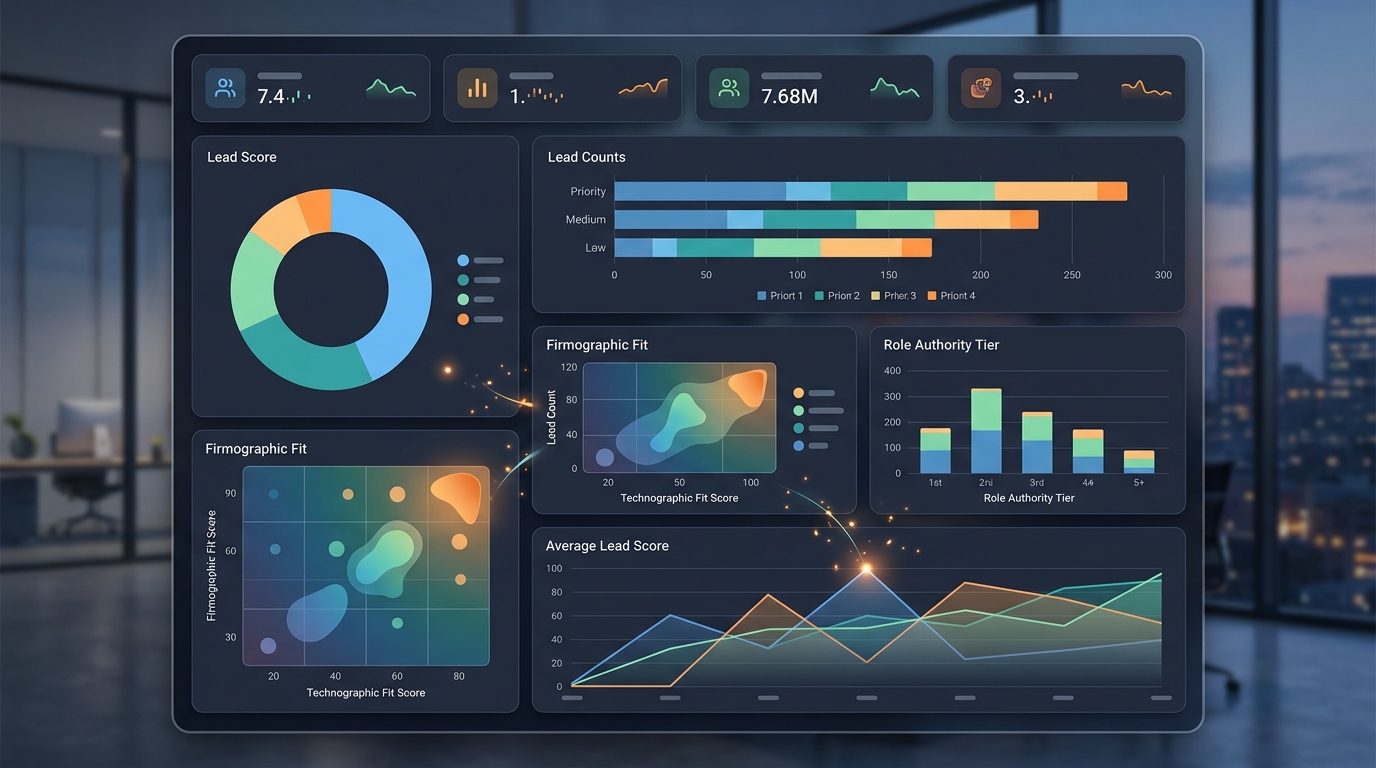
A dashboard visualizing the results of Python lead scoring, providing sales teams with actionable insights into lead priority and qualification criteria.
Creating a Basic Lead Scoring Algorithm
A programmatic scoring model evaluates weighted attributes across multiple criteria:
- Firmographic Fit: Company size, industry sector, location, and annual revenue.
- Technographic Fit: Use of complementary or competing technology stacks.
- Role & Authority: Job title seniority (e.g., C-Level, VP, Director vs. Entry Level).
The following Python code illustrates a modular, weighted lead scoring engine using pandas:
import pandas as pd

def calculate_lead_score(row):
    score = 0

    # 1. Evaluate Employee Count (Firmographic)
    employees = row.get('employee_count', 0)
    if 50 <= employees <= 500:
        score += 35  # Sweet spot for ICP
    elif employees > 500:
        score += 20

    # 2. Evaluate Role Seniority
    title = str(row.get('job_title', '')).lower()
    if any(keyword in title for keyword in ['vps', 'vp', 'director', 'head', 'chief', 'cmo', 'cro']):
        score += 40
    elif 'manager' in title:
        score += 15

    # 3. Evaluate Technology Stack Match
    tech_stack = row.get('tech_stack', [])
    if 'HubSpot' in tech_stack or 'Salesforce' in tech_stack:
        score += 25

    return score

# Example Dataframe Processing
leads_df = pd.DataFrame([
    {'company': 'Tech Corp', 'employee_count': 120, 'job_title': 'VP of Sales', 'tech_stack': ['Salesforce', 'AWS']},
    {'company': 'Small Biz', 'employee_count': 10, 'job_title': 'Sales Rep', 'tech_stack': ['Gmail']}
])

leads_df['lead_score'] = leads_df.apply(calculate_lead_score, axis=1)
print(leads_df[['company', 'job_title', 'lead_score']])
Leveraging Python for Sales Intelligence
Using Python for sales intelligence extends far beyond simple lead scoring. Advanced data-driven sales organizations use Python to aggregate buying intent signals, track executive changes, and trigger timely automated outreach.
Key sales intelligence applications built with Python include:
- Job Board Intent Tracking: Tracking corporate hiring portals to identify companies actively recruiting roles that indicate budget expansion (e.g., hiring SDR managers or Data Engineers).
- Executive Motion Monitoring: Scraping public news feeds and company announcements to identify new C-level executive appointments, which often precede software stack evaluations.
- Competitor Tech Detection: Monitoring target company website headers or DNS records to identify when a prospect drops a competitor’s script, signaling potential dissatisfaction.
Integrating these sales intelligence signals directly with Python sales prospecting workflows ensures reps reach out with relevant, timely messaging when prospects are actively seeking solutions.
Python for Market Research in Sales
In addition to individual prospect intelligence, deploying Python for market research sales workflows enables revenue leaders to analyze macro trends across entire addressable markets.
Sales analysts use Python’s data analysis libraries (pandas, matplotlib, seaborn) to conduct comprehensive market research:
- Total Addressable Market (TAM) Mapping: Aggregating web data across entire industry verticals to estimate market size and account distributions by geographic region.
- ICP Refinement Analysis: Performing historical win/loss analyses by comparing CRM opportunity outcome data against enriched account profiles to uncover hidden commonalities among high-value customers.
- Pricing & Competitor Analysis: Automating public pricing page monitoring to track competitor packaging and feature positioning shifts in real-time.
Once insights are generated, sales operations can establish a reliable CRM integration for sales to ensure that calculated scores and intelligence tags sync seamlessly to every sales rep’s desk.
Frequently Asked Questions (FAQ)
What is Python lead enrichment and how does it work?
Python lead enrichment is the process of using Python scripts to automatically fetch additional background data (such as company size, annual revenue, industry, and tech stack) from third-party APIs (like Clearbit or Apollo) using a prospect’s email domain, appending those attributes to CRM lead profiles.
What are the best ways to score leads using Python?
The best way to score leads using Python is to build a weighted scoring algorithm using libraries like pandas. The algorithm evaluates multiple attributes—such as firmographic fit (company headcount and revenue), demographic fit (job title and decision-making authority), and technographic alignment—assigning point values to calculate a total priority score for sales team routing.
What Python libraries are best for sales intelligence and market research?
For sales intelligence and market research, the most popular libraries are requests and httpx for querying APIs, pandas and numpy for data manipulation, BeautifulSoup and Playwright for gathering public market signals, and matplotlib or seaborn for visualizing market trends.
How does lead scoring improve sales efficiency?
Lead scoring ensures sales reps focus their time and energy on prospects with the highest propensity to buy. By prioritizing qualified leads programmatically, organizations reduce time spent on cold or ill-fitting prospects, improve conversion rates, and accelerate overall pipeline velocity.