
Top AI Landing Page Automation Tools for Technical Founders
If you can ship a production API but still find yourself hand-editing landing page copy at 11 p.m., something is broken — and it isn’t your work ethic. It’s your tooling.
Landing page automation tools exist to close that gap. Instead of treating every new page as a one-off design project, they let you treat landing pages the way you treat code: templated, parameterized, and deployed through a repeatable pipeline. For technical founders, that mental model shift is the whole game.
This guide breaks down what an AI landing page generator actually does, which categories of tools fit a startup stack, and how to choose an automation setup that won’t collapse the first time you need to launch twenty pages instead of two.
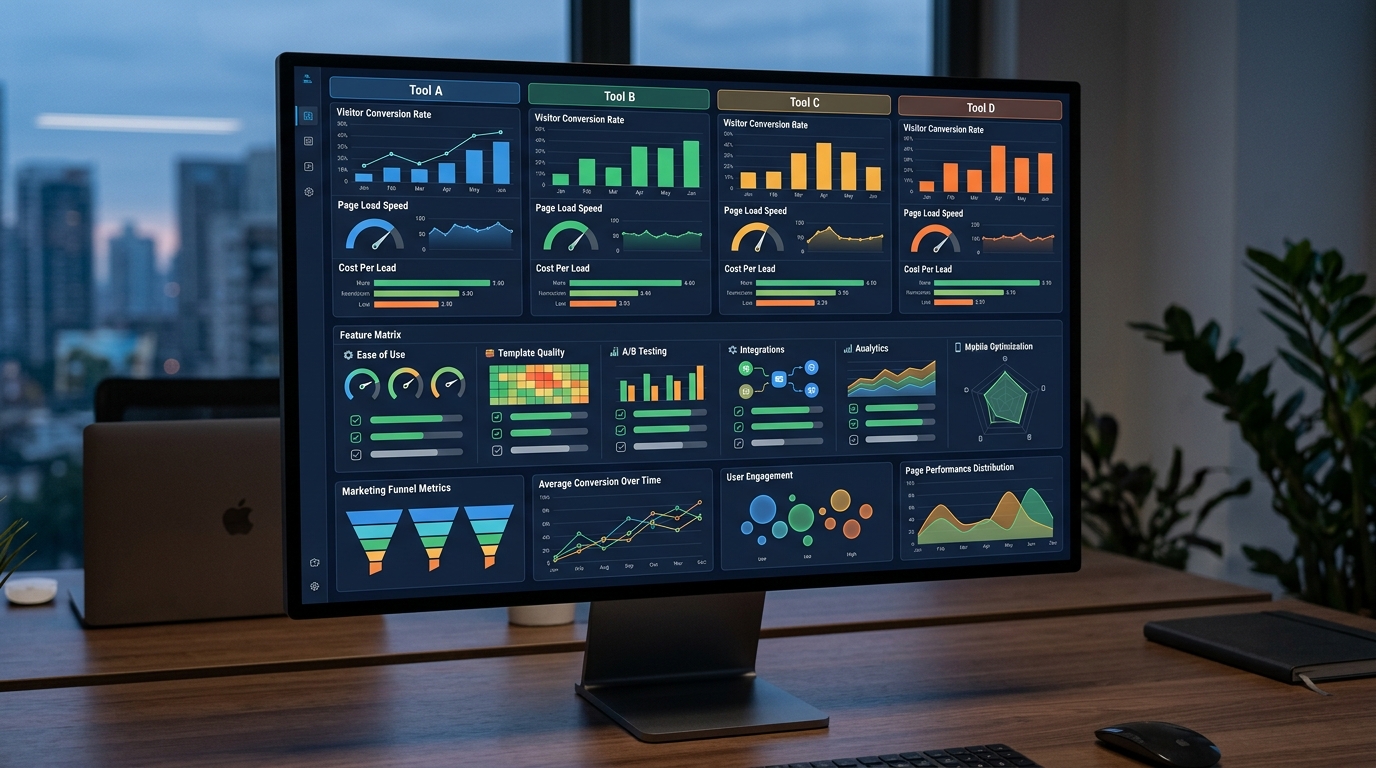
A visual comparison dashboard helps technical founders evaluate the best landing page automation tools for their startup needs.
What is an AI Landing Page Generator?
An AI landing page generator is a tool that produces complete, publishable landing pages from structured inputs — a product description, a target keyword, an audience profile, or a row of data — instead of requiring you to write and design each page manually.
Most tools in this category combine three layers:
- A content layer — a large language model (Claude, GPT, Gemini, or similar) that writes headlines, body copy, and calls to action based on your inputs.
- A template layer — a page structure with defined slots (hero, benefits, social proof, CTA) that the generated content flows into.
- A publishing layer — a way to push the finished page live, whether that’s a hosted builder, a CMS integration, a webhook, or a static-site deploy.
The critical distinction for technical founders: a generator makes one page faster, but an automation tool makes page creation a system. A true landing page automation setup can take a list of inputs — say, fifty customer segments or feature variations — and produce fifty coherent pages without a human touching each one.
If you’ve tried pasting prompts into ChatGPT and copying the output into a page builder, you’ve already discovered the problem: that workflow doesn’t scale, and the output quality is inconsistent. Automation tools solve both issues by locking your context, structure, and quality controls into a repeatable process.
What Are the Best AI Landing Page Generators for Startups?
“Best” depends on what constraint you’re optimizing for. Startups typically fall into one of three buckets:
- Speed-constrained — you need pages live this week for a campaign or launch. Prioritize tools with strong templates and one-click publishing.
- Scale-constrained — you need many pages (per-segment, per-integration, per-location). Prioritize tools with APIs, webhooks, or data-driven generation so you can automate landing page creation end to end.
- Quality-constrained — you’ve been burned by generic AI copy. Prioritize tools that let you inject brand context, product details, and real differentiators into every generation, rather than relying on a single generic prompt.
A useful evaluation rule: ask whether the tool can accept structured input (JSON, CSV rows, form data, or API payloads) and return a complete page without manual assembly. If the answer is no, it’s a writing assistant, not an automation tool — fine for prototyping, but not for a system.
Also check how each tool handles the pieces around the page: form capture, analytics events, and CRM handoff. A landing page that converts but drops the lead on the floor is only half a system. This is where broader AI marketing automation thinking pays off — the page is one node in a pipeline, not the destination.
Top Landing Page Automation Tools for 2026
Rather than an exhaustive vendor list, here are the three tool archetypes that matter for a startup stack in 2026, with a representative pick for each.
NORA — Best for No-Code Workflows
NORA (Node Orchestration & Runtime Automation) is a visual, node-based workflow builder that runs as a desktop app. Instead of writing glue code, you chain nodes together: pull data in, run it through AI models (Claude, GPT, and Gemini are supported natively), transform the output, and push finished content to its destination.
For landing page automation, that means you can build a workflow like: read a CSV of audience segments → generate headline, body, and CTA copy per segment with an AI node → assemble the page content → hand it off for publishing — all without writing code.
Key characteristics that matter for founders:
- Local and offline-first — workflows run on your machine, not a third-party cloud, so your product data and prompts stay with you.
- No per-task pricing — unlike per-operation cloud automation tools, you’re not metering every page generation against a subscription tier.
- AI-native nodes — model calls are first-class workflow steps, not bolted-on integrations, which makes multi-step generation (draft → critique → revise) practical.
Best fit: founders and marketing-technical hybrids who want a real automation system without maintaining scripts or paying per-execution fees.
Developer API Platforms — Best for Developer APIs
If you’d rather own the pipeline in code, the second archetype is the API-driven approach: workflow platforms such as n8n, Zapier, or Make orchestrating an LLM API plus your own page templates and deployment step.
This route gives you maximum control — version-controlled templates, custom validation, CI/CD-style publishing — at the cost of build and maintenance time. It’s the right choice when landing pages are core infrastructure (for example, if you’re doing programmatic page generation at serious scale) and you have the engineering hours to spend. Be honest about that trade-off: every hour spent maintaining marketing glue code is an hour not spent on product.
Hosted AI Page Builders — Best for Quick Prototyping
The third archetype is the hosted AI page builder: tools that generate a designed, hosted page from a short prompt in minutes. These are excellent for validating an offer, spinning up a test page for an ad campaign, or getting a “good enough” page live before you’ve built any automation.
Their limitation is the same as their strength: they’re optimized for one page at a time, with limited structured input and limited pipeline integration. Treat them as a prototyping tool, not the backbone of your system.
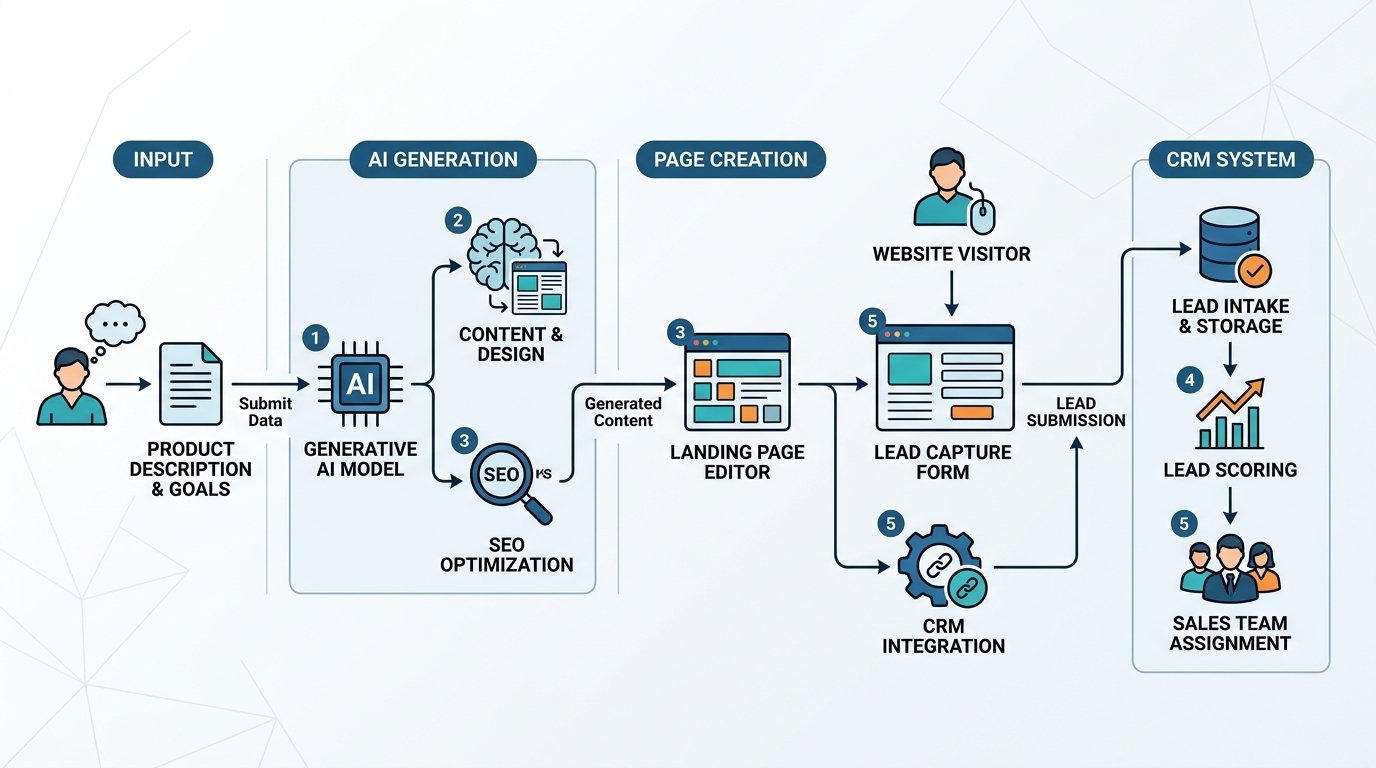
Illustrative workflow of an AI landing page generator, demonstrating its integration with a CRM for automated lead capture and management.
How to Choose the Right Automation Stack
Work through these questions in order:
- What’s your page volume? Under ~5 pages a quarter, a hosted builder is fine. Beyond that, you need automation — a workflow tool or an API pipeline.
- Who maintains it? If the answer is “me, in spare moments,” choose a visual no-code workflow tool. If you have dedicated engineering time, an API pipeline is viable.
- Where does the data live? Your pages need product details, segment data, and brand context. Pick a tool that can ingest that data directly rather than relying on you to paste it in.
- What happens after the click? Confirm the stack can pass leads into your CRM or email system automatically. Page generation without lead capture automation just moves the bottleneck.
- What does it cost at 10x volume? Per-task cloud pricing that looks cheap at 20 executions a month can get uncomfortable at 2,000. Model the scaled cost before committing.
The founders who get this right stop thinking about “making landing pages” and start thinking about a page pipeline: inputs in, quality-controlled pages out, leads captured downstream. Choose the stack that makes that pipeline boring and repeatable.
FAQ
Are AI-generated landing pages good enough to convert?
They can be — if the generation step is fed real context. Pages generated from a single generic prompt tend to read like everyone else’s. Pages generated from structured brand, product, and audience inputs, with a review step in the workflow, are a different class of output. The tool matters less than the pipeline design around it.
Can I automate landing pages without writing code?
Yes. Visual workflow tools like NORA let you build the full chain — data in, AI generation, content assembly, publishing handoff — with node-based workflows instead of scripts. See our step-by-step guide to automate landing page creation for the exact process.
What’s the difference between a landing page builder and a landing page automation tool?
A builder helps a human make one page faster. An automation tool produces pages from data without per-page human effort. Builders are fine at low volume; automation tools are what you graduate to when volume, segmentation, or campaign velocity outgrows manual work.
How many landing pages does a startup actually need?
Enough to match your segments and offers. If you sell to three personas across four use cases, that’s twelve meaningfully different pages before you’ve touched campaigns or geographies. That math is exactly why automation beats manual production for most startups.