
AI Marketing & Lead Generation Automation for Startups
Most startup marketing advice assumes you have a marketing team. You don’t. You have a product to build, maybe a co-founder, and a growing suspicion that the manual work you’re doing to generate leads — writing content, chasing follow-ups, updating spreadsheets — is exactly the kind of repetitive process you’d automate without hesitation if it were anything other than marketing.
AI marketing automation for startups is the discipline of treating that suspicion seriously: building systems that generate, capture, and nurture leads with minimal ongoing human effort. This guide covers what AI can realistically automate today, which workflows deliver the most leverage, and how to assemble a stack without burning engineering time you can’t spare.
The Role of AI in Startup Marketing
Traditional marketing automation — the email sequences and CRM triggers of the last decade — automated delivery. You still had to create everything by hand: the emails, the pages, the content, the segmentation logic.
AI changes the equation because it automates creation and decision-making, not just delivery:
- Content generation — blog posts, landing page copy, email variants, and social snippets produced from structured inputs instead of blank-page writing sessions.
- Personalization at scale — messaging adapted per segment or per lead without hand-writing every variant.
- Enrichment and qualification — classifying and routing inbound leads based on signals, so your attention goes to the leads that matter.
- Pipeline orchestration — chaining all of the above into workflows that run end to end: content attracts, pages capture, sequences nurture, the CRM stays current.
For a startup, the strategic value isn’t any single capability — it’s compounding. One founder with a well-built AI marketing system can sustain an output level that previously required a small team. That’s not hype; it’s the same leverage argument as any other automation, applied to the function founders most often neglect.
The catch: leverage only materializes if you build systems rather than doing one-off AI-assisted tasks. Pasting prompts into a chat window is AI-assisted manual work. The wins come from pipelines that run without you.
Can AI Completely Automate Lead Generation?
Honest answer: no — and being clear about the boundary saves you months of misdirected effort.
What AI can genuinely automate today:
- Producing the content and landing pages that attract search and referral traffic
- Capturing leads and syncing them into a CRM without manual data entry
- Sending personalized follow-up sequences triggered by lead behavior
- Scoring, tagging, and routing leads so humans see a prioritized queue instead of a raw inbox
- Reporting — assembling the numbers you’d otherwise compile by hand
What still requires humans:
- Strategy and positioning. AI executes an angle; it doesn’t know which angle wins in your market.
- Offer design. What you promise, price, and guarantee is a judgment call.
- High-stakes conversations. Demos, negotiations, and relationship-building with serious prospects.
- Quality control. Someone must own the standard the system is held to, and audit its output periodically.
The right mental model: AI automates the pipeline, humans own the strategy and the close. Startups that get this right route 80–90% of the repetitive work to machines and reinvest that time in the two things machines can’t do — sharpening the offer and talking to customers.
If a vendor promises fully autonomous lead generation with no human in the loop, treat the claim the way you’d treat “fully autonomous code deployment with no review” — technically arrangeable, rarely wise.
Essential AI Marketing Automation Workflows
Start with the two workflow families below. They cover the largest share of manual marketing effort for a typical early-stage company.
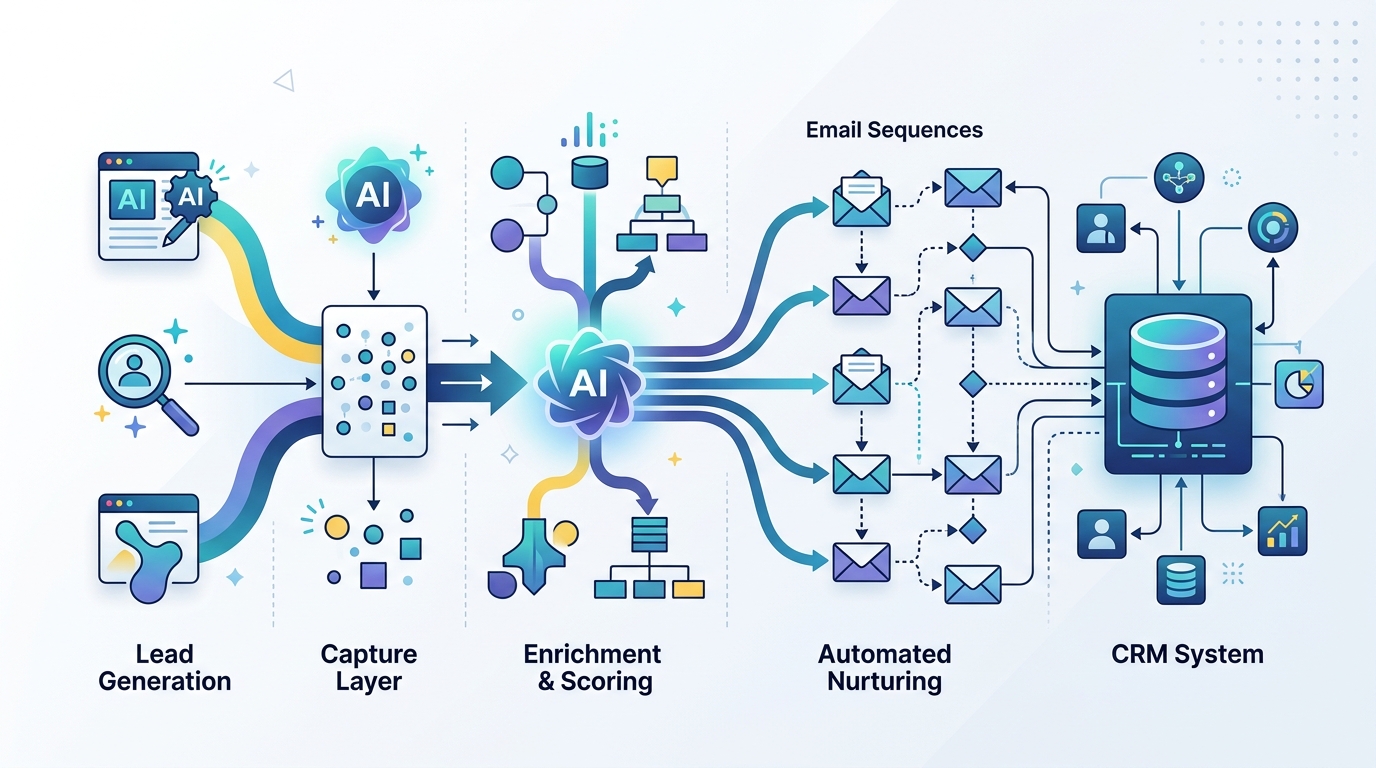
An illustrative diagram showcasing the essential workflows of AI marketing automation for startups, from lead generation and nurturing to seamless integration with a CRM for efficient management.
AI Lead Generation Automation
This is the front half of the funnel: attracting strangers and converting them into identified leads.
A complete AI lead generation workflow looks like:
- Content production pipeline. Keyword and topic inputs flow into an AI generation workflow that produces SEO content and landing pages on a schedule. Done properly — with brand context, structured prompts, and review gates — this is what an AI SEO content system provides: a steady stream of pages that pull in qualified search traffic.
- Capture layer. Every content asset carries a relevant next step — a form, a signup, a downloadable — wired to fire a webhook the moment someone converts.
- Enrichment and scoring. On capture, the workflow enriches the lead (company, role, source) and applies scoring rules or an AI classification step to separate “curious reader” from “active buyer.”
- Routing. High-scoring leads trigger a notification for personal follow-up; the rest enter automated nurture. Nobody sits in an unsorted inbox.
The compounding property matters: content assets keep attracting traffic after publication, so the same workflow produces more leads over time at flat effort.
Automated Email Sequences & Follow-ups
The back half of the funnel is where manual effort quietly dies — founders capture leads, then follow up late or never.
An automated nurture workflow:
- Trigger on capture. The lead’s entry point (which page, which offer) determines which sequence they join. Context-specific beats generic.
- AI-drafted sequence content. Generate sequence emails from your product facts, the segment’s pain points, and the entry context — then review and lock them. Sequences are written once and refined, not improvised per lead.
- Behavioral branching. Opens, clicks, and replies adjust the path: engaged leads get a direct call-to-action sooner; cold leads get longer-cycle value content.
- CRM sync throughout. Every touch is logged automatically, so when you do jump into a conversation, the full history is in front of you.
The standard to hold this workflow to: no lead waits more than a few minutes for a first touch, and no lead is forgotten. That reliability, more than clever copy, is what automation buys you.
Building Your Startup’s AI Marketing Stack
You need four layers. Resist the urge to buy more than four tools before the system works end to end.
| Layer | Job | What to look for |
|---|---|---|
| Orchestration | Runs the workflows connecting everything | Visual workflow builder, AI-native steps, webhook support, pricing that survives 10x volume |
| Generation | Produces content, pages, and email copy | Access to strong models (Claude, GPT, Gemini), multi-step prompting, context injection |
| Capture & pages | Turns traffic into identified leads | Form/webhook support, easy page deployment — see our comparison of AI landing page automation tools |
| CRM & email | Stores leads, sends sequences | API access, behavioral triggers, simple pipeline stages |
Principles for assembling the stack:
- Orchestration is the keystone. A node-based workflow tool like NORA can serve as the hub that connects AI models, data, and delivery endpoints — locally, without per-task cloud fees. Whatever you choose, every other layer should plug into it via API or webhook.
- Prefer boring integrations. Webhooks and CSVs beat fragile screen-scraping or manual exports. If two tools can’t talk automatically, one of them is the wrong tool.
- Mind the cost curve. Per-task cloud pricing looks harmless in month one and painful at scale. Model costs at the volume you’re building toward, not the volume you have.
- Ship one workflow at a time. Working lead-capture automation this month beats a grand five-workflow architecture that’s 60% built forever.
For a deeper look at the engineering mindset behind all of this — webhooks, CRM pipeline design, and treating the funnel like an architecture problem — see our guide to marketing automation for technical founders.
FAQ
What’s the difference between marketing automation and AI marketing automation?
Traditional marketing automation triggers pre-written actions (send this email when that form fires). AI marketing automation also creates — generating the content, copy, and classifications inside the workflow — which removes the manual production bottleneck that traditional automation left in place.
How much does an AI marketing stack cost for a startup?
It varies by tool choice and volume, so beware of anyone quoting a universal number. The structural advice: favor tools with flat or local pricing over per-task metering, and model your costs at 10x current volume before committing to any layer of the stack.
Can one non-marketer founder really run this alone?
That’s the design goal, and it’s realistic for the pipeline itself: content generation, capture, nurture, and CRM hygiene can all run as workflows. The founder still owns strategy, offer design, and sales conversations — the parts that were always the highest-value use of founder time.
Where should a startup start with AI marketing automation?
Start where leads are currently leaking. For most early startups that’s follow-up: automate lead capture and a nurture sequence first, because it converts demand you already have. Build the content generation pipeline second to grow top-of-funnel.
Does AI-generated marketing content actually convert?
It converts when it’s specific — generated from real product facts, real audience pain points, and a defined angle. Generic one-prompt output underperforms because it says nothing your competitors’ AI content doesn’t also say. The pipeline design, not the model, is the differentiator.