
How to Build a High-Quality AI Content Generation Workflow
If you have experimented with AI writing tools, you already know the uncomfortable truth: getting an AI to produce content is easy, but getting it to produce good content, consistently, at scale is an engineering problem. That is exactly why an AI content generation workflow matters. A workflow turns one-off prompting into a repeatable pipeline with defined inputs, quality gates, and predictable outputs — the same way you would treat any other production system.
This guide is written for technical founders and builder-operators who want to scale content without flooding the internet with generic filler. We will break down why most pipelines fail, what components a reliable workflow needs, and how to build a pipeline that maintains quality while your output grows.
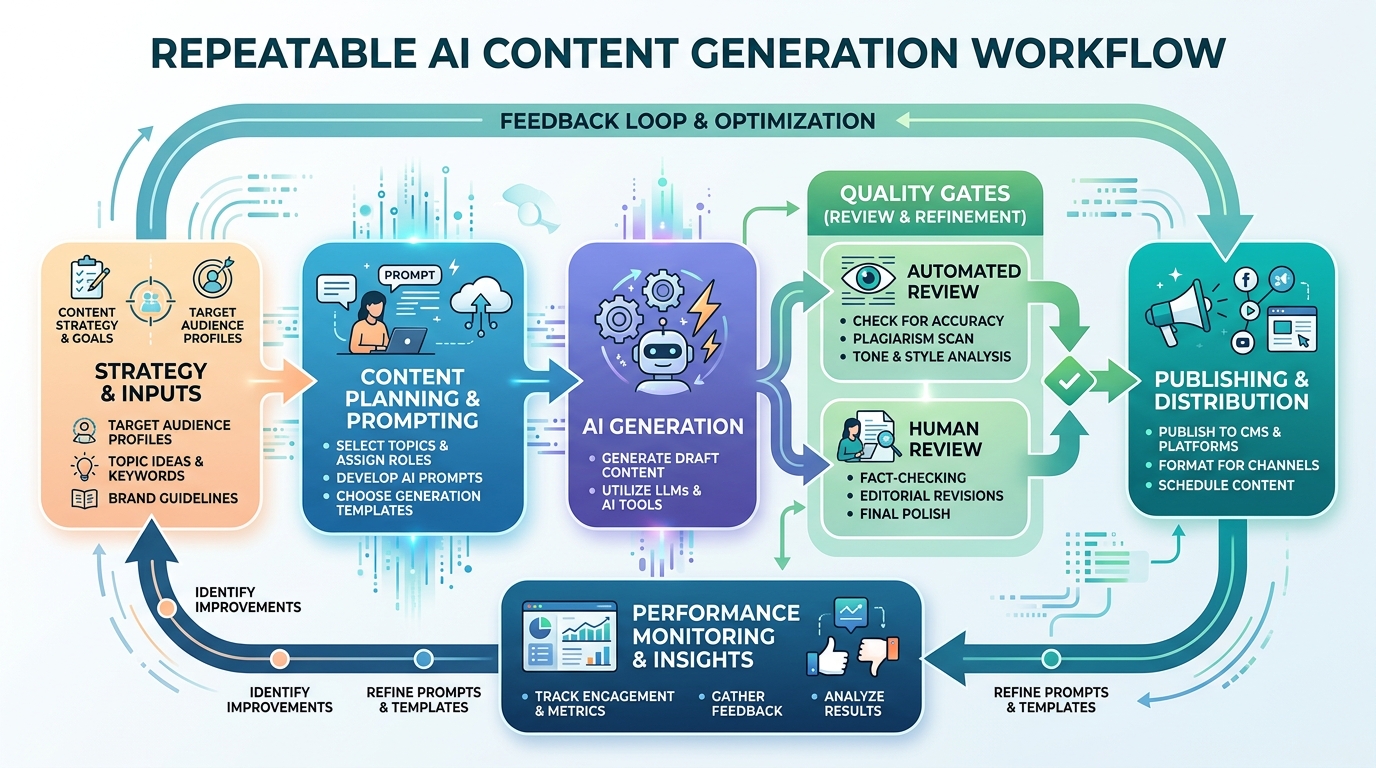
A well-structured AI content generation workflow integrates strategy, templated generation, and rigorous quality control to ensure consistent, high-quality output.
Why Most AI Content Pipelines Fail at Quality Control
Most AI content pipelines fail for the same reason most hastily-shipped software fails: no testing, no review process, and no feedback loop.
The typical failure pattern looks like this:
- Prompt-and-publish. A single generic prompt produces an article, and it goes live with minimal review.
- No source of truth. The AI has no access to your positioning, brand voice, or product facts, so it fills gaps with plausible-sounding filler — or worse, invented claims.
- No quality gate. There is no defined checkpoint where a human (or a validation step) can reject an output before it ships.
- No iteration loop. Nothing that is learned from a weak draft feeds back into the prompts or templates, so the same mistakes repeat forever.
The result is content that reads fine sentence-by-sentence but says nothing. Search engines increasingly reward content that demonstrates genuine experience and depth, and readers bounce quickly from generic material. Content generation pipeline quality control is not a nice-to-have; it is the difference between an asset and a liability.
Think of it this way: you would never deploy code straight from an autocomplete suggestion into production without review or tests. Your content pipeline deserves the same discipline.
Key Components of an AI Content Generation Workflow
A production-grade workflow has distinct stages, each with a clear input and output. At minimum, you need:
- Strategy inputs — keyword research, audience profiles, and content briefs that define what each piece must accomplish.
- Generation templates — structured prompts that encode your voice, formatting rules, and constraints.
- Quality gates — automated checks and human review steps that catch weak drafts before publication.
- Publishing and distribution — the mechanical steps of formatting, metadata, and deployment.
- A feedback loop — performance data that flows back into your briefs and templates.
Let’s look at the two components founders most often skip.
Defining Strategy and Brand Voice
Before you automate anything, document the things only you know:
- Who you are writing for. A one-page audience profile (expertise level, pain points, vocabulary) changes AI output dramatically.
- What you sound like. Capture 5–10 voice rules: sentence length preferences, banned phrases, how technical to get, whether you use humor.
- What you will never claim. A “do not fabricate” list — statistics, benchmarks, and competitor claims that must come from verified sources or not appear at all.
These documents become reusable context you inject into every generation step. Without them, every article regresses to the mean of the model’s training data — which is exactly the generic tone you are trying to avoid.
Structuring Prompts for Repeatable AI Content Workflows
Repeatable AI content workflows depend on prompts that behave like functions: same structure in, predictable structure out. In practice, that means:
- Templatize, don’t freestyle. Build a prompt template with slots for the brief, keyword cluster, outline, and voice rules — then reuse it for every article.
- Generate in stages. Outline first, then sections, then a revision pass. Staged generation gives you checkpoints where a bad direction can be corrected cheaply.
- Constrain the output format. Specify headings, word counts per section, and markup rules explicitly so downstream steps can parse and validate the result.
- Version your prompts. When you improve a template, keep the old version. If quality drops, you want to diff and roll back — exactly like code.
Achieve Content Automation Without Low Quality
The goal of content automation without low quality comes down to one principle: automate the mechanical work, and concentrate human judgment where it has the most leverage.
Here is a practical division of labor:
| Automate | Keep human |
|---|---|
| Research aggregation and outline drafts | Final approval of the angle and thesis |
| First-draft generation from approved briefs | Fact-checking claims and adding first-hand experience |
| Formatting, metadata, internal link insertion | Voice polish on introductions and conclusions |
| Consistency checks (headings, length, links) | The decision to publish |
Add explicit quality gates between stages:
- Brief approval gate. No generation starts without an approved brief. Garbage briefs produce garbage articles at any model quality.
- Draft validation gate. Automated checks for structure, required links, keyword coverage, and placeholder claims.
- Editorial gate. A human reads the draft as a skeptical reader would. If it teaches nothing, it does not ship.
The pipeline should make it harder to publish weak content than to publish strong content. That is what separates a quality system from a spam machine.
Building an AI Content Pipeline for Startups
An AI content pipeline for startups has different constraints than an enterprise content operation: you have limited time, no editorial team, and a strong incentive to keep the stack simple.
A pragmatic starting architecture:
- Keyword and topic research → produces a prioritized topic list (weekly or monthly).
- Brief generation → converts each topic into a structured brief: target keyword, outline, internal links, word count.
- Draft generation → your templated prompts plus voice documents produce a complete draft.
- Automated QA → scripts verify structure, links, metadata, and flag unverified claims.
- Founder review → a 15–20 minute editorial pass per article, focused on accuracy and insight.
- Publish and measure → deploy, then feed search performance back into step 1.
Founders who are comfortable in code can wire these stages together with an AI workflow builder for developers rather than stitching five SaaS subscriptions together — the same orchestration logic that powers content can later power other operations. In fact, many teams extend the same pattern to AI agents for internal tools once the content pipeline proves the model works.

Technical founders can leverage automated AI content pipelines to scale their content efforts efficiently, focusing on strategic oversight and quality control.
Best Practices for AI Content Workflows That Scale
Once your pipeline reliably produces one good article, scaling is about protecting quality while raising throughput. AI content workflows that scale share these habits:
- Scale briefs before drafts. Your bottleneck should always be brief quality, never generation capacity. A backlog of strong briefs is a strategic asset.
- Batch review sessions. Review three to five drafts in one sitting with a checklist. Context-switching kills editorial consistency.
- Track a quality metric, not just volume. Rejection rate at the editorial gate, time-to-publish, and organic engagement tell you whether scale is degrading quality.
- Refresh voice and strategy docs quarterly. Your positioning evolves; a pipeline running on stale context slowly drifts off-brand.
- Treat failures as pipeline bugs. When a bad article slips through, fix the gate that missed it — not just the article.
- Connect content to the rest of your growth system. Content is one input into a broader engine; pair it with marketing automation for technical founders so published articles feed lead capture and nurture flows automatically.
Conclusion: Start Automating Your Content Today
A high-quality AI content generation workflow is not about replacing judgment with automation — it is about building a system where your judgment is applied once (in briefs, voice docs, and quality gates) and then enforced automatically on every piece you produce. Start small: document your voice, template one prompt, add one quality gate, and ship one article through the full pipeline. Then iterate like you would on any product.
The founders who win with AI content are not the ones who generate the most — they are the ones who build the most reliable pipeline.
Frequently Asked Questions
What is an AI content generation workflow?
An AI content generation workflow is a repeatable, multi-stage process for producing content with AI assistance. It typically includes strategy inputs (briefs and voice guidelines), templated generation steps, automated and human quality gates, and a feedback loop that improves the system over time.
How do you maintain quality control in an AI content pipeline?
Add explicit gates between stages: approve briefs before generation, run automated checks on structure and claims, and require a human editorial pass before publishing. Treat any low-quality article that slips through as a pipeline bug and fix the gate that missed it.
Can content automation work without producing low-quality spam?
Yes — if you automate mechanical tasks (drafting, formatting, link insertion) while keeping humans responsible for angle approval, fact-checking, and the final publish decision. The failure mode is prompt-and-publish with no review, not automation itself.
How much of the content process should a startup automate?
Start by automating research aggregation, first drafts, and formatting, which typically consume the most time. Keep strategy, fact-checking, and final review manual. As your briefs and templates mature, you can automate more validation steps while retaining editorial sign-off.
What tools do I need to build a repeatable AI content workflow?
At minimum: a documented brief template, versioned prompt templates, a generation model, and a checklist-driven review process. Technical teams often orchestrate these stages with a developer-focused workflow builder so the entire pipeline runs as one automated system.