
The Ultimate Self-Hosted Automation Platform
Every workflow you automate carries data: credentials, customer records, internal documents, logs, prompts. On a cloud automation platform, all of it flows through someone else’s servers, under someone else’s terms, on someone else’s pricing meter.
NORA (Node Orchestration & Runtime Automation) takes the opposite approach. It is a self-hosted automation platform built local-first from the ground up — a visual, node-based workflow builder that runs on your own machines, connects to the AI models you choose, and never requires your data to leave infrastructure you control.
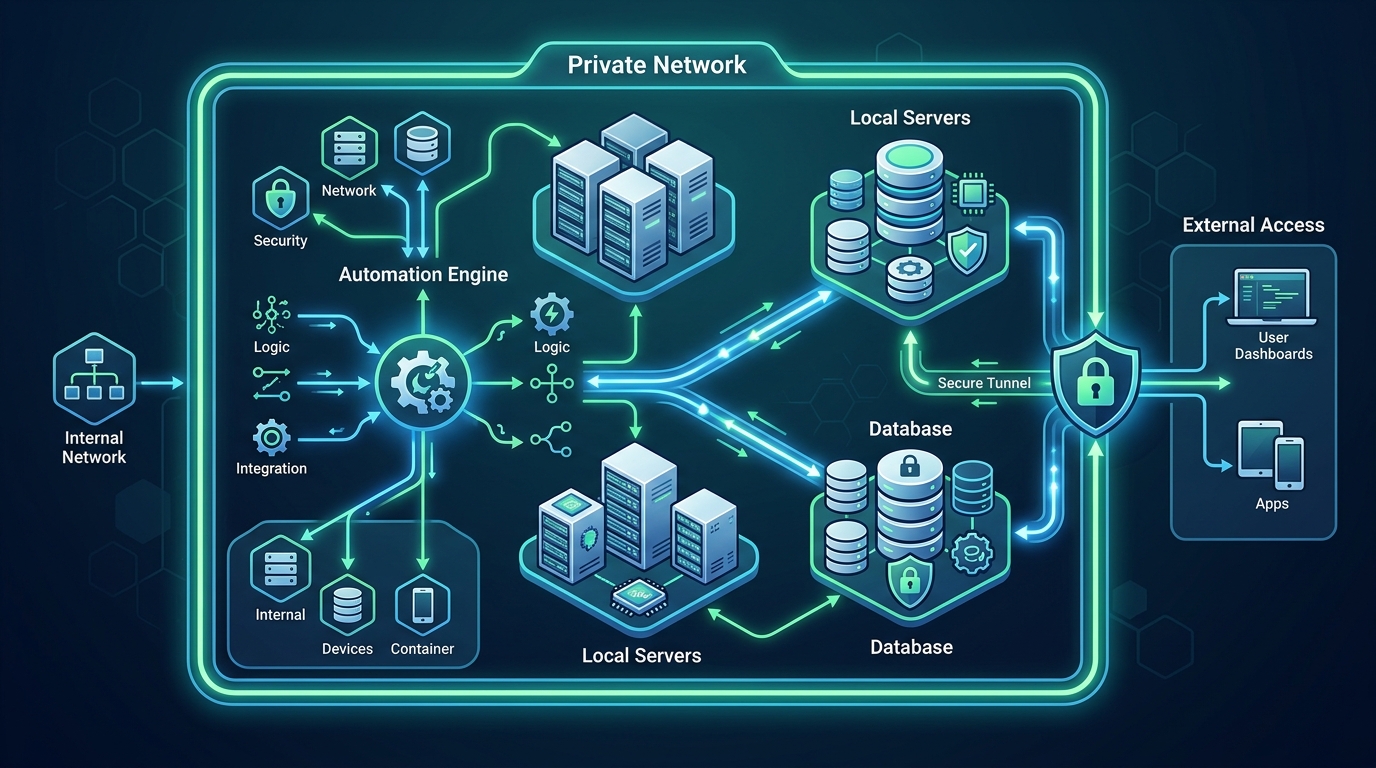
An architectural overview of a secure self-hosted automation platform, highlighting the containment of data and processes within a user’s private infrastructure.
Why Choose Local-First Automation Software?
“Self-hosted” is often treated as a checkbox feature — a Docker image offered alongside a cloud product that gets all the attention. Local-first automation software is a different architectural commitment: the local deployment is the product.
That distinction matters in practice:
- Your data stays yours. Workflow payloads, AI prompts and responses, credentials, and execution logs live on your infrastructure. There is no third party in the data path to audit, trust, or explain to a compliance reviewer.
- Your internal systems are reachable by default. Databases behind the VPN, internal admin APIs, file shares, on-premise services — a locally running platform connects to them directly, without tunnels, agents, or firewall exceptions.
- No per-task meter. Cloud platforms bill per execution, which punishes exactly the high-frequency workflows internal operations depend on. Local execution means a workflow that runs every five minutes costs the same as one that runs weekly: nothing extra.
- No dependency on someone else’s uptime. Your automations run even when a vendor’s cloud has a bad day.
For a deeper treatment of the trade-offs between deployment models, you can learn more about cloud automation vs self-hosted in our full comparison guide.
Features of Our Self-Hosted Workflow Automation (2026)
NORA is built for teams that want serious automation capability without surrendering control. Here is what self-hosted workflow automation in 2026 looks like on the platform.
Complete Data Privacy and Control
- Local execution by design. Workflows are built and run in a desktop application with no cloud dependency. Nothing about your workflows — their structure, their data, their results — is uploaded anywhere unless you explicitly send it somewhere.
- You control AI data flow. NORA connects to Claude, GPT, and Gemini using your own API keys, so model traffic goes directly from your infrastructure to the provider you selected — with no intermediary platform logging your prompts in between.
- Credentials stay on your machines. API keys and secrets used by your workflows are stored locally, not in a shared multi-tenant vault.
On-Premise Workflow Automation Software Integrations
On-premise workflow automation software has to meet your existing systems where they are. NORA’s node-based builder supports:
- AI-native nodes for Claude, GPT, and Gemini — model calls are first-class workflow steps, making multi-model pipelines straightforward.
- Script orchestration — run your existing scripts as workflow nodes, so years of accumulated automation assets become building blocks instead of technical debt.
- API connectivity — call internal and external HTTP APIs directly from workflow steps to tie your systems together.
- Visual composition — drag, connect, and configure nodes on a canvas, with the workflow logic visible and reviewable rather than buried in code.
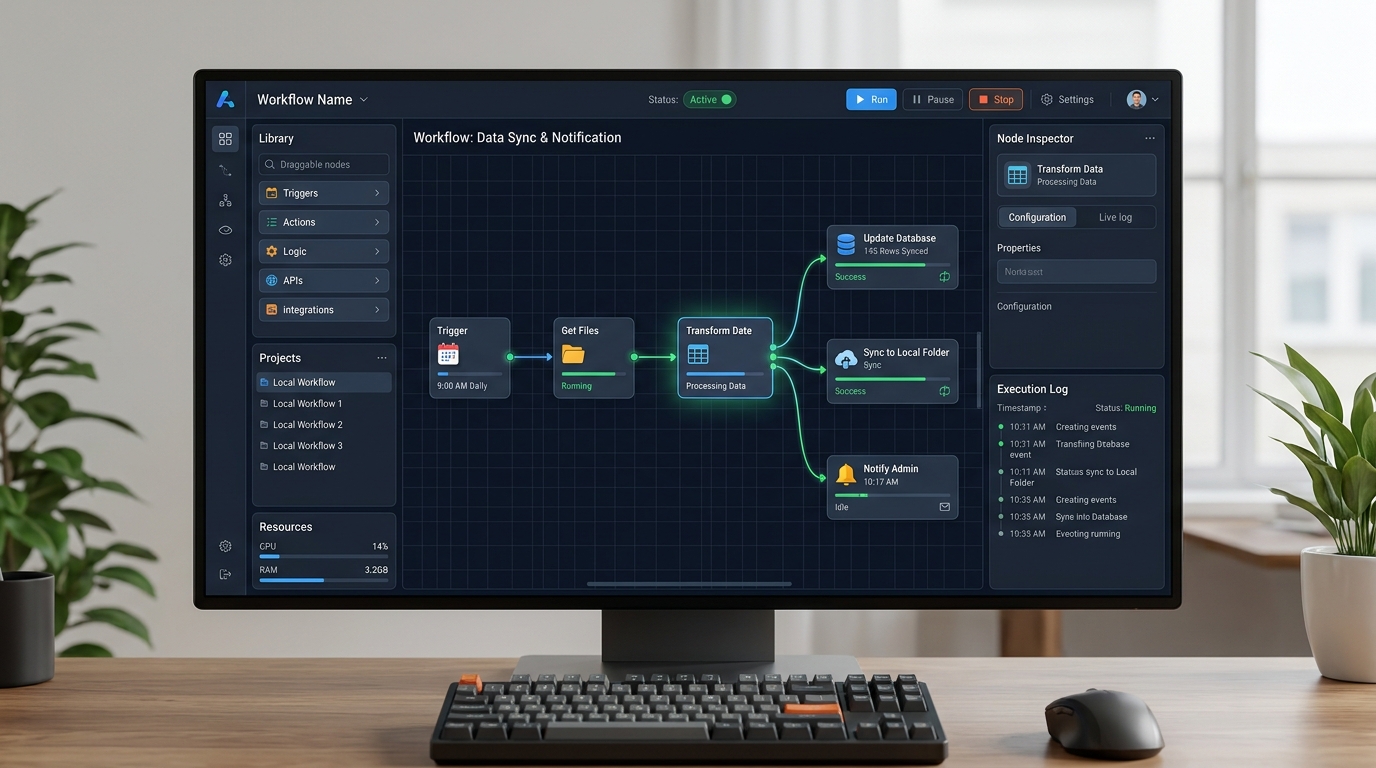
A visual representation of a local-first automation software dashboard, demonstrating a node-based workflow being built and executed within a secure, on-premise environment.
Building Private AI Automation Infrastructure
AI automation raises the privacy stakes. The workflows worth building — ticket triage, document processing, report drafting, log analysis — are precisely the ones that handle your most sensitive content. Running them through a cloud automation vendor inserts an extra party into every prompt and every response.
Private AI automation infrastructure means the orchestration layer runs where the data lives. With NORA:
- Workflows execute locally, so intermediate data never rests on third-party automation servers.
- You choose the model per step — route high-volume classification to an inexpensive model and reserve stronger models for the steps that need them, all with your own provider accounts.
- Humans stay in the loop where it counts, with workflow structures that let you review AI output before it triggers consequential actions.
- Execution history stays local, giving you full auditability without exporting logs to a vendor.
This is the foundation teams need to scale your automation platform for internal operations — from a single triage workflow to an automation layer the whole team relies on — without renegotiating data policies at every step.
Cloud Automation vs Self-Hosted Security
The security comparison comes down to surface area. A cloud automation platform is a high-value multi-tenant target holding credentials and data for thousands of organizations; a breach there is a breach of everyone. A self-hosted platform reduces your exposure to the infrastructure you already secure and monitor.
Neither model is effortless — self-hosting means you own patching and access control — but the trust equation is fundamentally different:
- Cloud: you must trust the vendor’s security posture, employee access controls, retention policies, and subprocessors — continuously, and largely on faith.
- Self-hosted: you must trust your own practices, which you can verify directly.
For teams that have already been burned by SaaS data-handling surprises or vendor lock-in, that difference is decisive. It is also why we are the premier self-hosted n8n alternative for teams that tried hybrid self-hosting and found it heavier or leakier than promised.
Get Started with Local-First AI Automation
You do not need a migration project to start. A practical first week with NORA:
- Install the desktop app on a machine inside your environment.
- Connect one AI provider with your own API key.
- Rebuild one real workflow — a recurring report, a triage step, a data cleanup — using visual nodes and, where useful, your existing scripts.
- Run it, inspect the execution, and iterate. No usage meter is counting against you while you learn.
Local-first automation is not just a privacy decision — it is a simpler operating model: your workflows, your data, your infrastructure, your costs. Start building today.
Frequently Asked Questions
What is a self-hosted automation platform?
It is workflow automation software that runs entirely on infrastructure you control — your desktop, server, or private network — rather than on a vendor’s cloud. Workflow data, credentials, and execution logs stay in your environment.
How is local-first different from self-hostable?
Self-hostable often means a cloud-first product that also offers a version you can deploy yourself, sometimes with reduced features. Local-first means the software is designed to run locally as its primary mode — no cloud dependency, no feature gap between “their” version and yours.
Can NORA still use cloud AI models like Claude or GPT?
Yes. NORA connects to Claude, GPT, and Gemini using your own API keys. The orchestration and your workflow data stay local; only the model calls you explicitly configure go to the provider you chose.
Does self-hosted automation cost more to operate?
You take on running the software, but you eliminate per-task execution fees — which is where cloud automation costs grow unpredictably. For high-frequency internal workflows, local execution is typically the more predictable cost model.