
Efficient Prompt Engineering in 2026: Maximize Token Usage
Prompt engineering has evolved beyond crafting clever, conversational instructions for single-turn AI chatbots. In 2026, prompt design is a software engineering discipline centered on token optimization, system prompt efficiency, and programmatic context packing.
As technical automation and autonomous multi-agent pipelines become production standards, inefficient prompts cause high API expenses, increased execution latency, and unexpected agent failures. Modern developers must balance descriptive clarity with optimal token usage.
In this guide, we outline core principles for efficient prompt engineering in 2026, covering top prompt efficiency tips, token optimization strategies, and context packing techniques to maximize LLM performance.
The Shift Toward System Prompt Token Efficiency
Early prompt engineering practices emphasized narrative framing, conversational framing, and verbose role assignments. System prompts frequently contained paragraphs of background fluff before introducing core execution rules.

The evolution of prompt engineering highlights a significant shift towards token efficiency and structured directives between 2025 and 2026.
In 2026, the industry has shifted toward extreme system prompt token efficiency:
+--------------------------------------------------------------------------+
|                  The Evolution of Prompt Engineering                     |
|                                                                          |
|  2024 - 2025: Conversational Era                                         |
|  "You are a helpful, smart, world-class senior software engineer..."     |
|  - Highly verbose narrative personas                                     |
|  - Unstructured multi-paragraph instructions                             |
|  - High token cost, medium precision, slow prefill                       |
|                                                                          |
|  2026: Programmatic Efficiency Era                                       |
|  "ROLE: Senior Systems Engineer | TASK: AST Code Analysis"              |
|  - Modular key-value directives                                          |
|  - Strict input/output schema definitions                                |
|  - Token-optimized markup, fast prefill, deterministic output            |
+--------------------------------------------------------------------------+
Modern LLMs (such as Claude 3.5 Sonnet, GPT-4o, and open-weights reasoning models) no longer require conversational padding to perform accurately. Concise, structurally unambiguous instructions produce equal or superior accuracy while drastically cutting token consumption.
To see practical implementations of structured prompts for automated workflows, read our guide on technical automation task prompt patterns.
Top LLM Prompt Efficiency Tips for Developers
Optimizing your prompt codebase yields immediate improvements in API latency, context allocation, and unit economics. Apply these core tips to your system prompt architectures:
1. Replace Natural Language Paragraphs with Key-Value Rules
Convert multi-paragraph instruction sets into key-value directives. LLMs parse key-value structures rapidly while consuming fewer tokens.
<!-- Verbose Prompt (High Token Footprint) -->
When you generate code for the backend API, you must always make sure that you use TypeScript. Ensure that all functions have strict type definitions and never use the 'any' type under any circumstances. Also make sure to write inline documentation for every function.

<!-- Efficient 2026 Structured Directive (Low Token Footprint) -->
[RULES]
LANG: TypeScript (Strict)
TYPES: Explicit only (NO 'any')
DOCS: Inline JSDoc required
2. Standardize Structural Markup Tags
Use lightweight XML or custom block tags (<rules>, <context>, <input>) rather than verbose headers ("Below is the context that you should read carefully before answering..."). Models recognize markup boundaries natively, eliminating the need for transitional introductory phrases.
3. Move Stationary Instructions to Cached System Context
Place static system instructions, formatting guidelines, and baseline schema definitions inside persistent system prompts rather than re-sending them in dynamic conversation turns. This optimizes prefill operations when leveraging provider prompt caching.
Token Optimization for AI Prompts
Token optimization requires reducing raw character volume without stripping logical intent or domain-specific constraints.
Here are four high-impact strategies for token optimization in AI prompts:
- Eliminate Polite Conversational Fillers: Strip terms like “Please analyze the following”, “Could you kindly provide”, or “Thank you”. These phrases consume tokens without adding semantic value.
- Utilize Shorter Schema Identifiers: When sending structural data (such as JSON representations or schema definitions) to an LLM, shorten key names where possible (e.g.,
user_identification_number$\rightarrow$uid). - Trim Redundant Few-Shot Examples: Provide 1 or 2 high-quality, edge-case few-shot examples instead of 5-10 redundant examples. Ensure every example targets a unique syntax requirement or boundary condition.
- Enforce JSON Output Schemas Programmatically: Rather than writing extensive text prompts explaining how to format JSON responses, enforce structural schemas via native function-calling or structured-output API flags.
What is Context Packing in LLMs?
As models support larger context windows, developers face a new architectural challenge: how to pass multiple heterogeneous datasets (code, API specs, database records, and chat history) into a single LLM invocation without exceeding attention or token budgets.
Context packing is the practice of bundling, ordering, and compressing disparate background information into a single prompt payload to maximize reasoning quality while minimizing token usage.
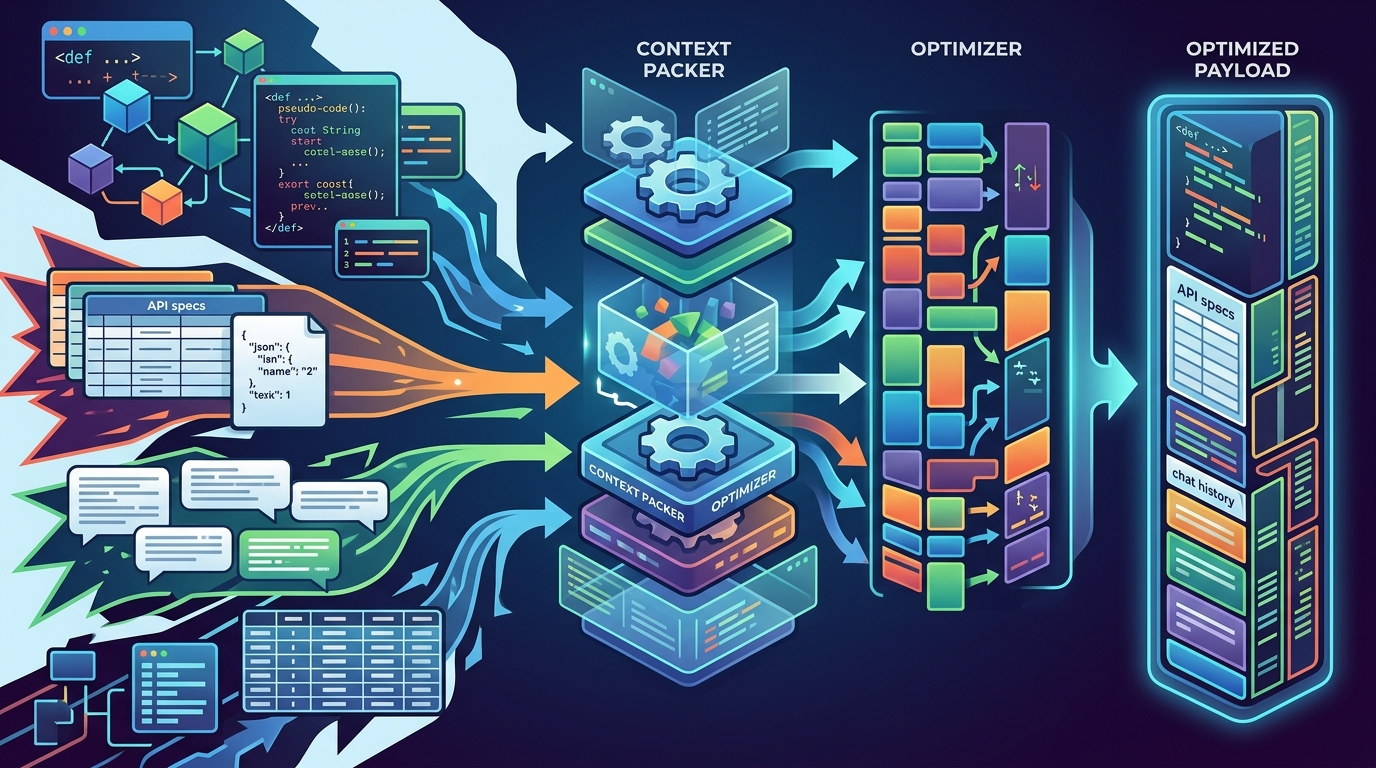
Context packing involves bundling, ordering, and compressing diverse datasets into a single prompt payload to maximize reasoning quality and minimize token usage.
Context Packing Techniques
Effective context packing relies on three primary techniques:
A. Attention-Optimal Placement
Transformer self-attention allocates the highest weights to tokens at the beginning (system prompt) and end (final query) of the prompt window. Pack reference data and background context into the middle block, while keeping action commands at the top and bottom.
B. Line-Referenced Context Indexing
Instead of duplicating full files or logs when asking an LLM to edit code or review logs, pack the prompt with line-numbered code snippets and reference line numbers in your instructions.
<code_context file="src/auth.ts">
1: import { sign, verify } from 'jsonwebtoken';
2: export function validateToken(token: string) {
3:   return verify(token, process.env.JWT_SECRET!);
4: }
</code_context>

<instruction>
Refactor line 3 to handle missing secret errors gracefully.
</instruction>
C. Deduplicated Token Compression
Before packing context payloads into your prompt, pass text through local deduplication filters. Strip duplicate stack traces, duplicate status updates, and repetitive boilerplate headers across multi-file codebases.
How to Maximize Token Usage for AI Agents
Autonomous agents operating in multi-turn loops (such as task schedulers, monitoring agents, or coding assistants) consume tokens rapidly. Without optimization, long execution loops stall due to context saturation.
When building scheduled background workers, review our guide on running AI agents on a schedule.
To maximize token usage and maintain high reasoning precision across long agent execution cycles:
- Maintain Ephemeral Scratchpads: Store intermediate reasoning steps in short-term agent state variables. When a step completes, output a concise execution summary to the main context and discard raw intermediate execution steps.
- Compress Tool Responses: Intercept raw tool outputs (e.g., database queries or shell command responses) before sending them to the LLM. Filter progress indicators and return formatted key summary lines instead of raw terminal logs.
- Implement Dynamic Tool Loading: Do not load all tool definitions into the LLM system prompt on step 1. Provide a lightweight tool discovery router so the agent loads specialized tool schemas only when needed.
Frequently Asked Questions
What is the goal of efficient prompt engineering?
Efficient prompt engineering aims to optimize LLM input structures to maximize reasoning accuracy and speed while minimizing unnecessary token usage, execution latency, and API costs.
What is context packing in LLMs?
Context packing is the technique of assembling, compressing, and structuring multiple context sources (e.g., docs, code, and chat history) into a single prompt payload to optimize attention allocation and token density.
Do shorter prompts reduce LLM output quality?
Not if key semantic instructions are preserved. Removing conversational fluff, redundant examples, and boilerplate text improves model clarity, enabling the LLM’s attention mechanism to focus directly on core logic constraints.
How does prompt caching affect token optimization strategies?
Prompt caching lowers cost and latency for repetitive system prompt components. By segregating static context from dynamic user queries, developers can maintain rich system directives in the static cached block without incurring full prefill charges on every turn.