
Understanding Local LLM Hallucination: Why Your AI Makes Things Up
Running open-source Large Language Models (LLMs) locally on consumer hardware—whether through platforms like Ollama, LM Studio, or llama.cpp—has transformed how developers, researchers, and privacy-conscious users interact with artificial intelligence in 2026. Having an unmonitored, private, zero-latency assistant on your local GPU provides unprecedented freedom. However, developers quickly encounter a frustrating phenomenon: local LLM hallucination.
When a local model confidently generates a non-existent Python library method, fabricates a historical historical citation, or invents incorrect command-line flags, it is demonstrating AI hallucination. While cloud-based APIs like GPT-4 or Claude 3.5 Sonnet also experience factual errors, local models often exhibit higher rates of unpredictable confabulation.
Understanding why local LLMs hallucinate is the critical first step before you attempt to fix local AI errors. This guide breaks down the underlying architectural and operational causes of local model factual errors, compares local models to cloud counterparts, and provides a framework for diagnosing unreliable output in your local workflows.
What is Local LLM Hallucination?
At its core, a local LLM hallucination occurs when a open-source model generates text that sounds syntactically correct, logical, and authoritative, but is factually inaccurate, ungrounded, or completely fabricated.
Large Language Models do not possess a database of facts or a human-like understanding of reality. Instead, they are probabilistic text engines. They predict the next most likely token (word or sub-word) based on patterns learned during pre-training. When a model’s internal probability calculation points toward plausible-sounding text that lacks grounding in real-world facts, a hallucination occurs.
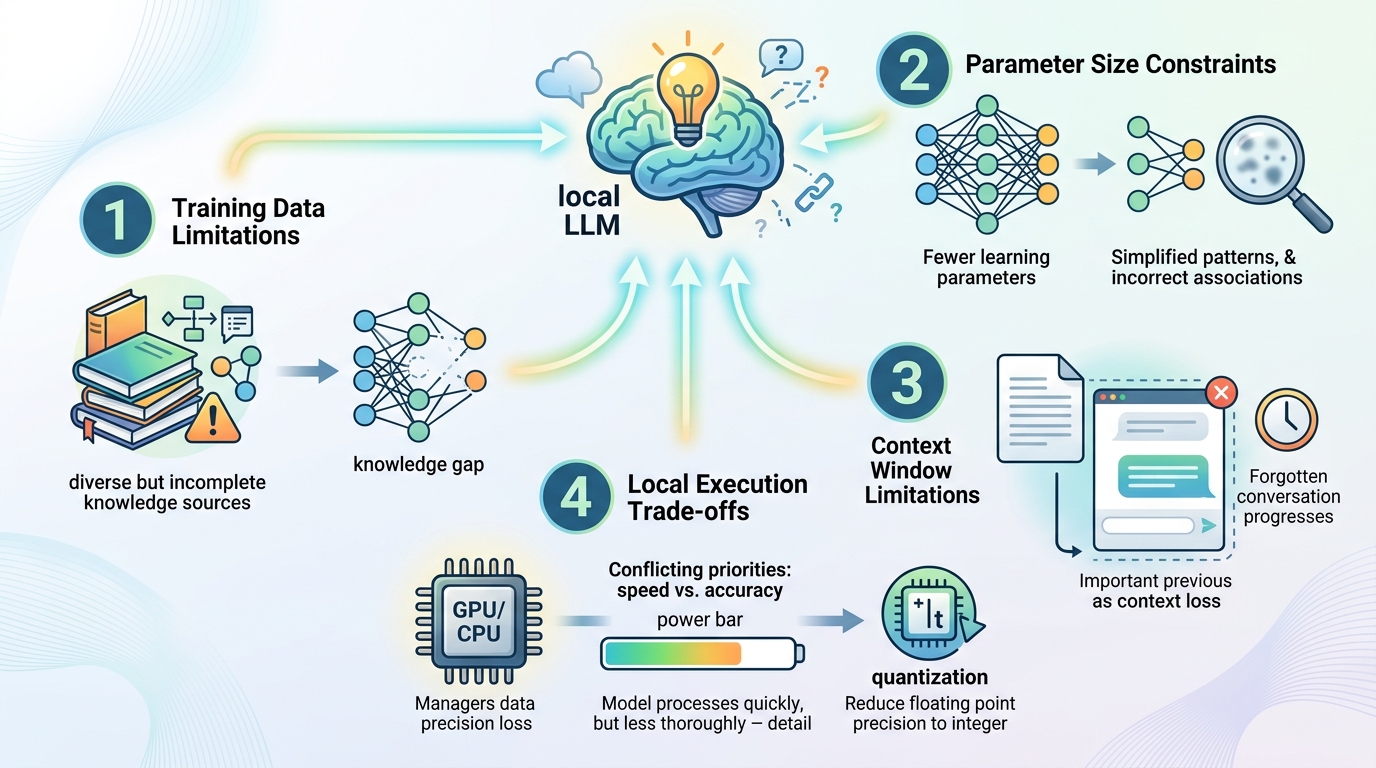
Core causes of hallucination in local LLMs including context window constraints and model limitations.
In local execution environments, hallucinations can manifest in several ways:
* Invented API calls & code methods: Suggesting functions like pandas.DataFrame.to_super_csv() that sound real but do not exist.
* Factual misattribution: Assigning real historical events or scientific formulas to the wrong entities.
* Logical loop drift: Repeating incorrect premises progressively over long conversation turns.
* Nonsensical output (Confabulation): Generating grammatically coherent sentences that carry zero semantic sense under close scrutiny.
Confabulation vs. Factual Errors
To effectively troubleshoot local AI factual errors, it is important to distinguish between confabulation and standard factual errors:
- Factual Errors: These occur when a model attempts to answer a specific factual question but retrieves incorrect parameter associations from its weights. For instance, stating that the capital of Australia is Sydney instead of Canberra is a basic factual error. The model recognized the intent but produced incorrect training data retrieval.
- Confabulation: Confabulation happens when a model faces high uncertainty or an ambiguous prompt and actively invents entirely new facts, entities, or logical frameworks to satisfy the request. For example, if you ask a local model to summarize a document that you forgot to upload, a confabulating model will invent a fictional document summary rather than informing you that the text is missing.
Understanding this distinction helps developers determine whether an issue stems from poor prompt grounding or fundamental parameter capacity limits.
Core Causes: Why Do Local LLMs Hallucinate?
Why do open-source models like Llama 3 8B, Mistral 7B, or Gemma 2 9B make up information? While multiple technical variables interact during inference, the core causes stem from fundamental constraints in training size, context processing, and local execution trade-offs.
If you are exploring why local models hallucinate more, the primary drivers can be categorized into technical bottlenecks below.
Training Data Limitations & Parameter Size
The primary differentiator between massive cloud models and local models is parameter count. A 7-billion or 8-billion parameter model compressed onto a local GPU must compress immense amounts of world knowledge into a small file size (typically 4GB to 8GB when quantized).
- Parameter Density vs. Knowledge Capacity: A model with 8 billion parameters simply cannot store the same density of precise world facts as a enterprise cloud model with hundreds of billions or trillions of parameters. When queried about niche topic areas, long-tail technical specifications, or obscure coding libraries, small local models lack the dense parametric memory required for exact recall.
- Data Compression Loss: Quantization and small parameter scale force the network to generalize heavily. Generalization allows the model to speak fluidly, but exact factual precision is often sacrificed, causing the model to fill memory gaps with high-probability “guesses.”
- Outdated or Domain-Specific Training Gaps: Open-source foundation models are trained on general web crawls up to a specific cutoff date. When asked about event developments, specialized enterprise schemas, or proprietary internal workflows, the model relies on pattern matching rather than verified facts.
Context Window Constraints
Another significant driver of local LLM hallucination is context window handling. Every model has a maximum token limit for its working memory. In local setups, hardware constraints often force users to reduce the active context window (e.g., capping context at 2,048 or 4,096 tokens to save VRAM).
- Attention Degradation: As a conversation fills the context window, the model’s self-attention mechanism must distribute attention scores across hundreds of prior tokens. In smaller parameter models, attention mechanisms are less robust, causing the model to lose track of earlier constraints or system instructions.
- Context Truncation: When context windows overflow, local engines often discard older tokens silently. If the discarded tokens contained critical instructions or reference facts, the model will hallucinate missing details to bridge the context gap.
- Needle-in-a-Haystack Failures: Smaller local models struggle with context retrieval depth. Even if factual information is provided in the context prompt, small models may miss relevant information buried in the middle of long texts, resulting in ungrounded responses.
Local vs. Cloud Models: A Hallucination Comparison
To understand local LLM trustworthiness, developers often benchmark local outputs against proprietary cloud APIs like OpenAI’s GPT-4o or Anthropic’s Claude 3.5 Sonnet. A direct local model unreliable output comparison reveals distinct structural differences.
| Architectural Feature | Local LLMs (e.g., Llama 3 8B, Qwen 2.5 7B) | Cloud LLMs (e.g., GPT-4o, Claude 3.5 Sonnet) |
|---|---|---|
| Parameter Scale | 3B – 70B parameters | Estimated 100B – 1T+ parameters (MoE) |
| Quantization Level | Typically 4-bit (Q4_K_M) or 8-bit (Q8_0) | Full FP16 / FP8 precision clusters |
| Active Context Capacity | 2k – 32k tokens (VRAM constrained) | 128k – 1M+ tokens |
| Post-Training Alignment | Basic RLHF / DPO tuning | Extensive multi-stage RLHF & safety alignment |
| Factual Precision | High risk for long-tail facts | High precision; better refusal capabilities |
| Privacy & Latency | 100% private, local control, zero latency fee | Data leaves local machine; API cost per token |
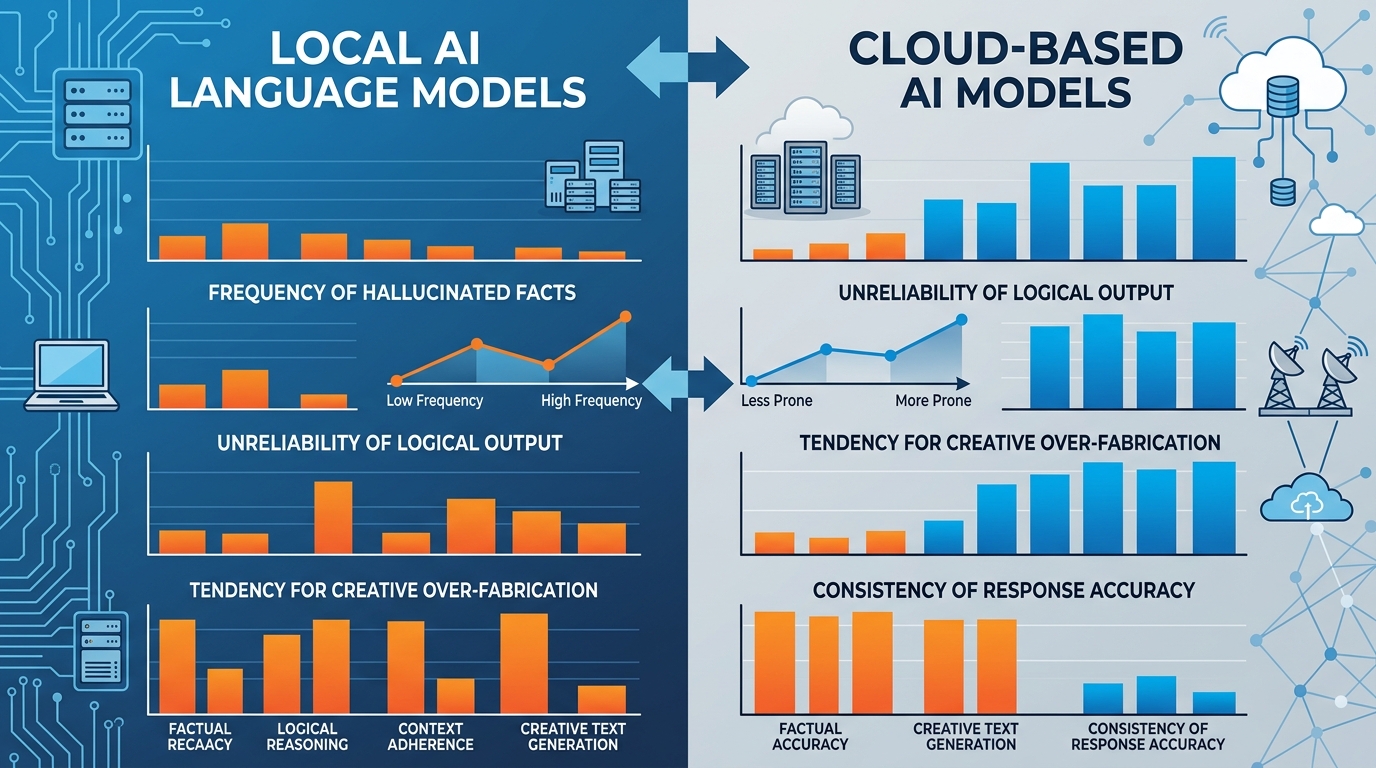
Hallucination frequency comparison between local and cloud AI language models.
Why Local Models Might Hallucinate More Often
Local open-source models experience hallucination more frequently than large cloud architectures for three main reasons:
- Lower Precision via Quantization: To fit models onto consumer GPUs like NVIDIA RTX 3080/4090 or Apple Silicon unified memory, weight parameters are quantized from 16-bit floating-point (FP16) down to 4-bit integer representations (INT4). Quantization strips subtle numeric weights that represent exact factual connections, increasing probability noise during inference.
- Less Guardrail Alignment: Commercial cloud providers invest millions in reinforcement learning from human feedback (RLHF) specifically trained to force models to say “I don’t know” when confidence is low. Smaller open-source models often lack strict refusal training, leading them to generate plausible guesses rather than admitting ignorance.
- Absence of Built-in Web Search Integration: Many cloud chat interfaces automatically perform live web queries when asked real-time or factual questions. Raw local models rely purely on parametric memory unless grounded through a custom local Retrieval-Augmented Generation (RAG) architecture.
The Impact of Unreliable Output on Local Workflows
Unchecked hallucinations in local models create real operational costs and software vulnerabilities:
- Software Bug Injection: When using local models as local coding assistants, hallucinated function signatures or incorrect library dependencies can introduce subtle bugs, broken builds, or security vulnerabilities (such as “slop code” that imports non-existent, typosquatted packages).
- Automated Pipeline Corruption: In automated local workflows where LLM outputs are parsed as JSON or piped into downstream scripts, unexpected confabulations break parsers and halt execution pipelines.
- Erosion of Developer Trust: If developers spend more time verifying and debugging generated output than writing code, the productivity benefit of local AI drops significantly.
Next Steps for Fixing Local Model Factuality
Understanding the root causes of local LLM hallucination—from parameter constraints to quantization noise and context limitations—is the necessary prerequisite for building reliable local AI applications.
While small open-source models have inherent limits, hallucinations are not inevitable. By applying targeted engineering techniques, adjusting generation hyper-parameters, enforcing strict system prompts, and integrating local document retrieval, you can dramatically improve the factual accuracy of your local models.
To begin implementing practical remedies, explore our step-by-step tutorial on a complete guide on reducing local model hallucination, where we cover parameter tuning, prompt templates, and local RAG architectures designed to keep your AI grounded.
Frequently Asked Questions
Why does my local LLM make up fake functions when writing code?
Local LLMs predict code based on statistical patterns learned during training. Small local models (like 7B or 8B parameter variants) often mix up similar methods across different libraries or versions. Because they lack the capacity to store every API signature accurately, they predict plausible-sounding function names rather than verifying syntax.
Does quantization increase hallucination in local models?
Yes. Quantizing a model from 16-bit floating-point (FP16) down to 4-bit (Q4) reduces its file size and VRAM usage by over 70%, but it also removes mathematical precision. This slight loss in weight resolution increases inference noise, which can increase factual errors and hallucination rates on complex topics.
Can prompt engineering fix all local model hallucinations?
No. Prompt engineering can significantly reduce hallucinations by providing strict boundaries and context, but it cannot overcome fundamental missing knowledge in a model’s parameters. For factual queries on proprietary or obscure data, grounding the model with Retrieval-Augmented Generation (RAG) is required.